
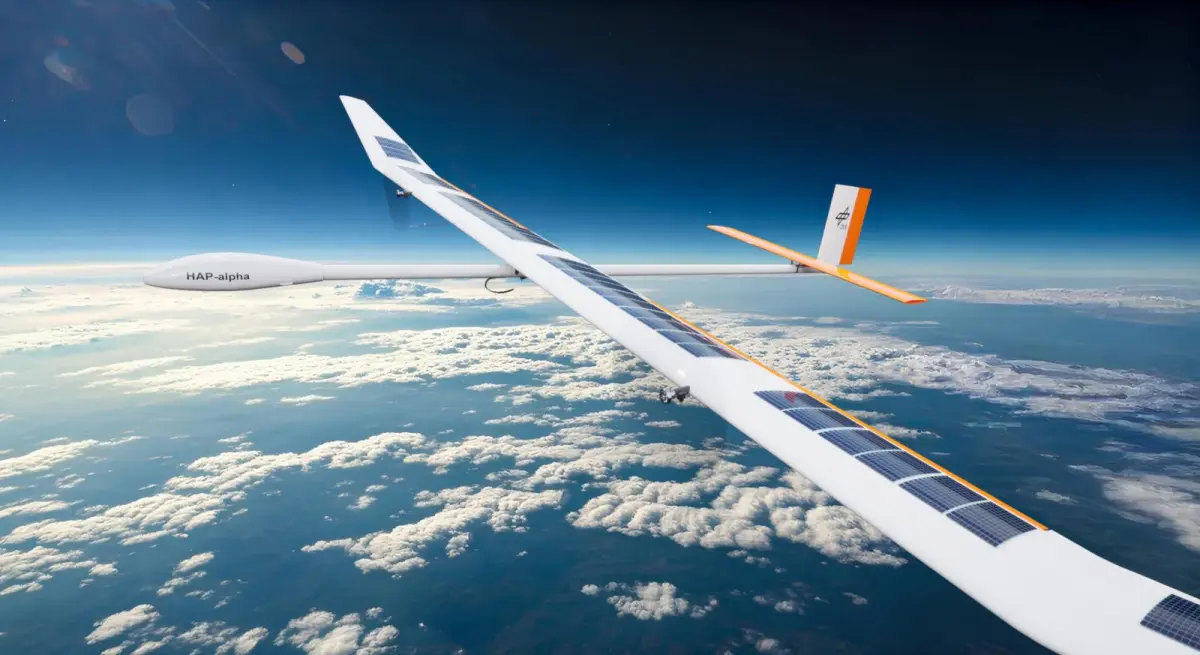
The HAP-alpha ultralight aircraft, which is being developed by the German Aerospace Center (DLR) as a partial alternative to satellites, has completed its first test flight. According to Andreas Biriga, the scientist in charge of the project, the flight went “absolutely flawlessly.” Europe is now looking for ways to reduce its dependence on American satellites, reports the NZZ.
The DLR has been working on the HAP-alpha since 2018. Initially, the aircraft was envisioned as a reconnaissance tool following floods or storms. It is designed to operate at an altitude of 20 kilometers for up to a year without interruption. It weighs 138 kilograms and has a payload capacity of 5 kilograms. Each aircraft costs several million euros, as it requires special films, adhesive, and ultra-light solar panels.
Birigu was asked why such platforms are needed when low-Earth orbit satellite constellations already exist. He acknowledges that satellites are the better technology for covering the entire planet.
“The more localized the application, the greater the potential of so-called high-altitude platforms (HAPs). A single HAP can provide communication channels, radar, or visual surveillance in a selected area because it remains stationary. Satellites, on the other hand, move along their orbits, so I need a lot of them to ensure that at least one is always in the right position,” Biriga emphasizes.
Frost, Heat, and Cosmic Radiation
The engineer identifies three main obstacles to the technology’s breakthrough. The first is energy: at night, the flight must be powered by a battery that accounts for about half the device’s weight. The second is ascending through the turbulent troposphere, which puts a strain on the fragile structure. The third is sustained operation in the stratosphere, where temperatures can drop to minus 90 degrees at night, while during the day the temperature inside the craft reaches 60 degrees. In addition, cosmic radiation can disrupt the electronics.
“A technical system that is designed to be extremely lightweight and yet flies at such an altitude year-round—no one has yet fully overcome this challenge,” Biriga warns.
The industry has already demonstrated flights lasting 50–70 days. In particular, in 2022, the Zephyr Z8 aircraft remained airborne for 64 days. The British company Prismatic plans to begin providing services with the PHASA-35 aircraft in 2028, according to Aerospace America.
Not a Replacement for Starlink, but a Reconnaissance Platform
Biriga is convinced that Starlink is currently more effective for delivering internet to remote regions. High-altitude platforms, on the other hand, could be useful during disaster relief efforts and for monitoring wildfires. Another area of application is military reconnaissance and surveillance. Due to their low speed, such platforms are relatively difficult to detect.
This technology is also being studied at the EU level. The Frontex agency conducted a technical assessment of pseudo-satellites operating at an altitude of 18–22 kilometers. The study analyzed whether they could be used for border security, law enforcement operations, search-and-rescue missions, and communications, according to Frontex.