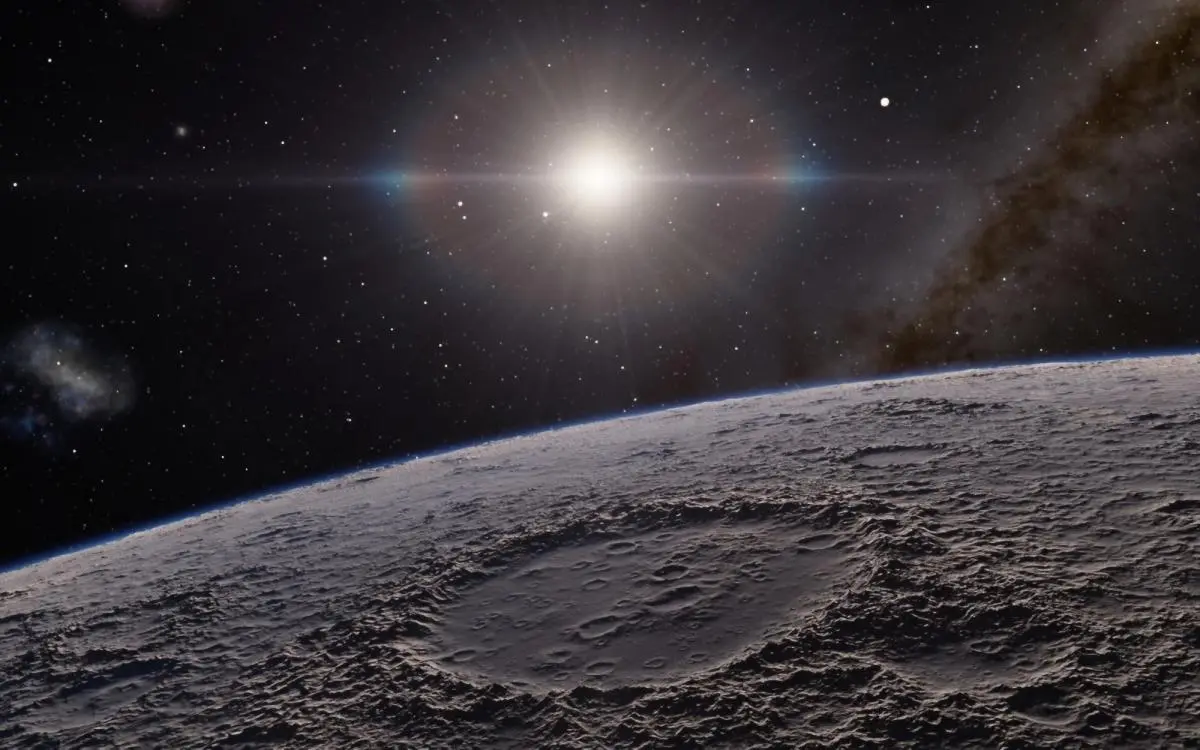
Three massive collisions that occurred billions of years ago determined why the side of the Moon visible from Earth differs so markedly from its far side. A team of scientists has proposed an explanation for this asymmetry: according to a new study, these ancient impacts left an indelible mark on the Moon’s structure, WP Tech reports.
The Largest Impact Crater on the Moon
The largest known trace of such catastrophes is the South Pole-Aitken basin on the far side of the Moon. Its inner rim measures approximately 2,000 by 1,500 km, making it the largest impact basin with visible relief among all terrestrial-type bodies. As the authors of the study published in *Nature* note, this impact shaped the crust and volcanic history of the far side. Furthermore, it may have caused large-scale instability in the Moon’s interior and triggered partial melting on the opposite, near side.
Scientists estimate the basin’s age to be approximately 4.32–4.33 billion years. To do this, they analyzed the lunar meteorite NWA 2995, found in Algeria in 2005: its rocks and minerals are consistent with an origin in the South Pole–Aitken basin.
A Chronicle of the First 500 Million Years
The far side of the Moon remained largely unexplored for a long time, as the Apollo missions of the 1960s and 1970s operated only on the near side. In 2023, NASA allocated $7.5 million to the CLOE project, which will study the oldest traces of impacts near the Moon’s south pole. Project participant Jun Korenaga, a geophysicist at Yale University, described the project’s goals, according to Yale News.
“Our new project will investigate a basin near the south pole that is approximately 2,500 kilometers wide. It is the oldest and largest impact basin on the Moon, and it will provide data on the first 500 million years of the Moon’s existence, which are not yet very well understood,” Korenaaga notes.
The scientist is convinced that these ancient catastrophes are important not only for the history of the Moon itself. In his view, they help us understand how the migration of Jupiter and Saturn affected the inner planets of the Solar System.
“By accurately interpreting the lunar crater record, we not only obtain a fundamental calibration needed to estimate the ages of cratered regions throughout the Solar System, but we also learn about the environment of early Earth—an environment that has been erased by our planet’s active geology,” the researcher emphasizes.