
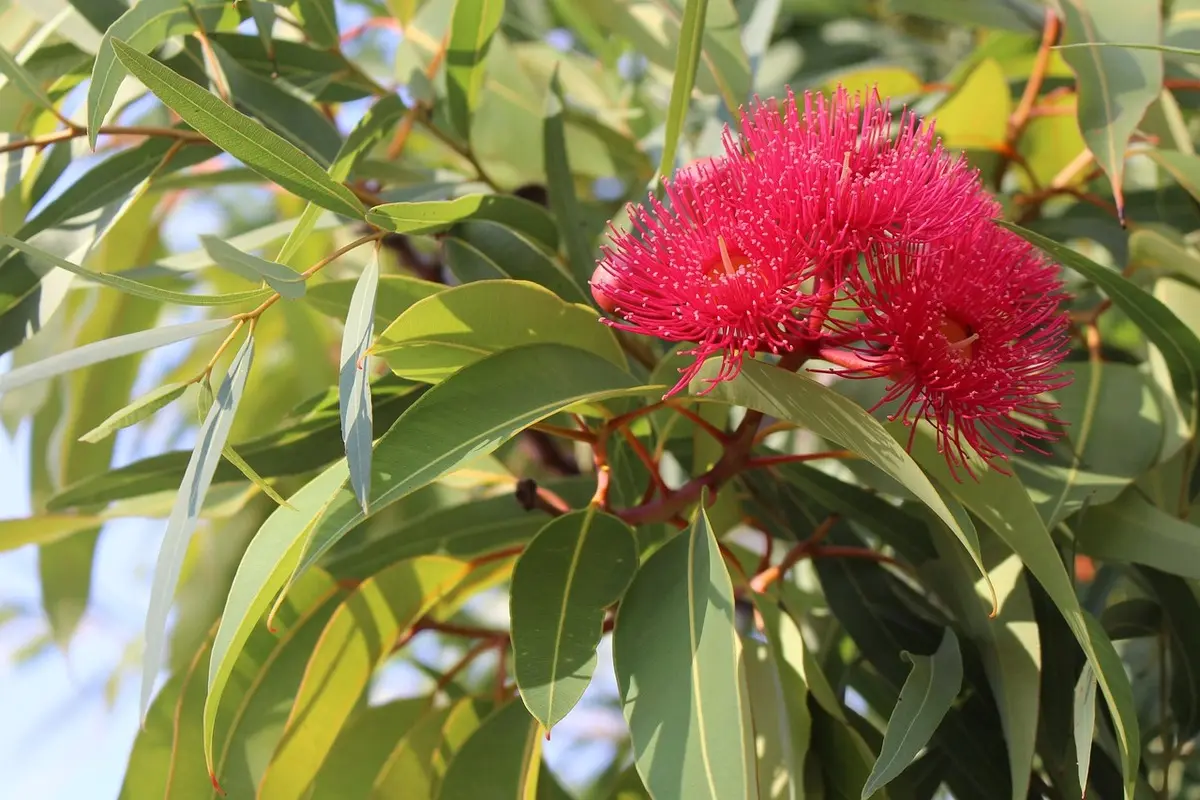
Australian eucalyptus trees transport gold particles in their leaves from a deposit located at a depth of approximately 30 meters. Researchers at the government-funded scientific organization CSIRO discovered this back in 2013, and analyzing the leaves could become a cheaper and less invasive alternative to blind drilling, according to Science et Vie.
In the arid Kalgoorlie region of Western Australia, eucalyptus roots reach groundwater at depths of 30 meters or more. Along with the water, the trees draw up dissolved gold. This metal is toxic to the plant, so it transports it to its leaves and branches. Above the ore body, the leaves contained up to 80 parts per billion of gold, whereas in trees 200 meters away, the concentration was only about 2.
To prove that the gold is contained within the leaves and not simply deposited on them along with dust, the samples were analyzed at the Australian Synchrotron. The images revealed gold particles in the plant’s vascular tissue. Greenhouse experiments with young eucalyptus and acacia trees confirmed that the roots absorb the metal and transport it upward.
A Clue for Finding Hidden Deposits
In an article in *Nature Communications*, the authors note that over the past ten years, the number of new gold deposit discoveries has fallen by 45%, so methods are needed to search for deposits beneath sedimentary rock layers. Biogeochemical exploration has not yet become widespread, partly due to doubts about whether plants actually absorb gold. Research at the Freddo site, 40 km from Kalgoorlie, has for the first time revealed natural gold particles up to 8 micrometers in size within living biological tissue, according to PMC.
The result came as a surprise to the scientists. The study’s lead researcher, CSIRO geochemist Melvin Linterne, compared the trees to natural indicators of what is happening underground.
“We didn’t expect this at all. Seeing gold particles in the leaves was a real ‘eureka’ moment for us. These trees are like messengers telling us what’s happening below,” Linterne said in an interview with ABC.
Nigel Redford, an experienced mineral exploration specialist who worked at Newmont, one of the world’s largest gold mining companies, is convinced that the discovery could make gold exploration significantly faster and cheaper. “Ideally, any exploration team could collect samples right on the surface. This saves all the costs and time required for drilling,” Redford emphasizes.
According to the researchers, gold was found not only in eucalyptus trees but also in mulga acacia and the shrubs growing beneath the trees.
There’s no point in extracting gold from the leaves: the particles are too small. According to Linter’s estimate, it would take 500 trees growing over the deposit to collect enough metal for a single wedding ring.