
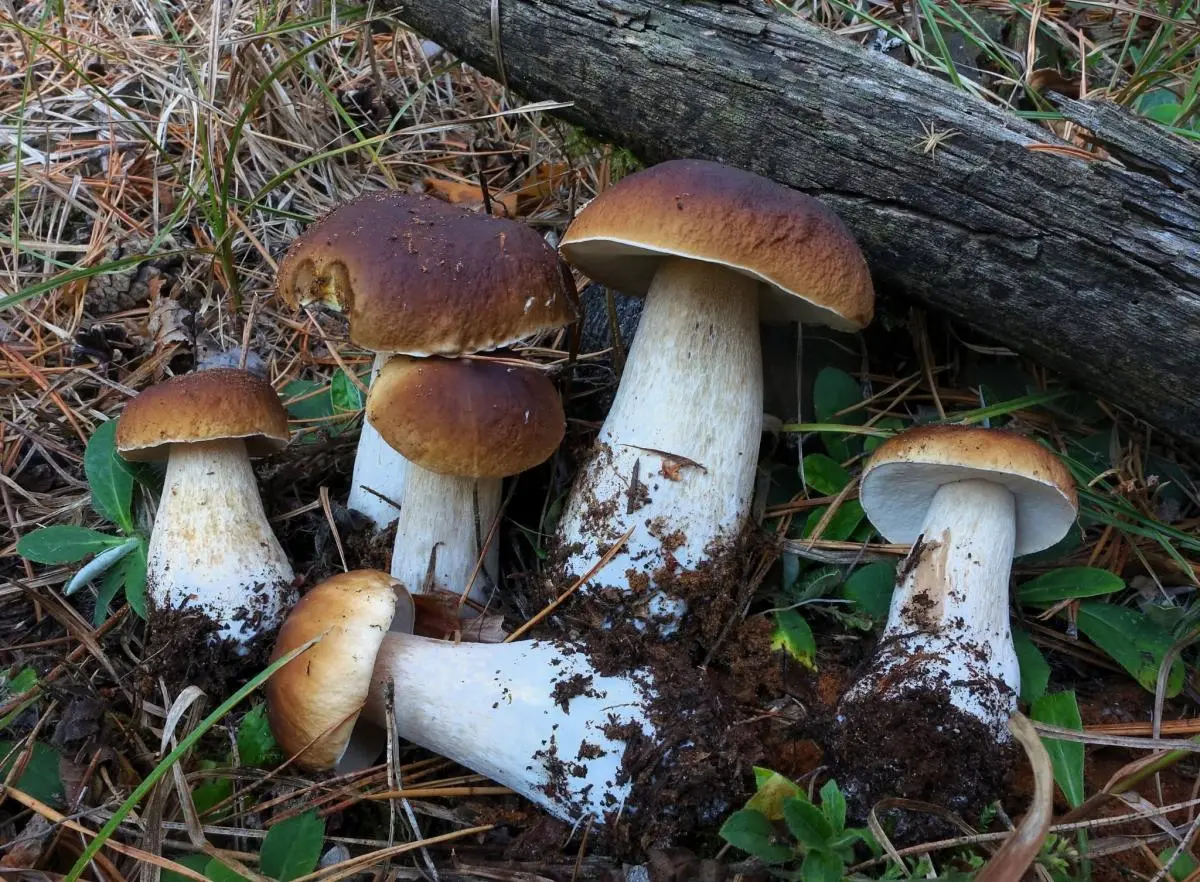
The white mushroom harvest in Europe each fall depends on a combination of several factors: precipitation levels, soil properties, and the condition of the forest. Record surges in porcini mushroom growth in the past have coincided with periods when temperatures remained around 13 °C for about 20 days. This is reported by Jean-Christophe Domecq, a professor of sustainable forestry at Bordeaux Sciences Agro and INRAE, and research engineer Xavier Larbi, according to Sud Ouest.
Mushroom hunters have long noticed that in some years the forests are literally littered with porcini mushrooms, while in others the harvest remains modest even after heavy rains. Scientists explain why rain alone is not enough.
“The answer depends as much on the climate as it does on soil moisture and the interaction between trees and fungi,” the authors note.
The white bolete (Boletus edulis) lives in symbiosis with trees. Its mycelium—a network of underground threads—entwines the roots of oaks, beeches, and some conifers. At the same time, the researchers emphasize that yields vary significantly depending on the region and even on the specific forest.
Ten Years of Observations
A temperature threshold of 13 °C is confirmed by a decade-long study of the boletus population in a beech forest near Bielefeld, Germany. Between 2015 and 2024, scientists recorded every fruiting body several times a week across 15–29 plots. Fruiting peaked when the average temperature over the previous 20 days was around 13 °C, and the number of mushrooms increased in proportion to the precipitation accumulated over 26 days. The study is currently a preprint and has not yet been peer-reviewed, according to bioRxiv.
The difference between years turned out to be enormous: from four mushrooms in 2016 to 354 in 2020. Sometimes fruiting did not occur continuously but in several separate waves per season. The authors warn that, given the projected warming and drier autumns, there will be fewer boletes in European beech forests.
The Heat Has Hit the Market
The consequences of weather anomalies are already being felt. In the United Kingdom, which this year experienced the hottest summer on record and the third-driest July, heat, drought, and flooding have reduced the supply of wild white mushrooms and driven up prices for London restaurants. A mycologist from Cranfield University linked the shortage to climate change. Commercial mushroom growers have also been affected: it has become too hot in their greenhouses to grow mushrooms, according to a report in The Telegraph analyzed by Newscord.
For some regions, fluctuations in the harvest have a significant economic impact. In British Columbia, Canada, about 100,000 kilograms of fresh porcini mushrooms are harvested in a good year, while in a bad year there may be none at all. In Italian chestnut orchards, porcini mushrooms sometimes cost more than the chestnut harvest itself, according to the FAO.