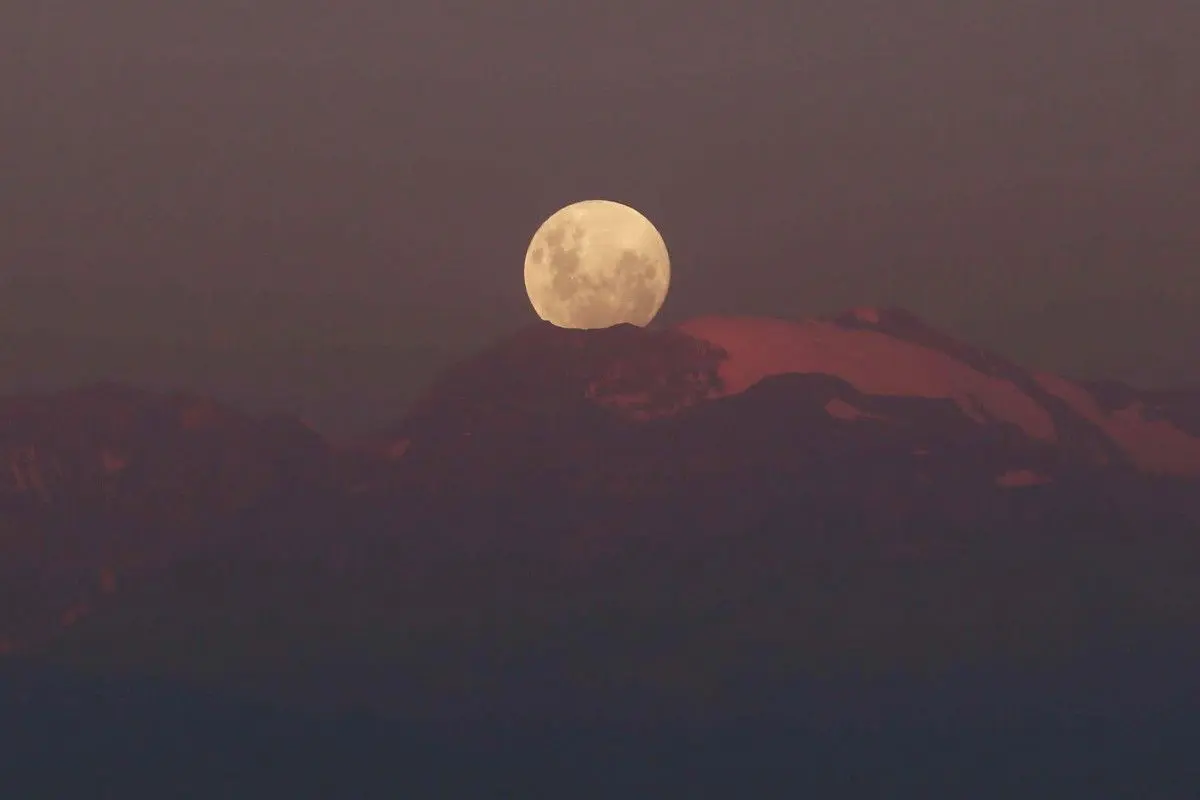
On November 24, a full moon—a “supermoon”—will appear in the sky. It will kick off a rare series of three consecutive supermoons, with the largest of them expected as early as December, according to National Geographic.
The Moon’s orbit is oval-shaped, so the distance between it and Earth varies from approximately 364,000 to 404,000 kilometers. The phenomenon commonly known as a “supermoon” is described by astronomers using a more technical term.
“The point where the Moon is closest to Earth is called the perigee, and the farthest point is called the apogee. Perigee can occur during any phase of the Moon, but when it coincides with a full Moon, it is called a ‘supermoon,’” notes Devon Salasin, chief astronomer at Stargazing Moab.
According to NASA, this term is typically used to describe a full moon that is at least 90% of the way to perigee. The term “supermoon” itself is popular but is not an official astronomical term.
When and Where to Look
The peak of illumination will occur on November 24 at 14:53 UTC, which is 16:53 Kyiv time. The Moon will appear nearly full both on the evening before and on the same day after sunset. The Pleiades star cluster will be visible near it. However, astronomers do not expect any major visual changes.
“Although the Moon appears slightly larger and brighter in the sky during a supermoon, it’s almost impossible to notice this difference with the naked eye,” warns Salasin.
NASA recommends looking toward the east around sunset to see the Moon rise. Near the horizon, it may appear even larger, but this is a lunar illusion typical of any full moon. The next supermoons in this series will occur in December and January, NASA notes.
The Beaver Moon Under the New Rules
The November full moon is traditionally called the Beaver Moon: at this time of year, beavers are actively building their winter dams. The website timeanddate.com has changed its supermoon criteria for the first time in 15 years, so this event has been dubbed the “Super Beaver Moon.” Previously, the site classified only full moons that were closer than 360,000 kilometers from Earth as supermoons, which often led to discrepancies with estimates from other sources.
“The new rule is more widely used in the astronomical community—which is good—and it gives us more supermoons—which is also good! On the other hand, it requires a painstaking calculation based on three different numbers, each of which varies from month to month,” notes Graham Jones, an astrophysicist at timeanddate.com.