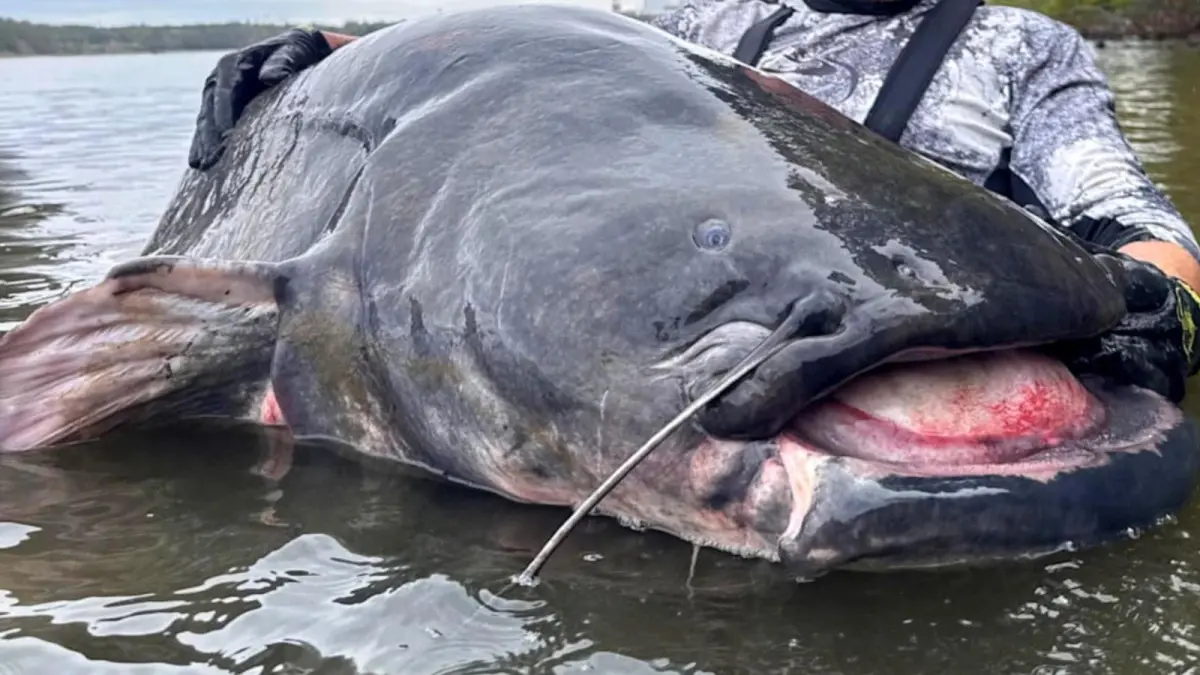
German angler Oliver Schäfer caught a 2.92-meter-long catfish in Rybnik, Poland. The official measurement set a new world record, although this same fish had already been recognized as a record-holder last year, according to Onet.
The 34-year-old toolmaker from Mechernich-Kallmuth won the trophy at a two-day tournament held on October 10–11. Seventy teams, comprising a total of 150 anglers from across Europe, took part in the competition. Conditions were challenging: strong winds were blowing over the body of water.
In an interview with the German tabloid Bild, Schäfer described his views on fishing legends and how close his catch came to matching them.
“As an angler, I know the stories about three-meter fish, but I only believe what I see with my own eyes. Now, it’s just the width of a palm short of three meters,” Schaefer noted.
He hooked the catfish using a special rod designed for large predators and a rubber lure, which the fish mistook for live prey. The struggle lasted more than 30 minutes: his 31-year-old friend from the Netherlands, Kevin Kremers, held the boat against the wind, while Schäfer kept the fish under control.
“Right away, based on my experience, I realized this was a huge fish. It wasn’t until it first broke the surface that we saw just how big it really was,” the angler said.
The participants only learned about the record after the judges on shore measured the catch. The catfish was carried on a tarp to avoid damaging its mucous membrane, and after being measured, it was released back into the water as quickly as possible.
The record-holder, which had already been caught
According to Onet, this is the same fish that was measured last year and recognized as the world record holder. Since then, it has gained a noticeable amount of weight, but has not grown any longer.
In October 2025, this catfish was caught during a competition by Krzysztof Pira and Adrian Gontaż of the Polska Akademia Wędkarska. At that time, the 292 cm catch surpassed the previous world record of 285 cm, held by Italian Alessandro Biancardi, as well as the Polish record of 261 cm. According to Pira, it took over 90 minutes to land the fish, Polskie Radio reports.
“When we finally saw it, we couldn’t believe our eyes—a huge, gigantic fish, a real monster,” said Pira.
Where Do These Giants Come From in Rybnik?
Shefer and Kremers came to Poland specifically to catch a record-breaking trophy. The reservoir near the coal-fired power plant is known for its unusually large fish.
“The water is used for cooling and then discharged back into the lake at a higher temperature. Since fish feed more actively in warmer water, carp, catfish, and pikeperch grow much faster,” Shefer emphasizes.
The Rybnik Reservoir, covering an area of 4.5 km², is located next to the Rybnik power plant. Giant fish have been caught here before: in 2014, a catfish 251 cm long and weighing 107 kg; and in the same year, another measuring 244 cm and weighing 95.7 kg. In 2018, Szymon Nowowiejski caught a fish 260 cm long and weighing 102 kg, and in 2021, Grzegorz Janicki caught a carp weighing 33 kg, according to Sport.pl.
In an interview with Dziennik Zachodni, ichthyologist Andrzej Kapusta from the Stanisław Sakowicz Institute of Inland Fisheries in Olsztyn explained what sets this body of water apart from other Polish lakes and rivers.
“In Poland, in large bodies of water—rivers and lakes—where there is plenty of food, catfish can grow to such sizes, but they are usually caught before they reach that size. What makes this fish farm reservoir unique is that its water remains warm all year round. Here, the fish grow faster than in areas with natural temperatures,” Kapusta noted.
At the same time, the scientist warns of the downside of this phenomenon. In winter, fish are supposed to stay in wintering holes, but the constant inflow of warm water “disrupts the fish’s vital parameters.” In the summer, when the reservoir is already warm, the power plant’s outflows force the reservoir’s inhabitants to enter a state of dormancy and eat less, since “excessively high temperatures are also dangerous for them.”