
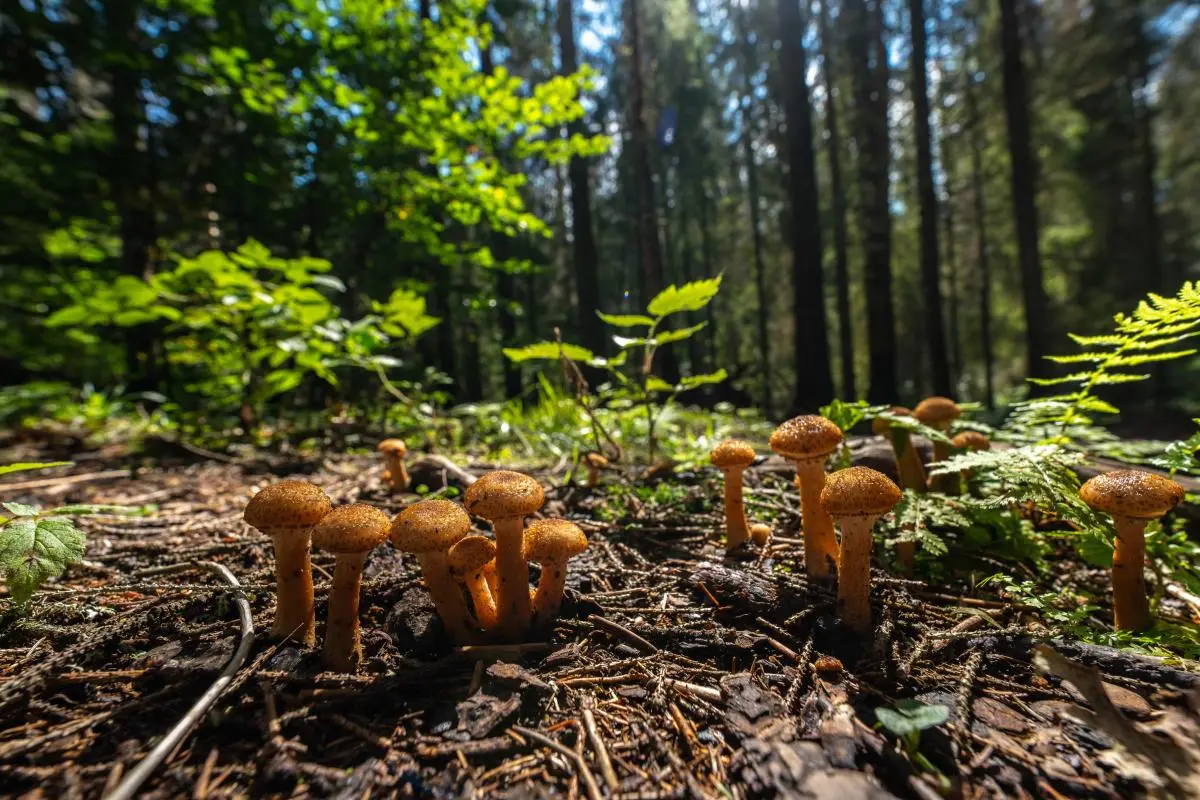
The dark honey fungus (Armillaria ostoyae), considered the largest organism on Earth, forms gigantic colonies not only in the United States but also in ordinary Polish forests. Its unremarkable brown caps, which grow in clusters on stumps in the fall, are only the visible part of an underground mycelium network that can cover an area larger than a city. This was reported by Piotr Grzes, a forester and certified mushroom classifier from the Regional Directorate of State Forests in Poznań, according to Głos Wielkopolski.
Beneath the ground, the fungus’s thin hyphae extend through the soil toward dead, weakened, or diseased wood, connecting tree roots into a single living system. It crosses trails, roads, and even small streams.
“When we walk through the forest, we are often actually walking on a single organism. We just can’t see it,” Grzes emphasizes.
According to the expert, the honey mushroom grows very slowly but steadily. A single specimen can live for several hundred years, and under favorable conditions—even several millennia.
The Record-Breaker from Oregon
The largest known specimen was discovered in the Blue Mountains in northeastern Oregon. Researchers from the U.S. Forest Service analyzed 112 mushroom samples across an area of approximately 16,100 hectares and identified five genetic individuals of A. ostoyae. The largest of these spans approximately 965 hectares, with a distance of about 3,810 meters between its most distant specimens, and its age is estimated to be between 1,900 and 8,650 years, according to a study published on the U.S. Forest Service website.
The search began in 1998, when researcher Catherine Parks learned of a mass die-off of trees caused by root rot. A comparison of fungal cultures revealed that 61 samples belonged to a single organism. The previous record, set in 1992 near Mount Adams in Washington state, was approximately 600 hectares. “No plant or animal larger than this has ever been measured using any scientific method,” said Oregon State University professor Gregory Philip, according to the Northern Nevada Business Weekly.
Prior to this discovery, the 200-metric-ton blue whale was generally considered the largest organism. Scientists speculate that such giant fungi are not unique at all. “We believe they are not very rare. We think they’re actually quite common,” notes Tom Volk, a biologist at the University of Wisconsin–La Crosse, as reported by Scientific American.
The Forest’s Cleanup Crew and a Dangerous Double
For forestry, the honey mushroom is both beneficial and harmful: it clears the forest of dead tree trunks and helps form fertile soil, but as a parasite, it can infect root systems and cause widespread rot.
“The honey mushroom decomposes dead wood, but if given the chance, it can attack healthy trees. For nature, this is a natural process; for foresters, it’s a major problem,” says Grzes.
The mushroom is edible, but the expert warns novice mushroom hunters: it is often confused with scaly mushrooms and, far more dangerously, with the fringed galerina, one of the most poisonous mushrooms in Poland.