
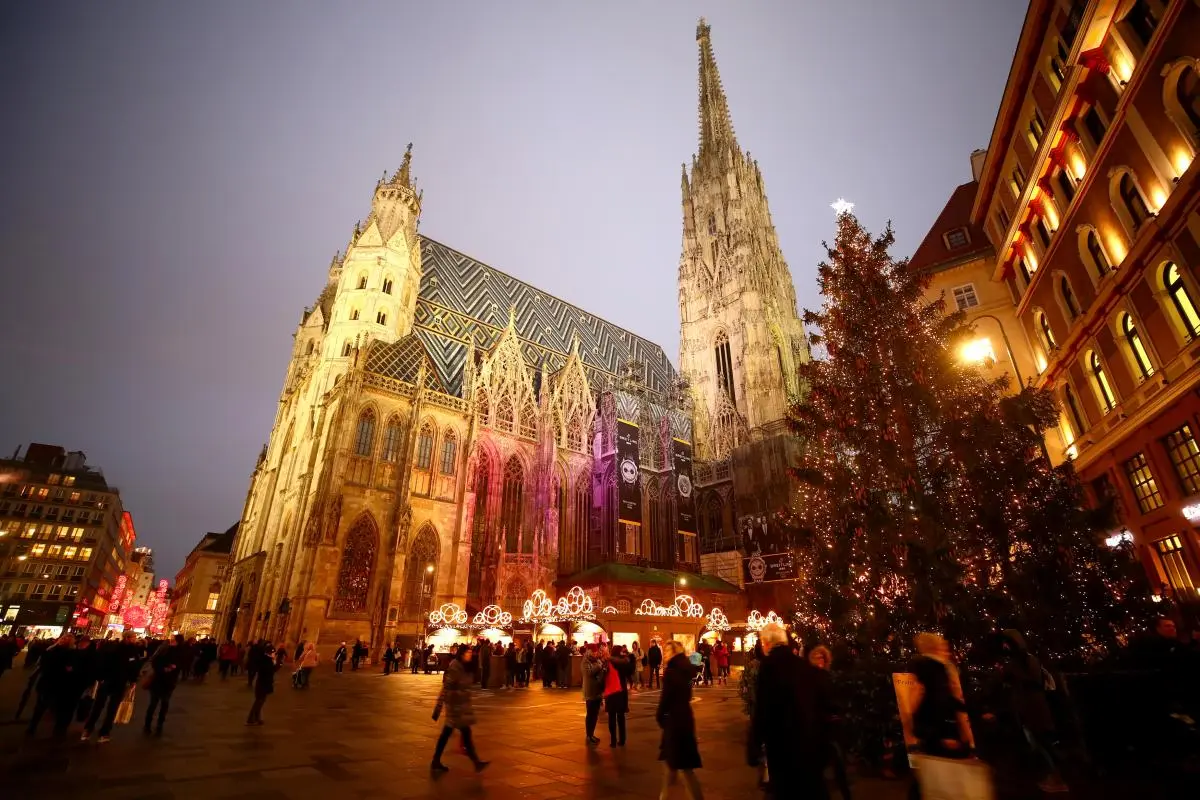
Lonely Planet has released its ranking of the 28 best Christmas markets in Europe for 2026. Vienna, Dresden, and Tallinn top the list, according to Lonely Planet.
The Vienna markets run from November 6 to January 6. The publication names the market near Schönbrunn Palace as the best: a huge Christmas tree is erected there, choirs and brass bands perform, and 80 market stalls sell wooden toys, wax candles, and Alpine cheese.
Dresden’s Striezelmarkt, which has been running since 1434, is named Germany’s top Christmas market in the ranking. Its 240 stalls welcome nearly 3 million visitors each year, and the world’s largest Christmas pyramid stands on Altmarkt Square. The market opens on November 27 and runs through December 24.
Tallinn, with its market on Town Hall Square, attracts visitors with its nearly guaranteed snow; the season there runs from November 20 to January 6. Helsinki, where the market runs from November 27 to December 22, offers the chance to combine Christmas shopping with a sauna and ice swimming.
From Alsatian half-timbered houses to the Northern Lights
In Colmar, France, six Christmas markets will be open from November 23 to December 29. In Brussels, the Winter Wonders festival—featuring an ice rink, a curling rink, and a market with 200 stalls—will run from November 27 to January 3. Tromsø, Norway, located 400 km north of the Arctic Circle, offers the chance to combine a market with the Northern Lights and dog-sledding.
Also making the top ten are the market at Hellbrunn Palace in Salzburg, featuring 400 Christmas trees and 24 windows transformed into an Advent calendar, and the market on Erfurt’s Cathedral Square. The publication praises the Budapest market on Véressmárti Square, which runs through January 1, for its lack of cheap tourist souvenirs.
A tradition younger than it seems
The tradition dates back to 1296, when Duke Albrecht I authorized 14-day December markets in Vienna, although they were not directly associated with Christmas at the time. Today, there are about 3,000 Christmas markets in Germany each year, and most of the smaller ones are only 50–60 years old, according to Smithsonian Magazine.
Despite the long history of some individual markets, scholars caution against the perception of their antiquity.
“The irony is that [the market] presents itself as this ancient, time-honored tradition, and that’s exactly how people think of it. But in reality, it’s much newer,” emphasizes Joseph Perry, a historian at Georgia State University.