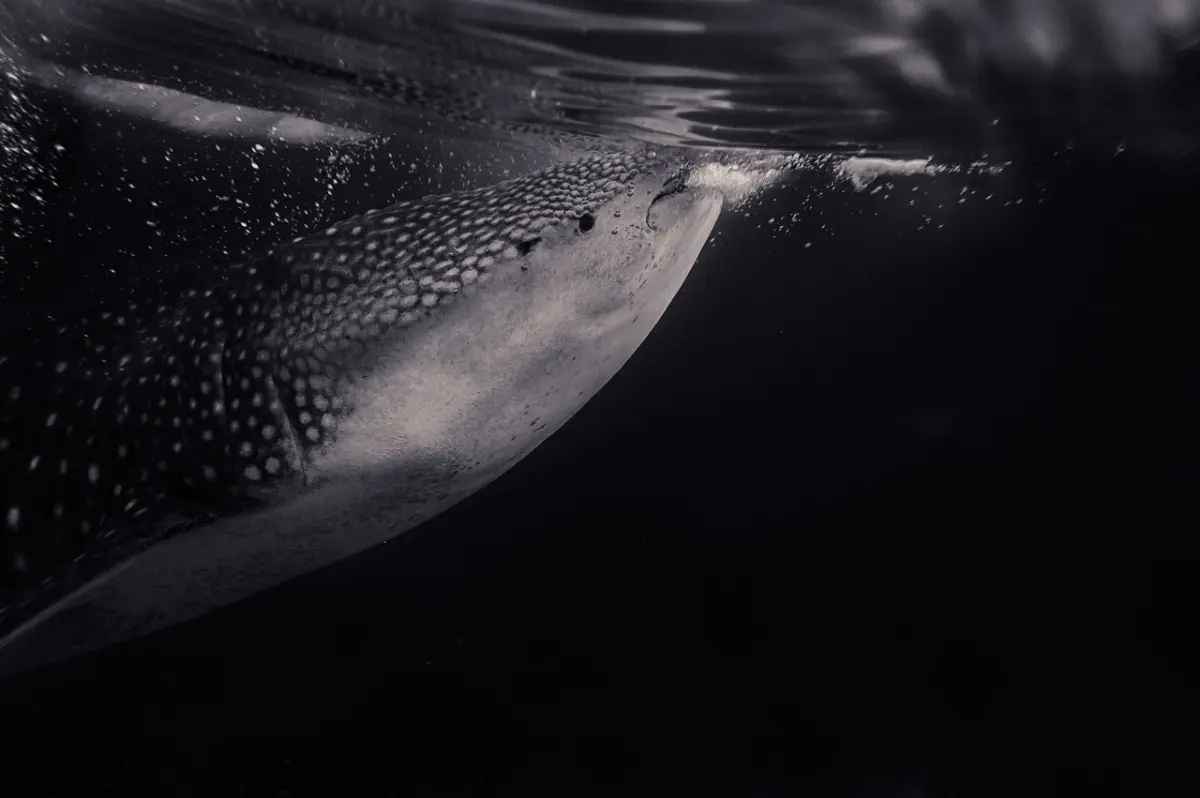
Nearly two-thirds of whale sharks in the Bird's Head Seascape off the coast of West Papua, Indonesia, have scars and injuries that could have been avoided, as they were caused by humans. These findings come from a 13-year study by an international team of scientists who believe that simple measures could significantly reduce this threat to the local population, according to ScienceDaily.
The whale shark—the largest fish on the planet—is listed as an endangered species on the International Union for Conservation of Nature (IUCN) Red List. Over the past 75 years, its global population has declined by more than half, and in the Indo-Pacific region, by as much as 63%. These animals do not reach sexual maturity until they are 30 years old, so their population recovers very slowly. The study’s lead author, Edy Setiawan, a senior researcher at the Elasmobranch Institute Indonesia, identified the main sources of injury.
“We found that the scars and injuries were mostly caused by human activity—specifically, from collisions with ‘bagans,’ traditional fishing platforms with lift nets, as well as from tourist boats used for whale shark watching. The most common injuries were relatively minor abrasions,” Setiawan noted.
Between 2010 and 2023, researchers identified 268 individuals from photographs, 98% of which were in Cendrawasih Bay and the Kaimana area. The animals were observed almost exclusively near fishing weirs, where they feed on anchovies, herring, and sprats, and sometimes even suck fish directly out of the nets. The majority were young males measuring 4–5 meters in length.
Of the 206 sharks with scars, 80.6% had injuries of anthropogenic origin, and 58.3% had injuries of natural origin (some animals had both types). Severe lacerations, amputations, and signs of blunt force trauma inflicted by humans were recorded in 17.7% of the individuals.
Danger Even in Protected Waters
According to a publication in a scientific journal, only 2.4% of the scars were likely caused by boat propellers, while predator bites accounted for 3.4% of the injuries. There were more injured sharks in the Cayman Islands (83.7%) than in Cendrawasih Bay (73.7%). The authors note that most observations were made in marine protected areas, and therefore, the species—which is fully protected in Indonesia—requires more effective management, according to Frontiers in Marine Science.
Whale sharks in Indonesia have had fully protected status since 2013, when all fishing and trade involving them were banned, and in 2021, the government adopted a separate national action plan for their conservation, according to WWF.
Sharp Edges and Fast Boats
With the growth of tourism, the risk of injury will increase unless measures are taken, scientists warn. Mark Erdmann, director of the shark conservation program at Re:wild, said the team plans to collaborate with reserve administrations.
“We aim to develop regulations that will require minor modifications to fishing gear, specifically the removal of any sharp edges from boat stabilizers and net frames. We believe these changes will significantly reduce the number of scars on whale sharks in the region,” Erdmann emphasized.
Setjawan also advocates for limiting tourist traffic. According to him, requirements for the design of bagan boats “must be accompanied by the development and strict enforcement of tourism regulations that restrict boat traffic, establish slow-speed zones, and promote responsible diving and snorkeling.” The scientist believes that such rules should be extended to other areas of Indonesia where sharks congregate near fishing weirs—Saleh Bay and Talysayan, according to Oceanographic.