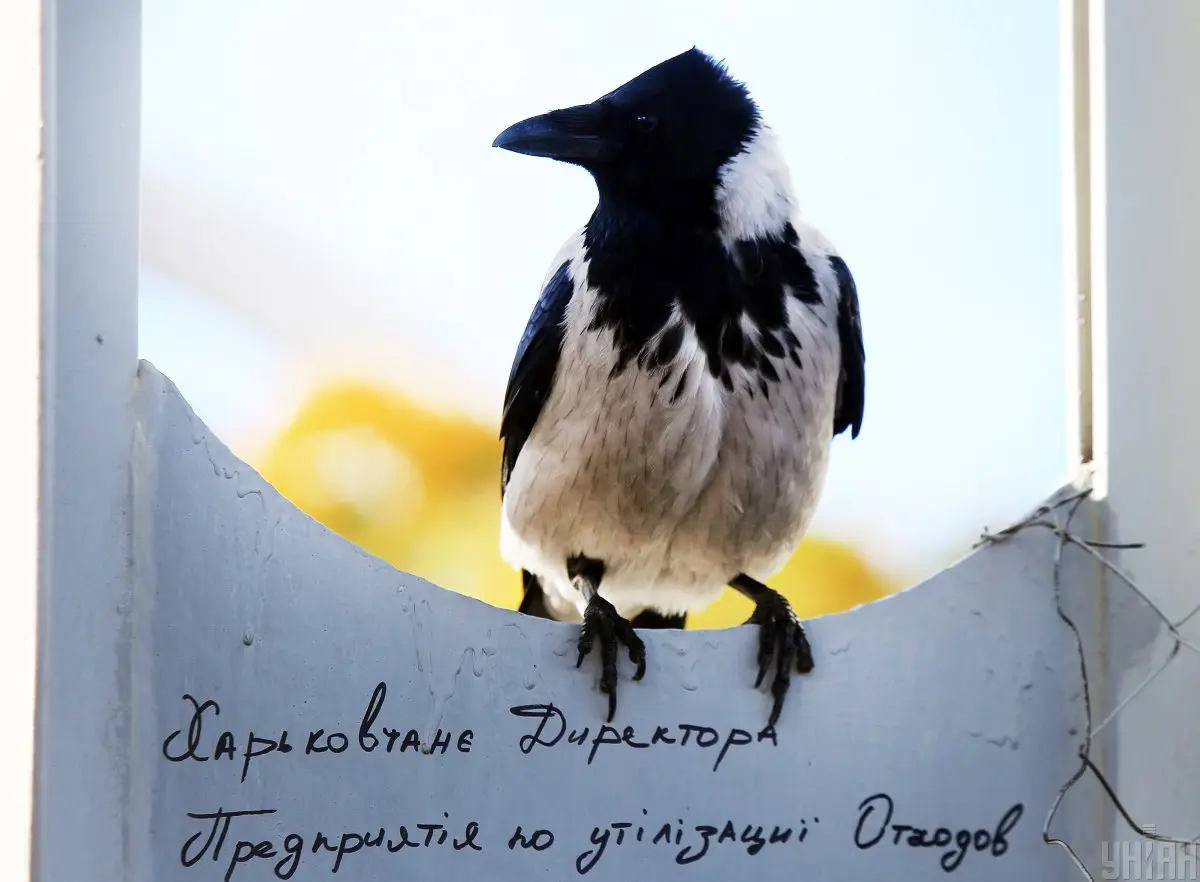
Black crows (Corvus corone) analyze images and make decisions about twice as fast as humans and monkeys: on average, they need only 235 milliseconds to make a choice, with virtually no loss of accuracy. These are the results of an experiment conducted by neurobiologists Philip Schmidbauer and Professor Andreas Nieder of the University of Tübingen, published in the journal *Science*, according to *National Geographic Polska*.
Two crows participated in the study. A cloud of white dots on a black background appeared on a touchscreen in front of them, and the birds had to determine which direction the majority of the dots were moving. They responded by pecking a circle on the side of the monitor and received a reward for doing so.
By comparison, a single blink of the human eye lasts 300–400 milliseconds, and humans and monkeys react twice as slowly in similar tests. The crows’ accuracy reached nearly 100%. Even when the dots moved chaotically and were difficult to distinguish, the birds guessed the correct direction more often than they would by chance.
Decision-making precedes beak movement
During the test, scientists recorded the activity of individual neurons in the caudolateral nidopallium. In birds, this region performs the same function as the prefrontal cortex in humans. Signals for different directions of movement began to diverge as early as 70 milliseconds after the image appeared, and neuronal activity gradually increased until it reached the threshold that triggered beak movement.
Study co-author Andreas Nieder points out how closely this mechanism resembles what scientists have long observed in mammals.
“These results show that the dynamics of neurons in the avian brain align with established models of decision-making in humans and other primates,” Nieder emphasizes.
According to the article’s abstract, the neurons encoded the upcoming choice approximately 170 milliseconds before the response, and their activity increased depending on the clarity of the visual information, peaking at the moment of reaction. The authors believe that such exceptional efficiency may have evolved as a result of the need for rapid visual control of movement, notes PubMed.
A Dense Brain as an Advantage in Flight
The similarity of these processes is surprising, given that the common ancestor of mammals and birds lived about 320 million years ago. Birds do not have a six-layered cerebral cortex. Instead, they have dense clusters of cells: there are more than twice as many neurons in one gram of a corvid’s brain as in the same mass of a monkey’s brain. Shorter distances between cells shorten the path of nerve impulses and, consequently, reaction time.
Nieder is convinced that this advantage was a direct response to the challenges of flight. Birds rely on their vision to maneuver around obstacles in the air and accurately catch prey with their beaks.
Researchers cite these similar cognitive abilities in corvids and primates—despite their completely different brain structures—as an example of convergent evolution, where different evolutionary paths lead to the same trait or behavior, according to the BBC.