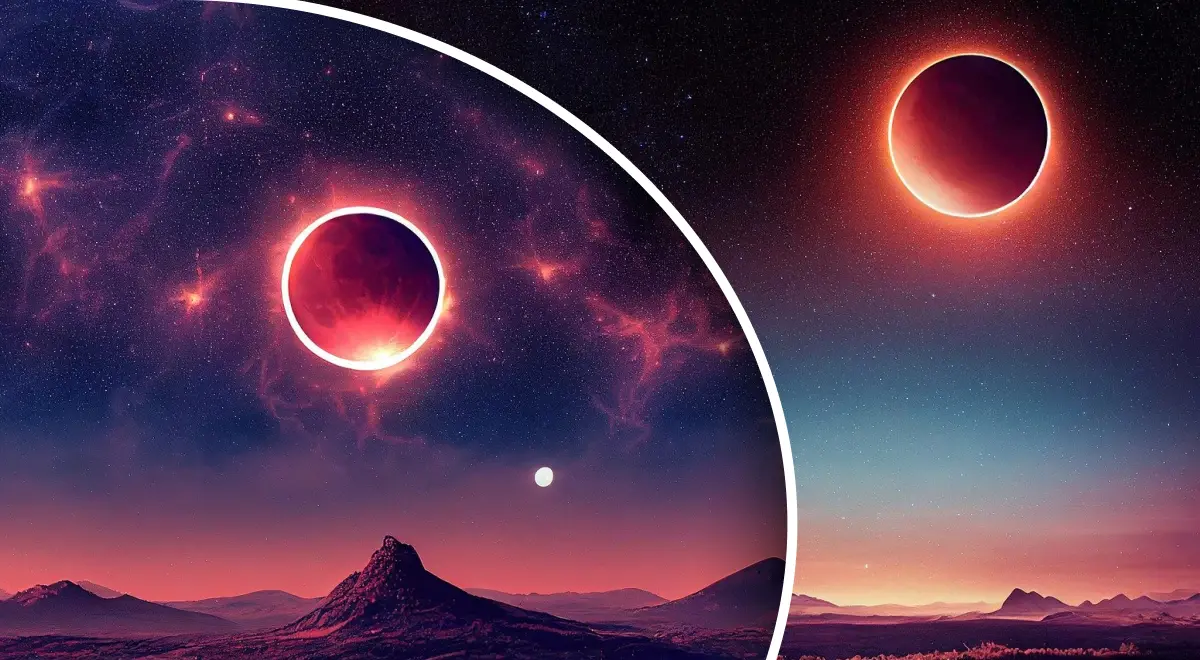
The total solar eclipse in August 2027 will be the longest one humanity will witness by the end of this century: in some regions, the Sun will be obscured by the Moon for more than six minutes. The next eclipse of this duration won’t occur until June 14, 2114, according to Blikk.
Compared to recent events, the difference is significant. The total eclipse on August 12, 2026, lasted no more than 2 minutes and 18 seconds, and in many parts of Spain, the total phase did not even last two minutes. A total eclipse of similar duration in this century was last observed in 2009.
The location where the total phase will last the longest was determined by the Astronomical Institute of the Czech Academy of Sciences. The institute’s press secretary, Pavel Suchan, spoke about this to the publication Aktualne.cz.
“It will be longest in Egypt, near Luxor, where it will last six minutes and 23 seconds. Only the eclipse on June 14, 2114, will have a similar duration,” Sukhan noted.
The path of totality will pass through Spain, North Africa, and part of the Middle East. In Morocco, the total phase will last more than four minutes, and in Egypt, more than six. According to Sukhan, these countries are also favorable due to the weather, although visitors should be prepared for intense heat there in the summer.
The duration of the eclipse depends on the distances between the Moon, Earth, and Sun. The longest eclipses occur when the Moon is relatively close to Earth—making it appear larger in the sky—and Earth is farther from the Sun. This exact alignment is expected in August 2027.
From Gibraltar to Mecca
The eclipse will take place on August 2, 2027. According to the U.S. National Solar Observatory, the path of totality will cross southern Spain, Gibraltar, Morocco, Algeria, Tunisia, Libya, Egypt, Saudi Arabia, Somalia, and Yemen. The Moon’s shadow will pass over the Valley of the Kings in Luxor, the Pyramid of Cheops in Giza, and Mecca. A partial eclipse will be visible across most of Europe, Africa, the Middle East, and Southeast Asia, according to WBAL-TV, citing CNN.
Ryan French, an astrophysicist at the Laboratory for Atmospheric and Space Physics in Boulder, advises not to miss this event and to book accommodations in advance: Hotels within the narrow path of totality are selling out and becoming more expensive much faster than airline tickets.
“This is an eclipse worth seeing, because it will truly be the longest one for the rest of our lives. Importantly, the weather in August along the entire path of the eclipse is almost guaranteed to be sunny, since a significant portion of it runs through the desert,” French emphasizes.
An Opportunity for Scientists
Total eclipses are of great importance to science. Only during this time can we see the inner part of the solar corona, which is key to understanding the solar wind and space weather. During the 2026 eclipse over Iceland and Spain, NASA research teams conducted experiments using a flying laboratory and stratospheric balloons, according to NASA.