
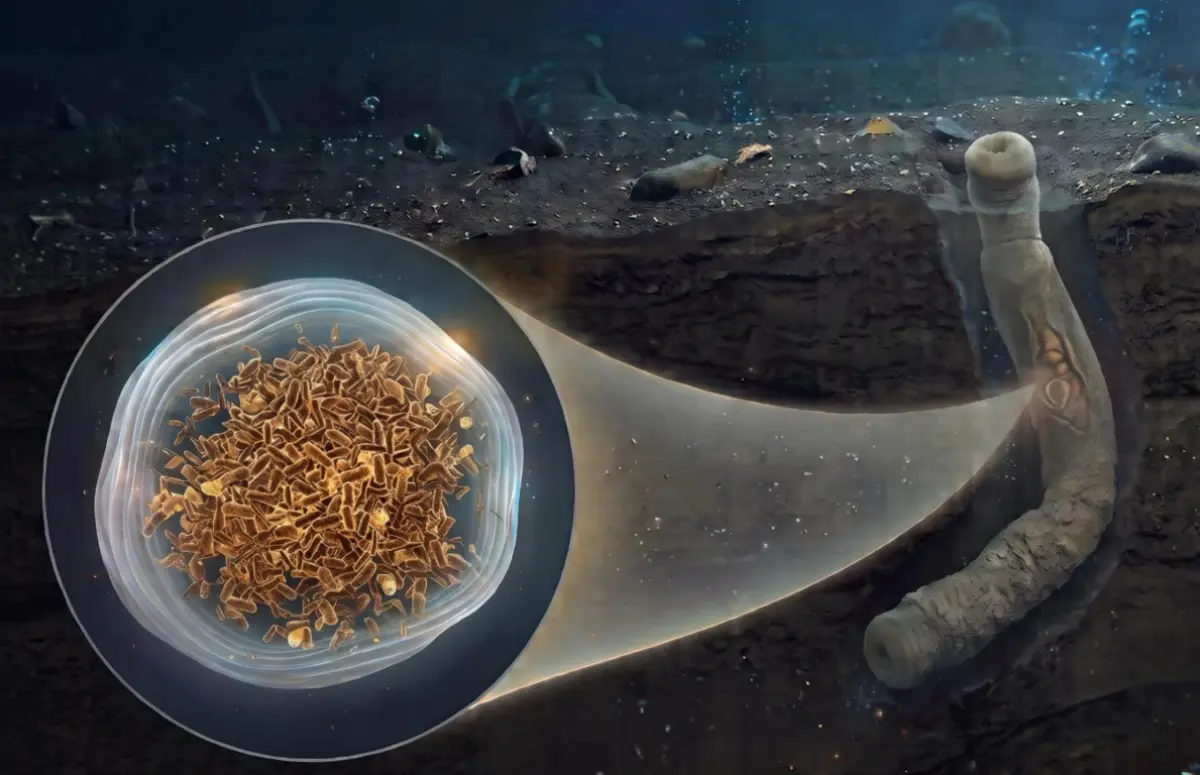
Researchers at the Hong Kong University of Science and Technology (HKUST) have discovered a previously unknown cellular structure, the “dragon sphere,” in the deep-sea mollusk Chaetoderma shenloong, in which it harbors thousands of symbiotic bacteria. This organelle helps the animal survive with almost no oxygen in the mud of the cold slopes of the South China Sea, according to SciTechDaily.
The mollusk, also known as the Divine Dragon Glistenworm, grows to over 150 mm in length and lives at a depth of several tens of centimeters below the seafloor surface, in sediments rich in hydrogen sulfide. Micro-CT scanning and 3D reconstruction revealed that its radula is significantly reduced, and its midgut, hindgut, and anal opening have nearly disappeared. Most of the body cavity is occupied by digestive glands filled with bacteria, which serve as the main source of nutrients and energy.
The bacteria are concentrated in spherical structures 10–15 micrometers in diameter, surrounded by more than 20 layers of membranes. Each of these structures contains hundreds to thousands of sulfur-oxidizing microorganisms, and a single host cell contains, on average, more than 1,600 symbionts. The dracosphere lacks a nucleus and lysosomes, so it is neither a typical cell nor a typical digestive vacuole. The name, derived from Latin, means “dragon’s ball” and refers to the structure’s bead-like shape.
A Membrane Filter for Oxygen
Genomic analysis has shown that the mollusk’s bacteria are adapted to sustain metabolism with a minimal amount of oxygen. Researchers speculate that the multilayered membranes slow down oxygen diffusion and direct its limited supply primarily to the host’s cells without disrupting the symbiotic system. This hypothesis still needs to be tested. Signs of digestive enzyme activity were also detected around the areas containing bacteria: the mollusk likely obtains the necessary nutrients by digesting some of the symbionts.
The study was led by Qian Peiyuan, a professor in the Department of Oceanology at HKUST, in collaboration with Sun Jing from Ocean University of China, Qiu Jianwen from Hong Kong Baptist University, and other institutions. The results were published in *Nature Communications*. It was previously known that deep-sea mussels, tubeworms, and Venus clams harbor bacteria within their cells, but there was no convincing evidence that these animals were capable of developing specialized organelles for symbiosis, notes Phys.org.
A Clue to the Origin of Mitochondria
It is believed that mitochondria and chloroplasts arose as a result of ancient symbiosis between microorganisms and their host cells. The authors emphasize that the dracosphere does not prove that a similar evolutionary transition is occurring in Chaetoderma shenloong, but it does provide a new example of close cooperation between animals and bacteria for studying how organelles form.
The species was described only in 2024 based on specimens from the Haim cold seep. It is the first member of the class Caudofoveata named from a chemosynthetic ecosystem and the first shell-less mollusk associated with mudslides, according to *Zoosystematics and Evolution*.
Traces of Chaetoderma shenloong have already been found near a mud volcano off the Japanese island of Kyushu and at Site F in the northern part of the South China Sea. Together with data on large related species in the Gulf of Mexico, this suggests that such animals are much more widespread on cold seeps than previously thought and may play a role in the deep-sea cycles of methane, sulfur, and carbon.