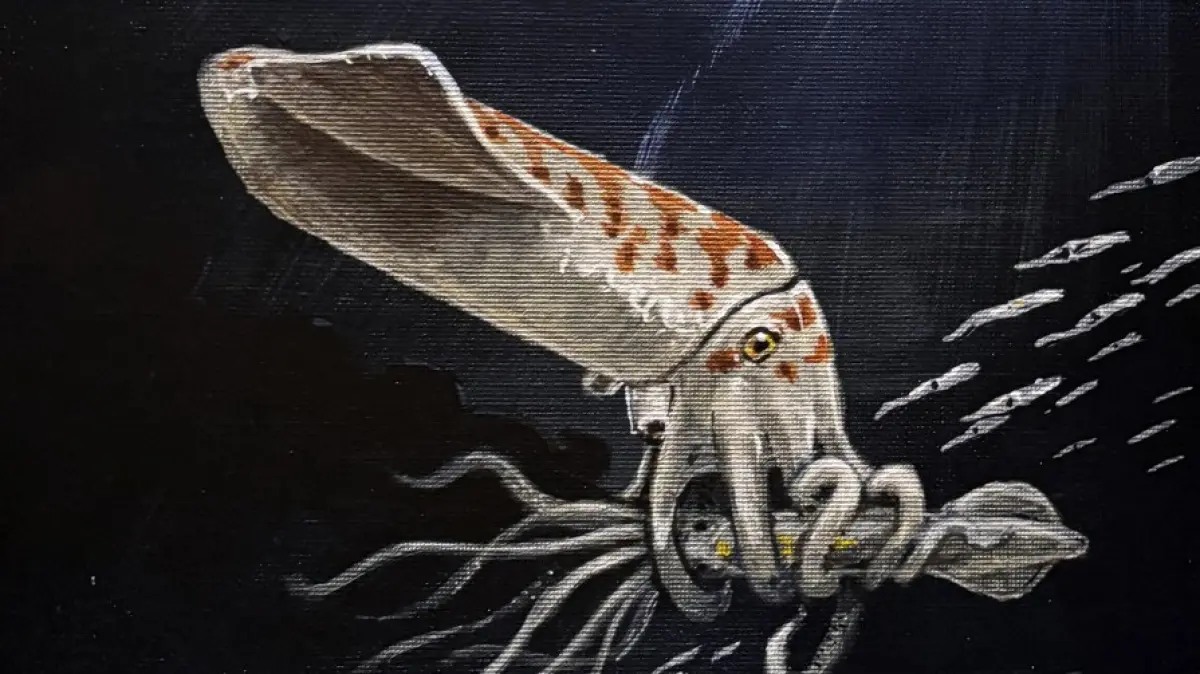
Paleontologists have identified a new species of extinct cephalopods that lived in the oceans during the Jurassic Period, about 160 million years ago. The remains of the creature, named Wyoteuthis linsterorum, were discovered during an excavation in Wyoming, USA, according to ScienceAlert.
The fossils found belong to the belemnite group—ancient relatives of modern squids and octopuses that had a cone-shaped internal shell known as a rostrum. Researchers note that this species is distinguished by its unusually massive size, making it one of the largest members of its genus known to science.
Structural Features and the Uniqueness of the Discovery
An international team of researchers, whose findings were published in the journal *Papers in Palaeontology*, used computed tomography to study the internal structure of the fossils. The analysis confirmed that the creature belongs to an ancient branch of belemnites, which, as previously believed, went extinct much earlier than anticipated, according to the University of Manchester.
Belemnite expert Alexei Ippolitov, who participated in the study, emphasized the rarity of such discoveries after two centuries of studying these mollusks. He suggests that the creature’s large size may have given it an advantage when hunting smaller relatives.
“One possible explanation is that their relatively large size gave them an advantage when hunting smaller belemnites of the genus Pachyteuthis. Modern squids, after all, are rarely picky about their prey: they readily hunt not only other cephalopod species but sometimes even their own relatives,” Ippolitov noted.
Scientific Significance and Research Context
The study of belemnites provides a better understanding of paleogeography and evolutionary processes in ancient seas. Some studies indicate that analyzing the morphological features and internal structures of these mollusks is crucial for revising the classification of species previously considered well-studied, according to the U.S. National Park Service.
Paleontologists estimate that the total length of Wyoteuthis linsterorum, including its tentacles, could have reached 60 centimeters. Both specimens, which served as the basis for the description of the new species, are currently on display at the Wyoming Dinosaur Center.