
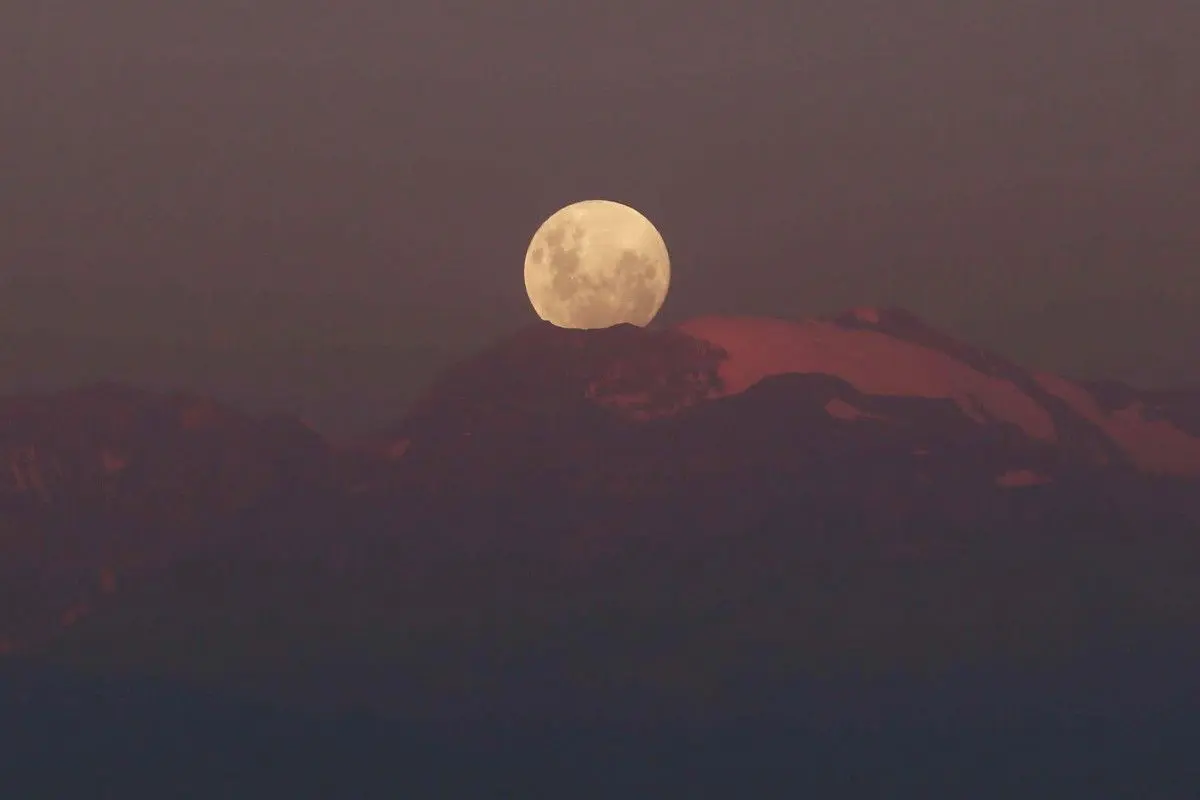
On Tuesday, November 24, one of the largest full moons of 2026 will occur. The Moon will come within 360,768 km of Earth, so its disk will appear about 6% larger than an average full moon and 12% larger than a full moon at the farthest point of its orbit, according to BR24.
The Moon’s orbit is elliptical, so the distance to it varies by about 50,000 kilometers. During a supermoon, nearly a third—or about 30%—more light reaches the Earth’s surface. Higher tides may be observed along the coasts.
The November full moon will not be the largest full moon of the year. On Christmas Eve, December 24, the Moon will be 356,737 km from Earth, and during the January full moon in 2027, it will also be closer than it is now. Supermoons are not uncommon: there are three or four of them every year.
An effect that’s easy to overestimate
The November full moon, known in North America as the Beaver Moon, will kick off a series of three consecutive supermoons. “Supermoon” is a popular name, not a scientific term: astronomers describe this phenomenon as a perigee syzygy—that is, when the Sun, Earth, and Moon are aligned in a straight line while the Moon is near the point in its orbit closest to Earth, according to National Geographic.
Devon Salasin, chief astronomer at Stargazing Moab, doubts that observers will be able to tell this full moon apart from a regular one.
“Although the Moon appears slightly larger and brighter during a supermoon, the difference is almost impossible to spot with the naked eye,” Salasin emphasizes.
The full moon will peak on November 24 at 14:53 UTC (16:53 Kyiv time). The Moon will appear most impressive low on the horizon at sunrise. This is due to an optical illusion: nearby buildings, trees, or hills trick the brain into perceiving the disk as much larger. That evening, the Pleiades star cluster will be visible near the Moon.
There will be no disasters
The Natural History Museum in London dismisses common theories that supermoons trigger earthquakes or volcanic eruptions. According to Professor of Planetary Science Sarah Russell, natural disasters on such nights do not occur any more frequently than usual, the Natural History Museum reports.
“There will be an effect on the tides, but it will be very slight—perhaps a few centimeters at most,” Russell notes.