
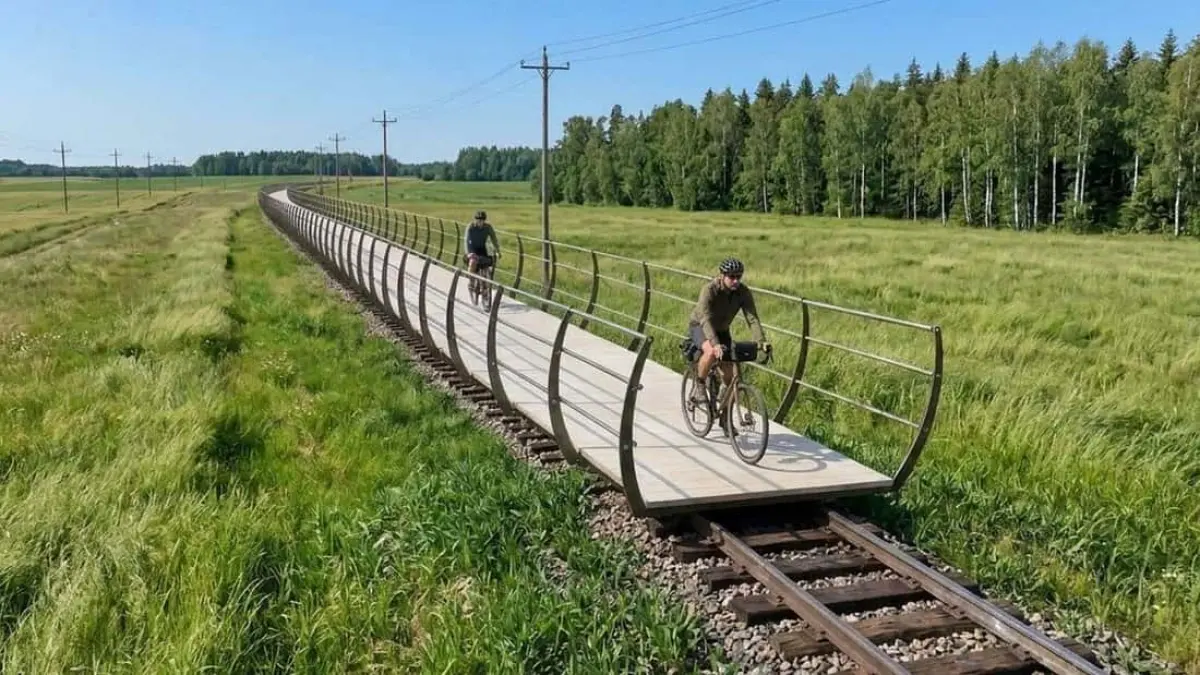
Italian design engineer Marco Tedeschi has patented a modular bike path that can be installed on the tracks of abandoned railroads without dismantling the tracks. The concept features steel modules 3 meters long and 2.5 meters wide. Each weighs between 350 and 500 kilograms and has a non-slip surface and side railings. A truck equipped with a crane installs the modules one by one and connects them to each other, according to BikeX.
The idea came to 59-year-old Tedeschi from his personal experience. It is seven kilometers from his home in Casale Monferrato to the factory where he works, but three of those kilometers are on a highway, so only a handful of the approximately 400 employees ride their bikes to work. A railroad track runs parallel to the road, though trains no longer run on it. The inventor explained to Bikeitalia why the railroad tracks could serve as the foundation.
“Since the rails are already firmly anchored to the ballast bed, they have exceptionally high mechanical properties relative to the weight required for the structure. After all, a railcar weighs about 15 metric tons,” notes Tedeschi.
If the train returns
Typically, when converting a railroad into a bike path, the rails and ties are removed and the embankment is cleared, making it practically impossible to restore the track afterward. Tedeschi’s modules leave the infrastructure intact.
“These are reversible modules that can be moved. If Ferrovie dello Stato ever demands that a section of the railroad be returned to restore rail service, since the track gauge in Italy is 1,435 millimeters, they can be moved anywhere,” the inventor emphasizes.
According to data from the Italian Ministry of Transport cited by the author, one kilometer of bike path built using traditional methods costs 300,000–350,000 euros. Tedesco is convinced that his solution will yield savings of 30,000–40,000, though he acknowledges that this is a preliminary estimate. He also proposes installing canopies equipped with solar panels to power lighting and charging stations.
The inventor does not plan to build major routes. “My idea for these paths is not to build a Rome–Milan route, but to create micro-projects and micro-routes that can relieve traffic congestion,” he says.
The potential for such solutions in Italy is significant. According to RFI data, the state-owned railway operator RFI lists approximately 1,500 kilometers of unused lines in its atlas, which it proposes converting into bike and walking routes.
So far, just a model in the garage
Tedesco received his patent back in 2022, but a prototype does not yet exist; there are only blueprints, renderings, and a hand-built 1:10 scale model. He doesn’t expect to carry out the project on his own: “A project like this really requires resources far greater than I could ever have.”
BikeX readers have reacted critically to the concept. They point out that the side barriers would obstruct animals and vehicles needing to cross the path, and that the steel surface could be dangerous in icy conditions. The lack of practical testing and, likely, the high construction cost also raise doubts.