
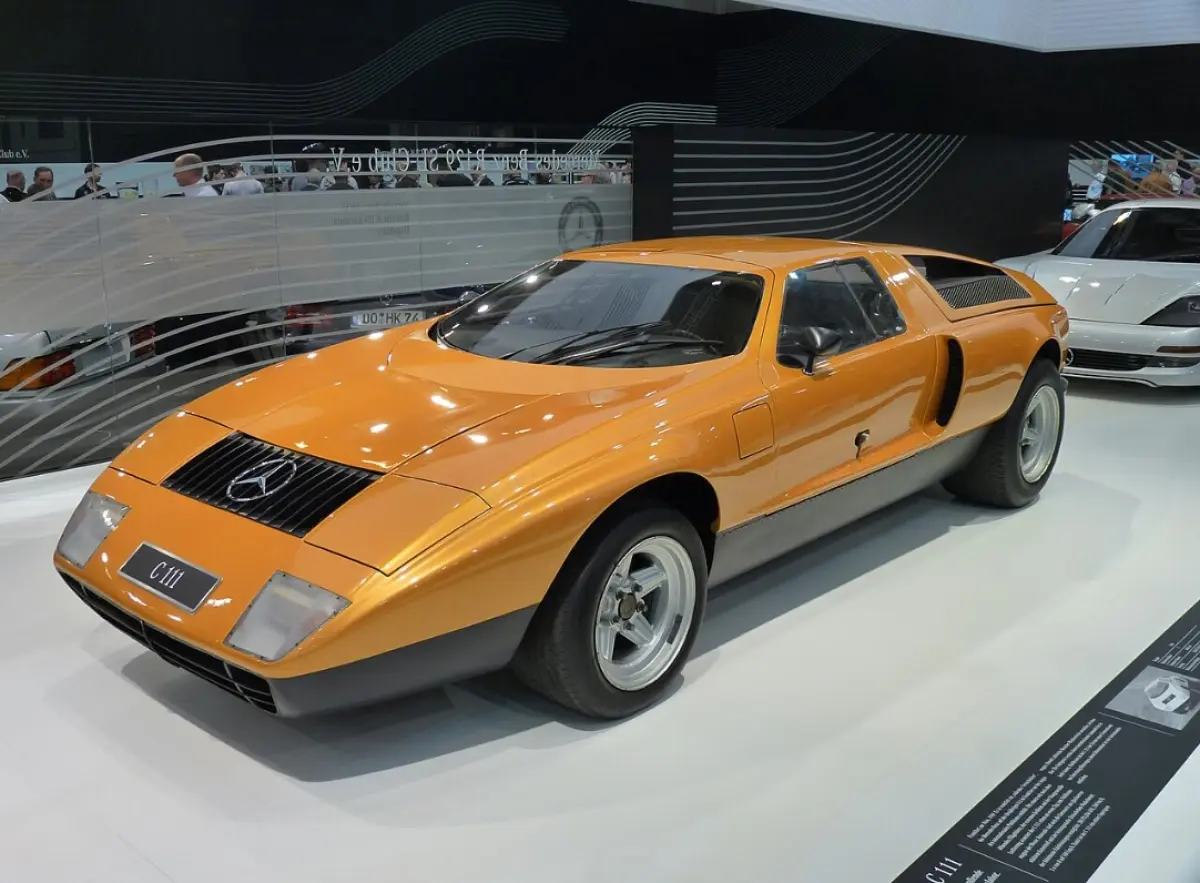
For the first time in its history, Mercedes-Benz will auction off a car from its own museum collection. It is the C111-II supercar with a Wankel rotary engine, which until now has been unavailable for purchase at any price. According to Gord Duff of RM Sotheby’s auction house, the lot’s price could significantly exceed 25 million euros, reports Totalcar.
The auction will take place on February 3, 2027, at the Louvre Palace in Paris during the Rétromobile exhibition. The proceeds will go toward the development of the Mercedes-Benz Museum in Stuttgart, specifically toward the creation of its digital twin. In addition, the company has contractually agreed not to sell any other C111s for at least 25 years—that is, until 2052.
“Car 33” from the test fleet
The third of the C111-II models ever built, listed in the collection as “Car 33,” will be put up for sale. The car is equipped with an original 2.4-liter four-rotor Wankel engine producing 350 k.s. Weighing 1,240 kg, the supercar accelerates to 300 km/h and reaches 100 km/h in 4.8 seconds. In the 1970s, it was part of the company’s test fleet; in particular, the anti-lock braking system (ABS) was tested on it, according to Mercedes-Benz.
In 1972, this car appeared in the first issue of the German edition of Playboy, and it has been on display at the museum since 2006. In 2024, it was restored to running condition, preserving the original patina of the body and interior. The car has only 24,766 km on the odometer.
Marcus Braitschwert, CEO of Mercedes-Benz Heritage, explains why the company decided to break with a long-standing tradition: “They say that potential buyers even sent blank checks to Stuttgart, but Mercedes-Benz never sold a single C111. Since then, the desire to own one of these extraordinary cars has resurfaced time and again. Now we’re turning a new page and, for the first time, passing one of these cars from our collection into new hands".
A dream that never made it into production
The C111 was unveiled at the 1969 Frankfurt Motor Show as the futuristic successor to the legendary 300 SL. In total, only 17 prototypes were built, 13 of which are still part of the Mercedes-Benz collection. The model never made it to series production: new environmental regulations, high production costs, and the 1973 oil crisis stood in the way.
A proposal to launch the C111 into production was put to a vote by the Daimler-Benz board, but it was rejected by a narrow margin. The rotary engine remained both the model’s main advantage and the most compelling argument against mass production, according to Hemmings.