
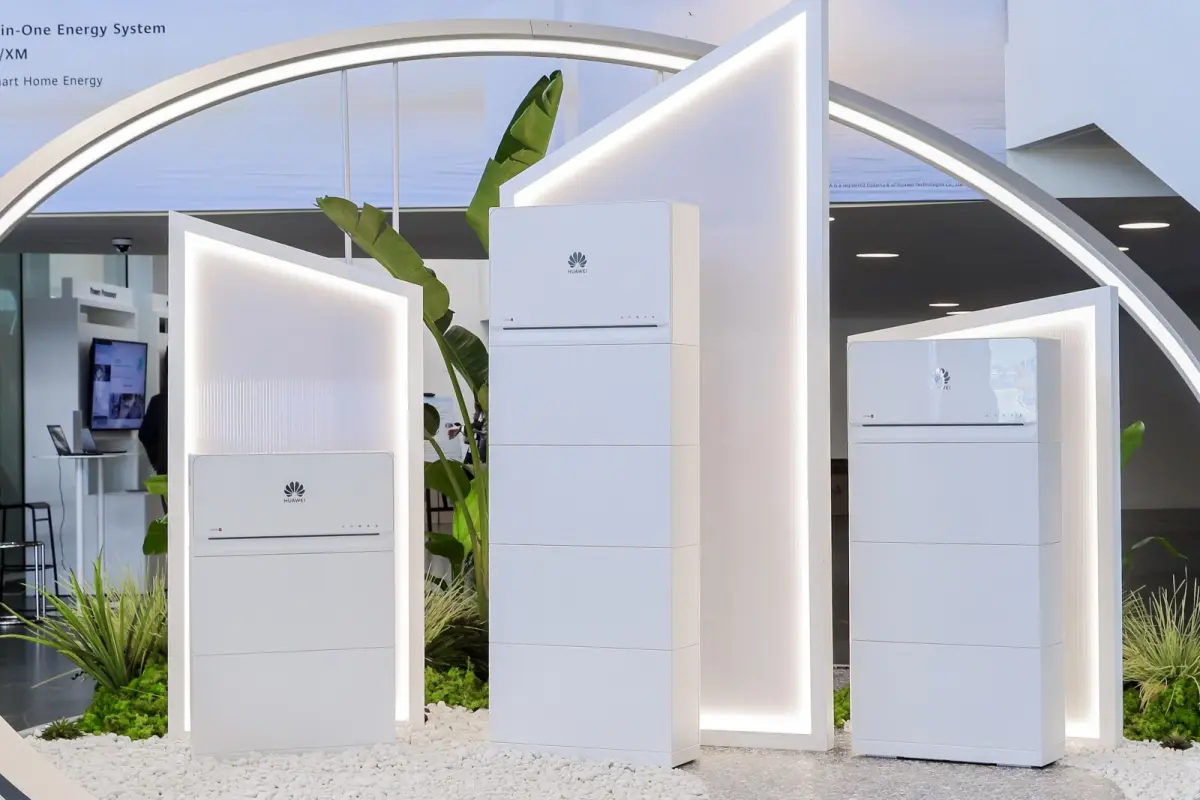
Huawei unveiled its new LUTERRA S2 home energy storage system at an event in Mallorca. The system is modular and consists of 5- or 7-kWh battery modules that are stacked on top of one another. The 5 kWh version can be scaled up to 20 kWh, according to Portfolio.
The company chose the presentation location with the European market in mind. The organizers also mentioned the large-scale blackout in the Pyrenees in the spring of 2025, when many Spanish households were left without power.
The maximum-capacity battery will last for 2–3 days of consumption for an average household that does not use electric heating. If the home has a heat pump or an electric vehicle being charged, the battery will drain much faster.
Thanks to built-in handles, the units assemble like “Lego for adults,” and the system can be up and running in 10–15 minutes. At the same time, in Hungary, a qualified specialist must connect the battery and inverter, so the simple design primarily speeds up the installers’ work.
Charging and discharging are controlled by artificial intelligence. It takes into account consumption patterns and the weather forecast: if plenty of sunshine is expected the next day, the storage unit releases as much energy as possible during the expensive evening peak to make room for cheap energy generated by solar panels.
The system is fanless, so it operates at less than 29 dB—roughly the sound of a very quiet whisper. The device has been tested with a 1,000 °C fire. It also monitors the temperature of the connectors and cells and provides advance warning of anomalies.
According to the manufacturer, the silicon carbide-based inverter delivers up to 99% conversion efficiency and a maximum power output of 20 kW. The 5 kWh module weighs 46 kg, while the 7 kWh module weighs 57 kg. TÜV Rheinland has verified the system’s safety, including in a scenario involving thermal runaway of the cells, Huawei notes.
The Hungarian market is currently held back by subsidies
The European market for home storage systems is highly heterogeneous. A representative of the German company explained that in Germany, price is not always the deciding factor: buyers place equal emphasis on cell lifespan, design, and software capabilities.
In Hungary, demand is difficult to assess due to government-imposed tariff caps and net metering for solar installations. The fixed price remains the same at all times of the day, which eliminates the main benefit of a storage system: shifting the consumption of cheap energy to other hours. Net metering effectively turns the grid into free storage.
The situation is changing. Net metering is gradually being phased out, and the state-owned energy company MVM will introduce a voluntary dynamic tariff D starting January 1, 2027. A fixed price will apply up to the preferential limit of 2,523 kWh per year, and above that limit—instead of the current rate of approximately 70 forints—a variable, market-linked rate will apply.
Market development is also supported by a state program for home energy storage systems with a budget of 100 billion forints. It provides non-repayable grants of up to 2.5 million forints. According to HVG, these grants will primarily go to owners of solar power systems who have already switched to or will switch to net metering by 2030, as well as residents of communities with a population of up to 5,000 people.