
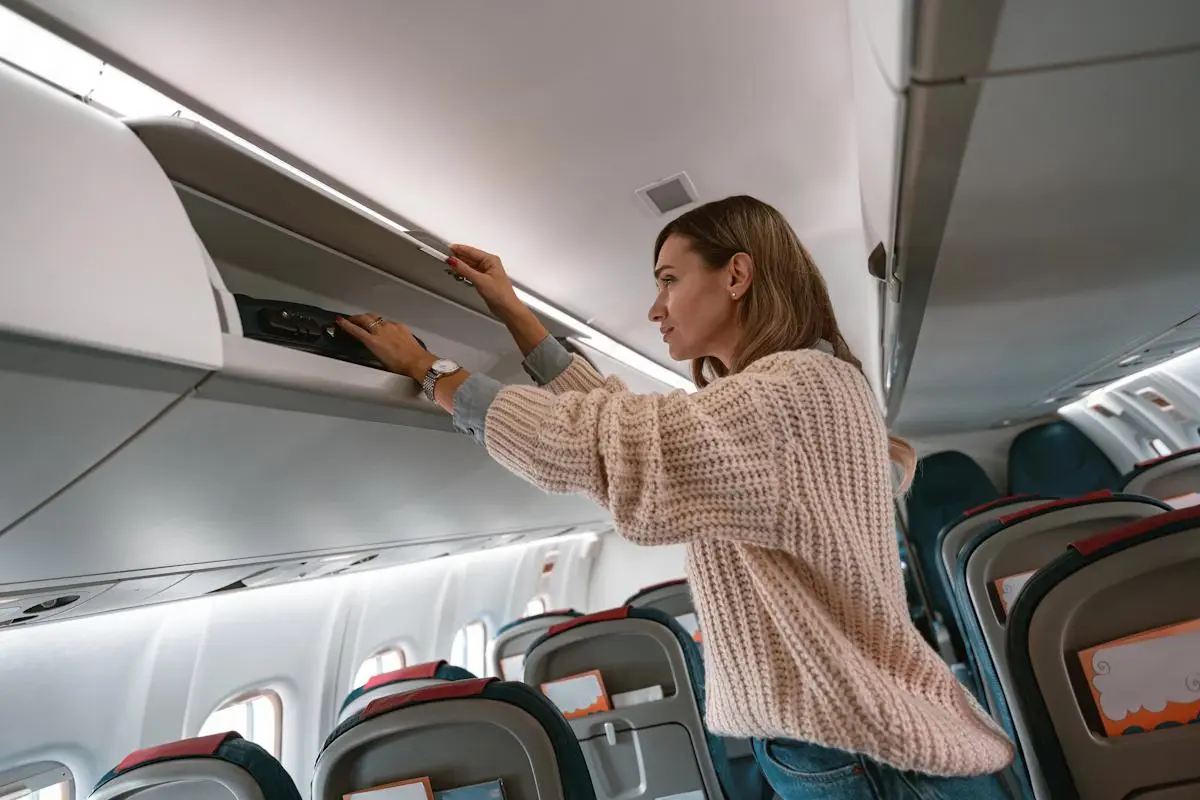
Airlines are tightening restrictions on carry-on luggage, and the rules are becoming increasingly confusing for passengers. At the same time, excess luggage in the cabin poses a real threat to flight safety. This is according to Natasha Hip, a former pilot and current aviation safety researcher who serves as director of the bachelor’s program in aviation at the University of Southern Queensland. In her view, clearer rules regarding carry-on luggage should be welcomed, reports The Independent.
Hip cites Virgin Australia as one of the most recent examples. Starting February 2, 2026, economy-class passengers on this carrier’s domestic flights will be allowed to bring only one standard bag weighing up to 8 kg for the overhead compartment and one small personal item that fits under the seat. Air Canada had previously allowed passengers traveling on basic fares on flights within North and Central America to bring only one personal item on board.
Overcrowded overhead bins delay departures as the crew tries to stow all the items in the cabin or sends some of them to the cargo hold. However, delays, the researcher notes, are not the only problem.
“Carry-on luggage is literally a pain for flight attendants, who often suffer back injuries while helping passengers stow heavy bags in the overhead bins. In addition to the physical risk, crew members have to deal with exhausting bottlenecks when passengers struggle with large items during boarding. It has been proven that in an emergency, passengers who stop to retrieve their bags instead of leaving them behind slow down the evacuation,” warns Hip.
One Plane, Different Rules
Hip explains this confusion using the example of the Sydney–Melbourne flight. It’s operated on identical Boeing 737 aircraft, but the restrictions depend on the airline and the fare class. Qantas allows one personal item and one standard bag weighing up to 10 kg, or two smaller bags weighing up to 10 kg each, with a combined weight of up to 14 kg. The low-cost carrier Jetstar allows only 7 kg for two items.
These rules are based on the aircraft’s maximum takeoff weight. This includes the weight of the aircraft itself, fuel, in-flight meals, cargo, crew, passengers, and baggage. Checked baggage is weighed at the check-in counter. On small aircraft carrying fewer than seven passengers, the actual weight of the passengers is taken into account: for example, on flights between the islands of the Torres Strait, passengers are weighed along with their bags.
For large aircraft, Australian regulations allow for the use of an average passenger weight. In 1998, when Hip began her flying career, the standard was 77 kg per person, excluding carry-on luggage. Now, for aircraft with 150–299 seats, such as the Boeing 737, the weight of an adult male is assumed to be 81.8 kg, a female’s 66.7 kg, and carry-on baggage 7 kg per passenger. Airlines can negotiate their own standards with the Australian Civil Aviation Safety Authority, so rules vary among carriers.
Billions in Baggage Fees and Failed Standardization
The rules regarding carry-on luggage used to be much more standardized, but low-cost carriers began charging separate fees for extra baggage, Wi-Fi, food, and beverages. According to a forecast by the International Air Transport Association (IATA), such additional revenue will reach $144 billion this year. That’s more than the global aviation industry earns from cargo transport. Passengers try to avoid these extra charges by bringing everything into the cabin, and airlines respond by imposing fines for exceeding baggage limits.
An attempt to introduce a single standard failed at the time. IATA proposed the “Cabin OK” guidelines, under which carry-on baggage dimensions were not to exceed 55 × 35 × 20 cm, instead of the 55 × 45 × 25 cm maximum in effect at the time. This would have reduced the allowable volume by nearly 40%. The initiative was criticized by German consumer advocates, and in the U.S., a number of airlines and lawmakers spoke out strongly against it, according to DW.
American travelers are particularly accustomed to large carry-on sizes. Among German carriers, Lufthansa and Air Berlin had the most generous allowances at the time: 55 × 40 × 23 cm, plus an additional small bag or laptop sleeve for economy-class passengers. Following a wave of protests, IATA clarified that its recommendations should not become a new industry standard.