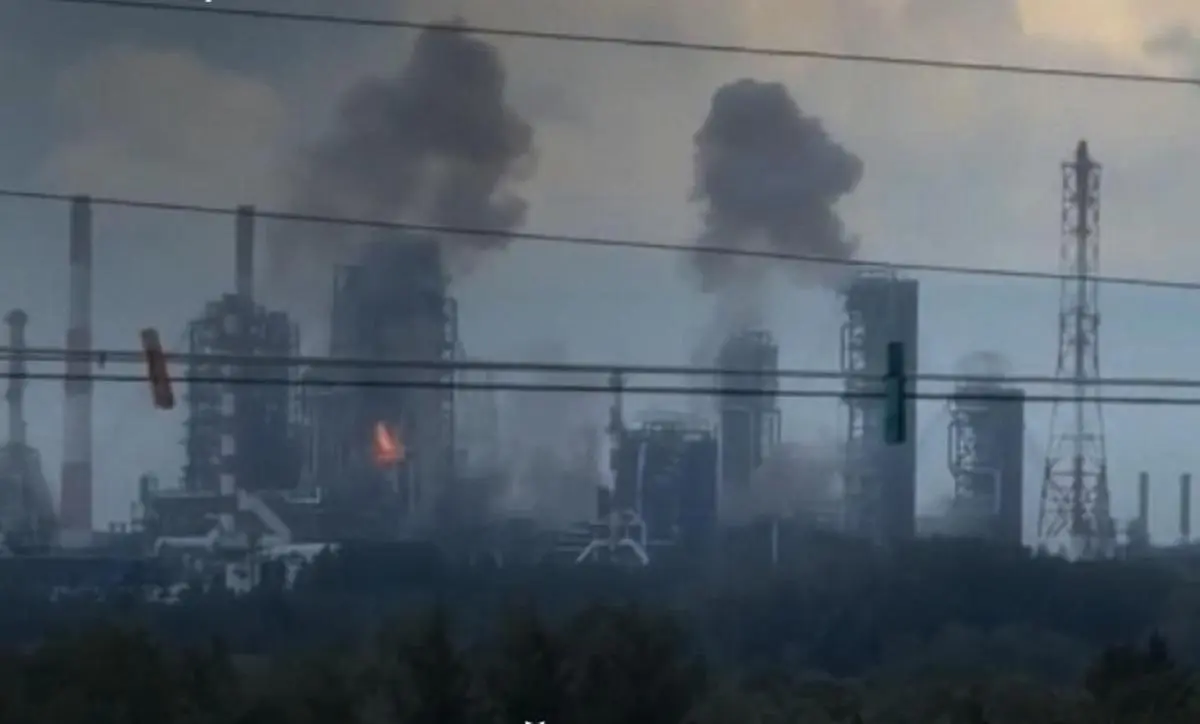
The Russian oil company Rosneft has restricted gasoline sales following a week of intense Ukrainian strikes on oil refineries. Drivers can purchase no more than 30 liters of fuel at gas stations in cities and 50 liters on highways, even though previous restrictions were lifted just two weeks ago, according to The Telegraph.
By the evening of Monday, November 9, at least six regional governments in Russia had confirmed the rationing, and the number was growing. Signs that the limits could extend nationwide emerged in a report from Transbaikal: “‘Rosneft’ is imposing restrictions in all regions of the country,” the local Ministry of Economic Development stated.
On Monday, a Ukrainian drone set fire to the large Kirish Oil Refinery near St. Petersburg. Following this, rationing was introduced in neighboring Karelia, and the republic’s governor, Artur Parfenchikov, acknowledged that residents would have to put up with the inconveniences.
“I am fully aware that these restrictions may cause inconvenience. However, under the current circumstances, these steps are necessary,” Parfenchikov emphasized.
A Ceasefire That Never Happened
Rosneft eased the limits on October 23, when Ukraine suspended its strikes in response to Donald Trump’s call for an “energy truce.” On October 11, the U.S. president—who, ahead of the November 3 midterm elections, had accused Kyiv of driving up fuel prices in the U.S.—stated that Putin and Zelenskyy had agreed not to attack each other’s energy infrastructure for 30 days. Since Russian airstrikes continued, Ukraine resumed missile and drone strikes in late October.
In October, Putin claimed that Ukraine had not struck a single “particularly significant” oil refinery. Kyiv, on the other hand, claims to have disabled 15 of 38 key Russian refineries and forced another 12 to cut production.
The shortage in Russia is worsening as Trump is still waiting for the 300,000 metric tons of Russian diesel promised by Putin last month. Of the three tankers that were dispatched, two are heading away from the U.S., and the third never entered port on November 7. Multi-day peace talks involving Russia, Ukraine, and the U.S. are scheduled to take place in Abu Dhabi this week.
Repairs will take months
Ukrainian attacks have cut Russian diesel exports by more than 75%: in September, exports stood at 141,000 barrels per day, compared to 608,000 a year earlier, according to Kpler. Tatyana Mitrova, an expert on the Russian oil industry at Columbia University, notes that Ukraine has learned to target complex equipment: a destroyed storage tank can be restored in a few weeks, while replacing secondary refining units requires foreign suppliers and at least several months of waiting, CNBC reports.
“You can’t just order this on Alibaba. Orders have to be placed in advance, so it’s impossible to get this equipment quickly. You have to compensate for the risks of all parties involved because [counterparties] are violating sanctions,” Mitrova notes.
As early as late June, fuel shortages were reported in 92% of Russia’s regions; two-thirds of them imposed purchase limits, and some drivers waited up to 40 hours at gas stations. According to Rosstat, gasoline prices have risen by more than 19% since the beginning of the year, and diesel prices by approximately 18%, reports the International Energy Agency.
Analysts estimate that Russia’s refining capacity has fallen by 30–50% as a result of Ukrainian strikes and forced repairs. Russian governors themselves acknowledge that the restoration of individual refineries could take up to half a year, writes RUSI.