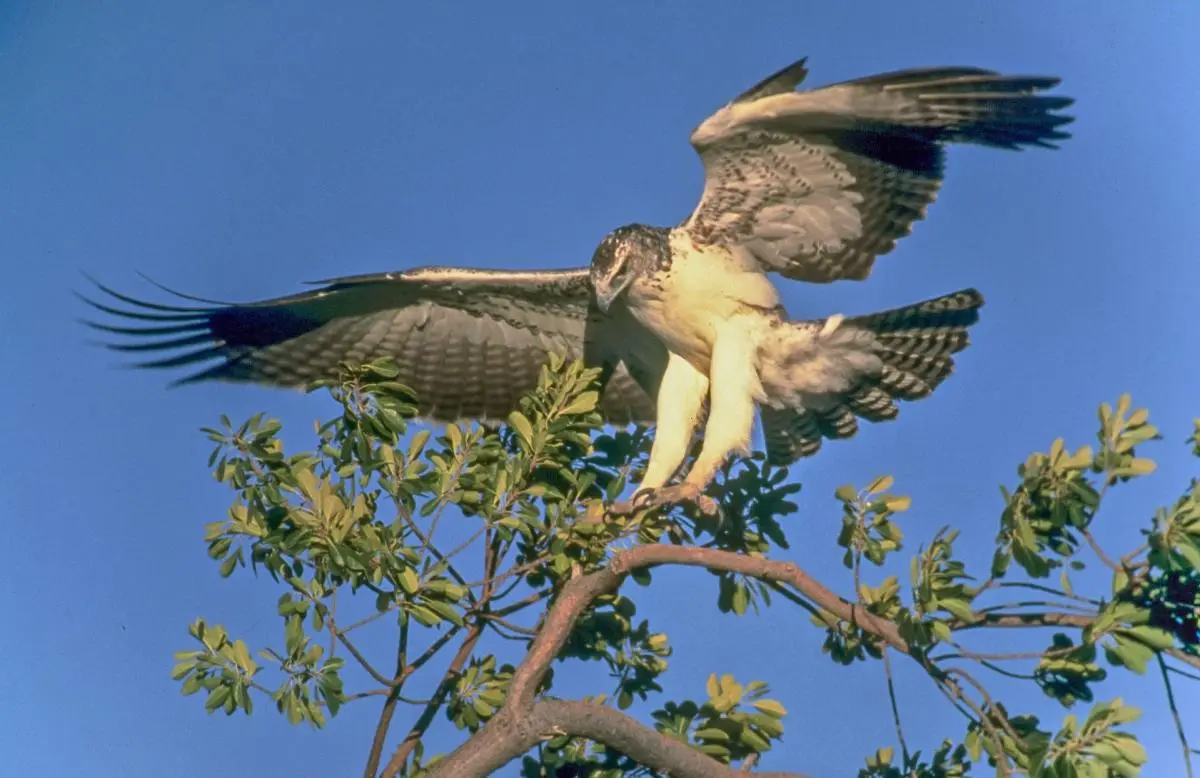
Eagles are capable of hunting surprisingly large prey, including baboons weighing about 26 kg. Some human ancestors were smaller than modern humans and weighed about the same, so researchers speculate that these birds of prey may have attacked them as well, according to Live Science.
Until now, there had been no confirmed cases in scientific literature of birds of prey killing a primate weighing more than 13 kg. Animals weighing over 20 kg were considered virtually out of reach for eagles. During an expedition to the Ennedi Plateau in northeastern Chad in February and March 2025, scientists found the skulls of two adult male olive baboons beneath some rocks, both with puncture wounds in the eye sockets. Such injuries resemble the marks on the skull of the “Taunga Child,” a specimen of the species Australopithecus africanus, whose death had previously been linked to an eagle attack. Based on the femurs, the scientists estimated the animals’ weight at 20.1–28.9 kg. One of the males with puncture wounds weighed about 22 kg, and claw scratches were also found on his scapula. The suspected hunter is the Verreaux’s eagle (Aquila verreauxii), which researchers observed near the site of the findings, according to an article in the *American Journal of Biological Anthropology*.
An Unexpected Discovery in the Sahara
An isolated population of baboons on the Ennedi Plateau lives apart from other primates. Scientists studying the animals initially did not see any danger in the birds circling above the cliffs, according to Popular Science.
“We saw eagles while searching for baboons, but we couldn’t even imagine that they might pose a threat to them. Then we found the first skull with a puncture mark, and then another, and another,” said study co-author Catherine Gobaiter, a primatologist at the University of St. Andrews.
Jean Didier Akpona of African Parks, who has been working in the region for about three years, notes that he has often seen these birds near helts—natural pools in the rocks. According to him, he hadn’t suspected such large prey for them until the team stumbled upon the evidence. “This discovery encourages us to delve deeper into the mystery surrounding the kettles of the Sahara Desert,” Akpona emphasized.
How Human Ancestors Defended Themselves
To defend themselves against eagles, ancient primates likely attacked the predator as a group to drive it away. Modern primates in areas where eagles hunt often form large mixed groups with other species. Early human ancestors lived similarly, alongside other hominins and primates.
“Baboons are among the best-studied monkeys in Africa, but even our initial observations in Ennedi have overturned many assumptions about how these baboons behave—from their diet to their social lives. I can’t wait to see what other ‘rules’ they’ll break!” said Gobaiter.