
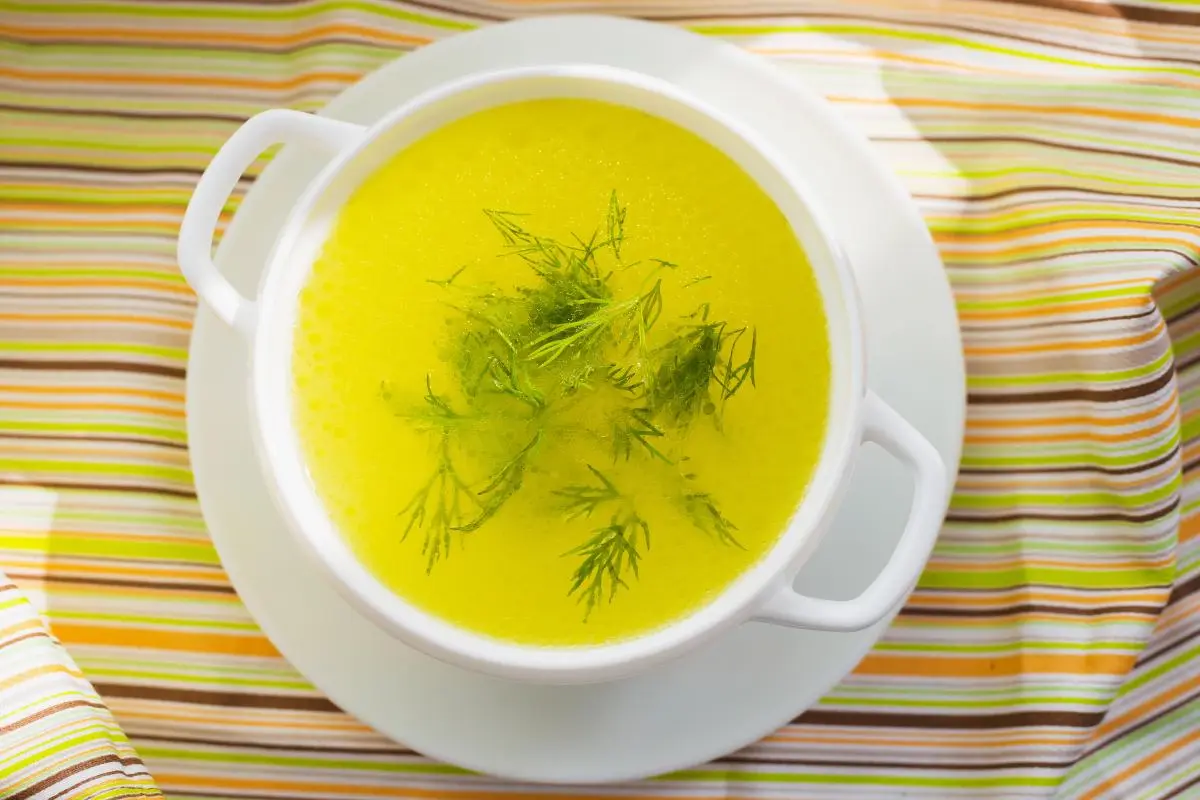
You can make a cloudy broth clear right after cooking, even without skimming off the foam. To do this, use agar-agar according to the “2:1” method: 2 grams of agar-agar per 1 liter of broth, or 0.2% of the broth’s weight, according to Moje Gotowanie.
Agar-agar is a natural thickener derived from red seaweed. It is usually added to desserts as a plant-based alternative to gelatin. When dissolved in hot broth, it forms a delicate jelly as it cools, trapping small particles of sediment. Unlike traditional clarification with egg whites or gelatin, this method does not require animal products, so it is also suitable for vegetable broths.
The proportions are easy to scale: for half a liter of broth, you need 1 g of agar; for two liters, 4 g.
Jelly Instead of a Skimmer
First, mix 300 ml of strained broth with agar in a saucepan and bring to a gentle boil. Simmer the mixture for 2–3 minutes, stirring constantly with a whisk, until the agar is completely dissolved. Then gradually pour in the remaining 700 ml, preferably preheated. The temperature should not drop below approximately 35°C, otherwise the agar will begin to set prematurely.
Next, place the container in ice water until the liquid turns into a gel. Break it into small, cheese-like lumps and place them on a sieve lined with fine cheesecloth. The clear broth gradually drains off, while some impurities remain in the gel. You can press the mass lightly, but do not wring out the cloth, as agar particles and suspended matter will end up in the liquid. You’ll end up with less broth than you started with.
The main cause of cloudiness is boiling too vigorously: the fat breaks down into droplets, and the coagulated protein particles disperse throughout the liquid. Skimming off the foam only helps until these particles have dispersed. If the broth has already become cloudy, skimming won’t make much of a difference.
Why You Should Still Skim Off the Foam
Mexican chef Patty Hinich emphasizes that foam on broth isn’t harmful. It’s a natural byproduct of cooking: as meat or bones simmer, protein and impurities rise to the surface. However, she still skims it off because the foam makes the broth cloudy. “Visually, it matters—after all, we eat with our eyes first,” Hinich noted in an interview with Tasting Table.
According to the chef, the foam also affects the taste, making the broth feel heavy. “When you skim it off at the beginning of cooking, the soup seems lighter and more refined. The flavors of the chicken, vegetables, or herbs come through more clearly, and the broth’s texture remains smooth,” Hinich believes. She advises doing this as soon as the foam appears and keeping the heat low, because vigorous boiling will stir the impurities back into the liquid.