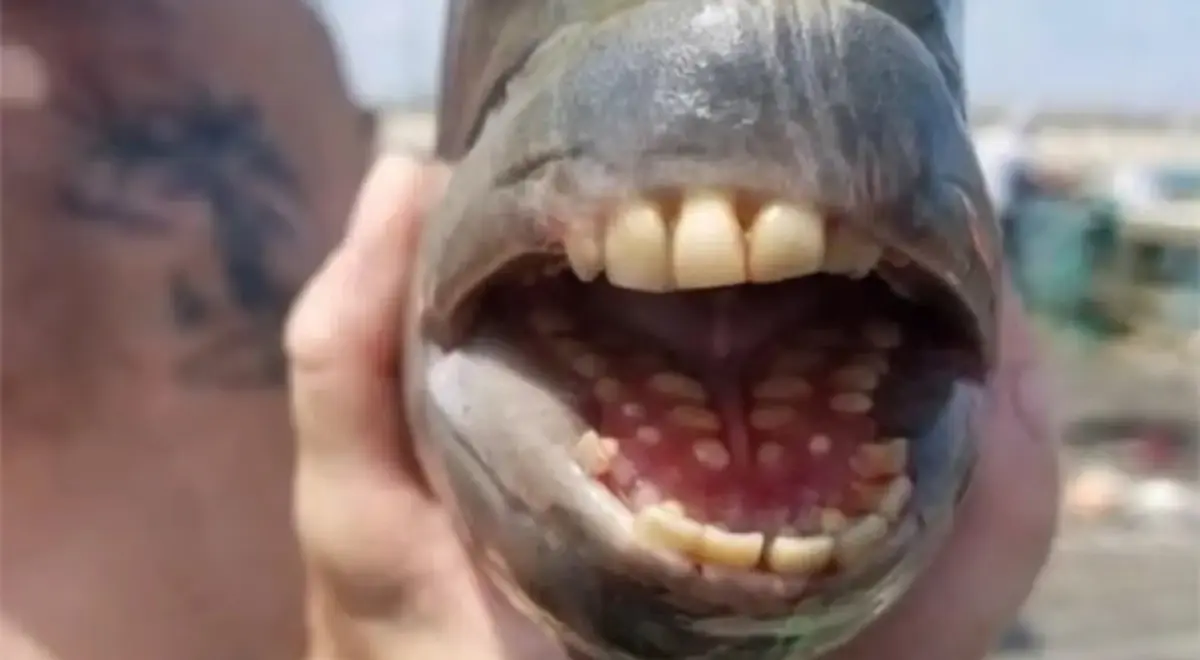
The spinyhead fish (Archosargus probatocephalus) has front teeth that resemble human teeth. It is found from eastern Canada to southern Brazil, and this set of teeth helps it crush shells and carapaces. In its latest assessment, the International Union for Conservation of Nature (IUCN) classified the species as having a low risk of extinction, according to Wirtualna Polska.
Should We Be Afraid of the “Demon Fish”?
A TikTok video filmed in Cape Coral, Florida, brought widespread attention to the spinyhead. The clip featuring the “demon fish” has garnered 27 million views. According to David Catania, an ichthyologist at the California Academy of Sciences, this is a common species, especially in Florida’s waters. The structure and arrangement of its teeth—with incisors in front and molars in back—indicate that the fish is omnivorous, just like humans, according to Snopes.
The similarity isn’t just superficial: like humans, this fish’s teeth are covered in enamel. For swimmers who fear an encounter with a spinyhead, the scientist has a reassuring answer.
“I would swim without hesitation in waters where these fish live. They pose no threat to humans if left undisturbed,” Catania emphasizes.
The only real risk is for fishermen. The spinyhead is a tasty fish, so it’s hunted, and when handling a caught fish, it can bite or prick with the sharp spines on its dorsal fin.
Three rows of molars and a 20-year lifespan
In addition to its incisors, the spiny-headed fish has molars and chewing teeth. In the upper jaw, they are arranged in three rows; in the lower jaw, in two. The fish uses these powerful teeth to crush blue crabs, oysters, and mollusks, and to scrape barnacles off rocks and pilings, according to the Florida Museum of Natural History.
Spiny-headed fish grow up to 76 cm in length and weigh up to 9.6 kg, although adults typically weigh between 0.5 and 3.6 kg. These fish live for at least 20 years. They are found near piers, breakwaters, and mangrove thickets, preferring brackish water. The densest populations are found off the southwestern coast of Florida.
Despite the current low risk of extinction, spinyhead populations have at times been subject to overfishing. Restrictions on fishing methods, size limits, and catch limits have helped reduce fishing mortality and increase the spawning stock in Florida.