
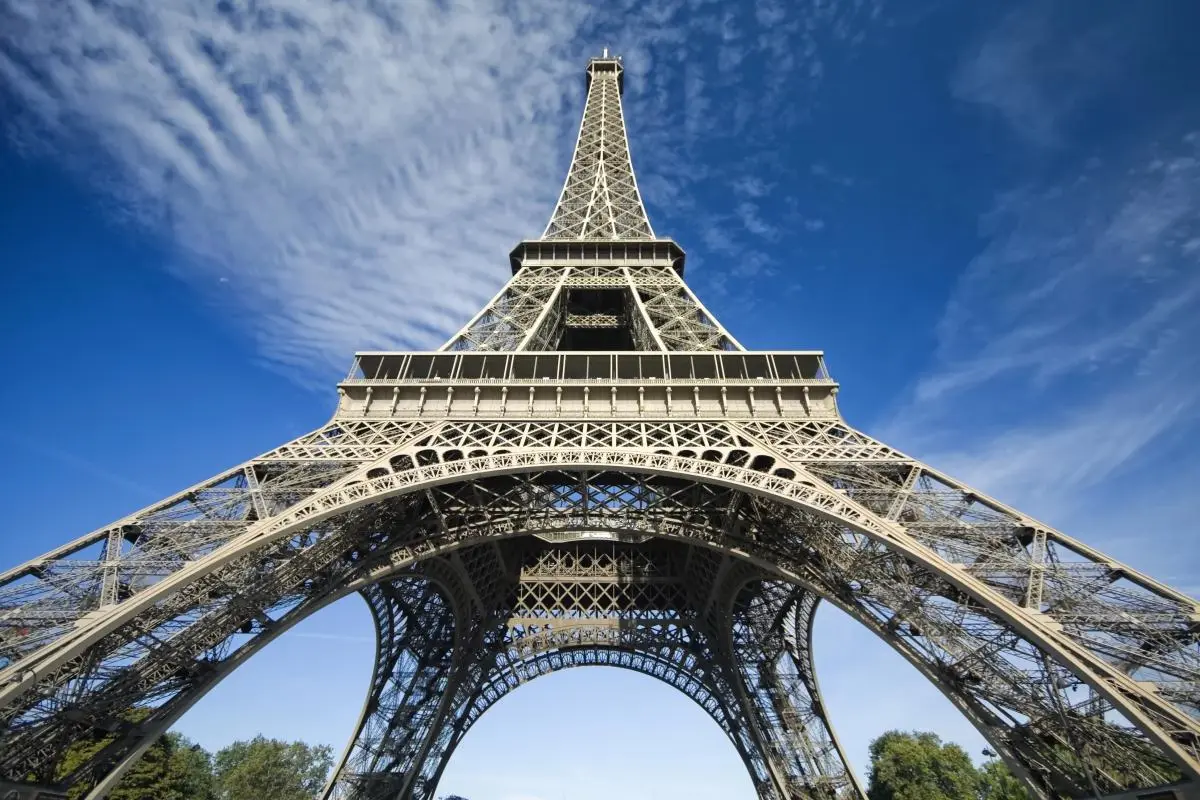
At the top of the Eiffel Tower, just below its spire, there is a secret apartment that Gustave Eiffel had built for himself. The apartment measures about 100 square meters, though a significant portion of that space is taken up by staircases, elevators, and technical equipment. Eiffel limited himself to a living room, kitchen, and bathroom; there was no bedroom. Wealthy Parisians offered large sums of money to spend at least one night in the tower, but the engineer turned them all down. He used the apartment for work, scientific experiments, and entertaining select guests. Among them was Thomas Edison, who in 1889 presented Eiffel with a phonograph, one of the most sensational technical innovations of the time, according to Hamu és Gyémánt.
A piano, writing desks, and not a single bed
From the very beginning, Eiffel reserved the top floor for himself, surrounded on all sides by an open balcony. The living room contained a table, a sofa, a piano, and three small writing desks; a separate kitchen, a bathroom with a sink, and a toilet were also set up. The sounds of his scientific experiments could be heard in other parts of the tower. According to historian Bertrand Lemoine, Eiffel probably never spent a single night there. Later, the space was converted for technical services, and today visitors can view a reconstruction of the study featuring wax figures of Eiffel, his daughter Claire, and Edison, according to the Eiffel Tower’s official website.
The apartment stood in stark contrast to the structure’s iron framework. In a book published in 1891, writer Henri Girard wrote that it was furnished “in the simple style so beloved by scientists”: wooden chests, paintings, and even a grand piano. In a small adjoining room stood scientific equipment that Eiffel often used to conduct meteorological observations. Turning down wealthy suitors, he kept the apartment as a personal space for solitude in the middle of the city, notes The Independent.
The Eiffel Tower was built between 1887 and 1889 as the entrance gate to the World’s Fair commemorating the centennial of the French Revolution. After the exhibition closed, Eiffel sought a new practical use for the structure and, in 1890, installed a meteorological station on it. The tower stands 300 meters tall, or 330 meters including the television antenna. According to Britannica, it attracts about seven million visitors each year.