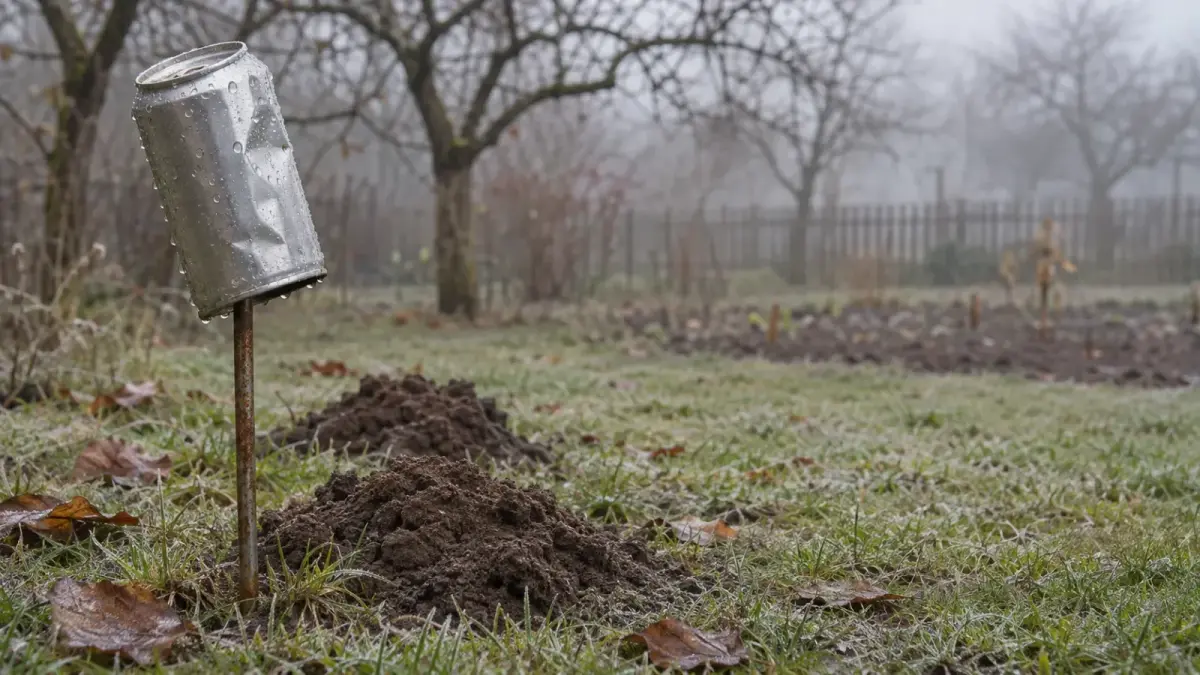
An empty beer can stuck on a stick or metal rod in the garden is not a random decoration or a leftover from a barbecue. It’s a homemade repellent for moles, voles, and birds: when the wind blows, the can spins, taps against the rod, and reflects light, according to Trojmiasto.pl.
The can must be empty and sit loosely on the rod. Then even a gentle breeze will set it swaying, and the metal rod transmits the vibrations into the ground, straight to the underground tunnels. Moles and voles have poor eyesight but are highly sensitive to sounds and ground vibrations, so the constant noise should discourage them from digging tunnels nearby.
If, on the other hand, the tin can is hung higher—above strawberries or cherries—it is intended to deter starlings and other birds, which are scared off by the glint of aluminum and the rustling sound. It is recommended to place these structures near fresh molehills and areas of sunken lawn. This should be done with caution if there are children or animals in the garden, as the sharp edges of the tin can cause injury.
The effectiveness of this method is inconsistent: within a few weeks, moles get used to the sound and return. Therefore, it is recommended to reposition the rod from time to time.
Experts recommend traps
Scientists are skeptical of such methods. Drew Ricketts, a wildlife expert at Kansas State University, points out that homeowners have tried to combat moles with chewing gum, noise-making devices, windmills, broken glass, bleach, and even human hair. However, none of these methods has produced consistent results, and traps remain the most effective tool, according to K-State Research and Extension.
“There are three types of traps: harpoon, snare, and snap traps. Each can be effective, but it may take some time to master them,” Ricketts notes.
The expert advises first identifying active burrows. To do this, pierce several tunnels and check after 24 hours to see which ones the animals have repaired. If the trap hasn’t caught anything in three days, it should be moved.
Birds get used to them, too
A similar problem arises with bird deterrents. Bird behavior expert Susan Friedman explains that birds are wary of new objects but quickly realize that a scarecrow poses no threat to them. Depending on the species, this can take anywhere from a few days to a few weeks, according to Popular Science.
“Often, it only takes one brave little bird to lead the way for the others,” Friedman emphasizes.
Movement and noise can indeed enhance the effect, acknowledges avian behavior specialist Julia Ponder. However, even the most ingenious solutions, she says, only provide a few extra days free of uninvited guests.