
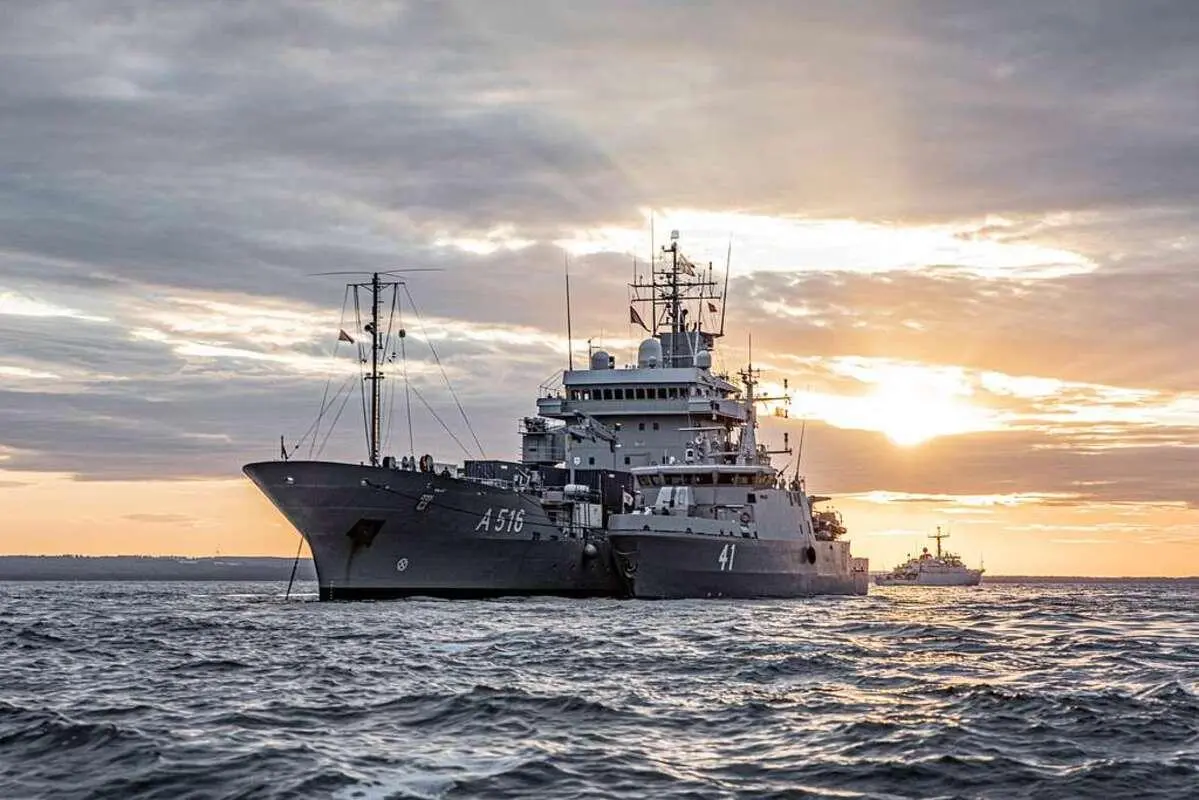
A bulbous protrusion on the underwater section of a warship’s bow reduces wave resistance and can cut overall fuel consumption by 12–15%. At the same time, it serves as a protected fairing for sonar systems that detect enemy submarines, according to WION.
A moving ship generates a powerful bow wave in front of it, which creates significant hydrodynamic drag. The bulb forms its own wave slightly ahead of the hull, and the two waves cancel each other out. For large fleets, such a simple change to the hull shape translates into significant fuel savings and greater cruising range.
Placing the sonar inside the bulbous bow positions the sensitive acoustic equipment far forward, away from the noise of the ship’s own propellers. Additionally, the sensors remain fully submerged below surface waves, so operators are not hindered by surface interference. The additional volume in the bow also improves buoyancy and reduces keel roll during storms, allowing for safer use of weapons and helicopter launches.
A Longer Bow Isn’t Always Better
Ship designers for whom sonar is critical must strike a balance between cost-effectiveness and acoustic signal quality. Naval architect Inno Gatin of Cloud Towing Tank, the company that optimized the hull of a research vessel over 100 meters long, acknowledges that the bulb itself increases drag.
“But the point is that you get it back, because bulbous bows create their own wave field that interacts with the one generated by the ship’s bow. This creates what’s known as ‘destructive wave interference,’ and as a result, the wave pattern becomes smaller,” notes Gatin.
Although tests showed a decrease in drag as the bulb’s length increased, it had to be shortened. The customer’s main requirement was a bow shape that produces as little foam as possible: air in the water reflects the sonar signal. In addition, the bulb cannot protrude beyond the highest point of the stem, since in the event of a collision, the above-water section must make contact first.
“If you have higher drag, your propeller has to spin faster, which means the propulsion system generates more noise,” warns Gatin. According to him, this is critically important for a research vessel, as the onboard equipment requires very quiet operation. As a result, thanks to a smaller but more efficient bulbous bow and a redesign of the stern, the ship’s hydrodynamic efficiency was increased by 16%, writes the Maritime Journal.
From Battleships to Machine Learning
Bulbous bows were first installed on U.S. Navy battleships in the early 20th century, following experiments by engineer Taylor. Today, their shape is determined using machine learning: researchers who optimized the bulb on the DTMB5415 model achieved a 4.95% reduction in drag. At the same time, scientists note that at low speeds, the bulb can be counterproductive, as viscous drag predominates, according to an article in the journal Applied Sciences (MDPI).