
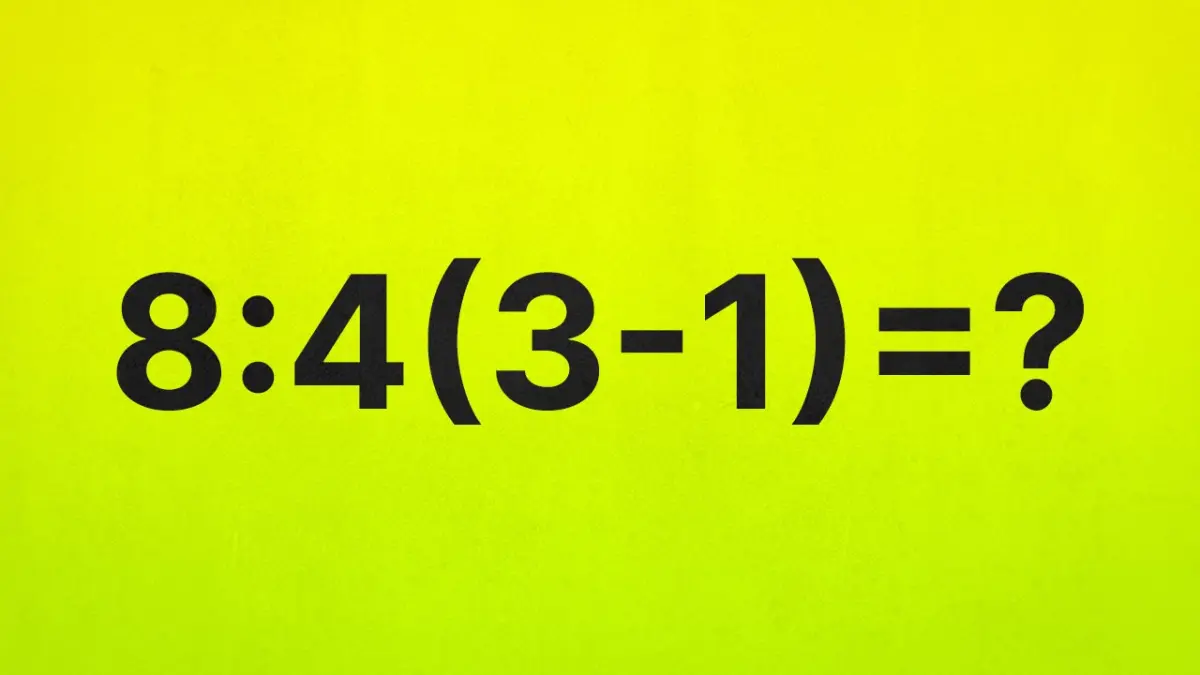
The correct answer to problem 8:4(3-1) is 4, although many readers tend to think the answer is 1. This solution, in accordance with the school rule of order of operations, is suggested by a Hungarian puzzle website, where readers were asked to choose one of three options: 1, 4, or 8, according to Keresztlabda.
First, the operation in parentheses is performed: 3 – 1 = 2. Next, add the missing multiplication sign, and the expression becomes 8 : 4 · 2. Multiplication and division have the same precedence, so they are performed from left to right: 8 : 4 = 2, and then 2 · 2 = 4.
The puzzle’s creators see the trap in answer 1. Without the multiplication sign, the expression 4(3 – 1) can easily be interpreted as a single unit: then 4 × 2 = 8, and 8 ÷ 8 = 1. The number 8 among the options is only an intermediate result—the product of 4 and 2.
According to the school rule, an omitted multiplication sign does not change the order of operations. However, some authors and certain calculator models treat implicit multiplication as having higher priority than division, resulting in 8 : (4 · 2) = 1. In the editors’ opinion, this is a genuine ambiguity of linear notation: both interpretations are valid, and the choice between them rests with the author of the problem. The expression becomes unambiguous only when written as a fraction or with parentheses.
A controversy that has already taken the internet by storm
A similar problem, 8 ÷ 2(2+2), went viral in 2019 and sparked heated debates even among math teachers. Some got 1, others got 16. In the U.S., this confusion is partly attributed to the PEMDAS mnemonic: it supposedly prioritizes multiplication over division, even though these operations are actually equal in priority, according to Education Week.
Some educators insisted at the time that the only correct answer was 16. Others argued that mathematical symbols are conventions, and expressions in the language of mathematics—just like in everyday language—are sometimes written ambiguously. Hannah Fry, a professor at University College London, compared such an expression to a phrase that can be interpreted in two ways.
Stephen Strogan, a professor of mathematics at Cornell University, also expressed his position on such notations.
“No professional mathematician would ever write something so obviously ambiguous. We would have added parentheses to clarify our intent and indicate whether division or multiplication should come first,” Strogatz wrote in The New York Times.
Some educators drew a practical lesson from this story: teachers should formulate problems clearly and, at the same time, teach students to write mathematical expressions just as clearly.