
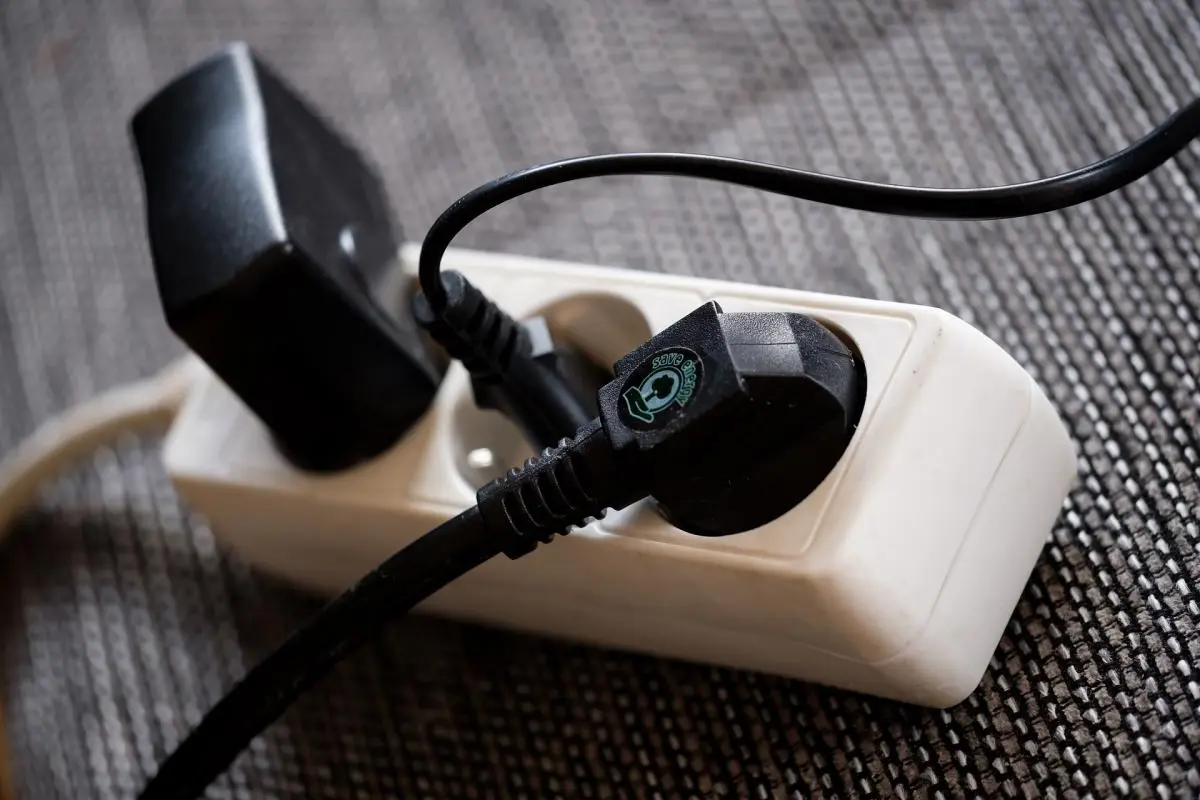
Electricians warn: Anything that heats up, has a motor, or draws more than 1,000 watts should be plugged directly into an outlet, not into an extension cord. According to their data, more than 3,300 residential fires in the U.S. each year are caused by extension cords and power strips, and many of these are due to overloading—a mistake nearly every family makes, reports The Coolist.
The most dangerous items on this list are space heaters. They continuously draw about 1,500 watts for hours on end, causing the extension cord’s thin internal contacts to overheat. Microwave ovens, toasters, coffee makers, and air fryers consume between 800 and 1,800 watts at peak times. A typical extension cord is rated for approximately 1,875 watts, so a single appliance like this can exhaust its entire capacity.
It is also recommended to plug refrigerators and freezers into the outlet, as their compressors start up with current surges. The same applies to washing machines, dryers, and dishwashers, as well as portable air conditioners, hair dryers, irons, and curling irons.
A Common Mistake Noted by Experts
Dan DiClerico, director of the Home Improvement & Outdoor lab at the Good Housekeeping Institute, explains what experts most often encounter when it comes to the safety of household appliances, according to Good Housekeeping.
“The biggest mistake we see is people plugging high-wattage appliances into an extension cord. Overloading an extension cord is a serious fire hazard. A space heater is probably the most common example. They should always be plugged directly into an outlet,” DiClerico emphasizes.
Another bad habit is daisy-chaining multiple extension cords together. “Connecting extension cords in series also overloads the circuit, increasing the risk of fire in your home,” the expert warns.
How to Check an Extension Cord in a Minute
Electricians recommend adding up the power ratings of all connected devices and ensuring that the total is significantly lower than the extension cord’s rated power, which is indicated on its underside. If, after a night of use, the extension cord is warm, smells like plastic, has a scorched outlet, or the light flickers when you turn on appliances, it should be replaced. It’s also worth choosing models with UL or ETL certification and a built-in fuse.
Official statistics illustrate the scale of the problem. In 2021, U.S. fire departments recorded approximately 24,200 residential fires caused by electrical issues. These fires claimed 295 lives, injured 900 people, and caused over $1.2 billion in property damage. The U.S. Fire Administration recommends plugging large household appliances directly into an outlet, never using extension cords for them, and choosing surge protectors with overload protection, according to the USFA.