
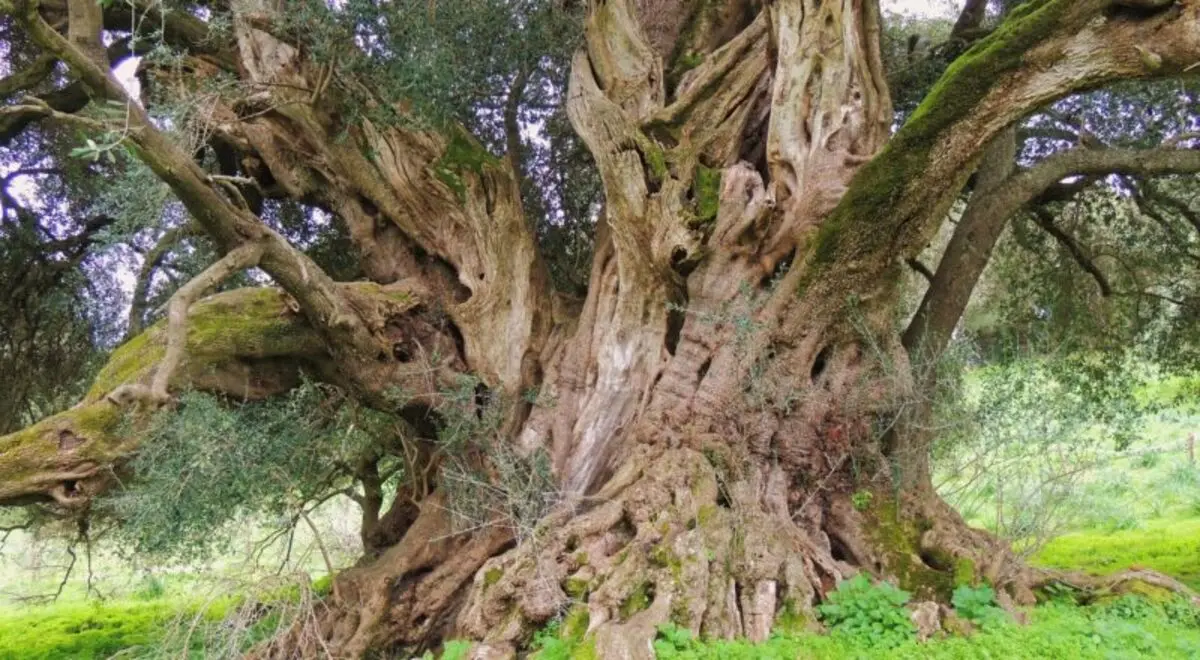
In Sardinia, in the municipality of Luras, the wild olive tree known as S'Ozzastru—estimated to be 3,000 to 4,000 years old—still grows and bears fruit. This tree may have sprouted as far back as the Bronze Age, long before the founding of Rome, and is currently considered one of the oldest living trees in Europe, according to Science et Vie.
The olive tree grows in the Santu-Baltolu-di-Carana area in the Gallura region, not far from Lake Liscia. The circumference of its trunk exceeds 11 meters, so it takes six adults holding hands to encircle it. The crown rises 14 meters high.
Over the centuries, the tree’s core has rotted, forming a large hollow inside. However, the dead wood still supports the structure, the leaves remain green, and the olive tree bears fruit every year. Scientists attribute this longevity to the wild olive tree’s ability to regenerate tissue: when part of the trunk dies, new layers form around it.
An Age That Cannot Be Determined
It has not yet been possible to accurately date S’Ozzastru. The growth rings disappeared along with the old wood, so experts estimate its age by comparing the tree’s structure and dimensions with those of other specimens.
The oldest tree in Europe, whose age has been scientifically verified, is a 1,230-year-old pine in a national park in southern Italy. The Sardinian olive tree is estimated to be approximately 3,800 years old, meaning it could be three times older. A younger wild olive tree, about 2,500 years old, grows nearby. The older tree is fenced off to prevent visitors from grabbing its branches, notes Atlas Obscura.
The Patriarch Under Protection
Locals call the olive tree the “Patriarch.” In 2023, it was named Italy’s Tree of the Year. To preserve this natural landmark, tourists are allowed to walk only on designated trails. It is also forbidden to climb the trunk or step on the roots protruding from the ground.
Its estimated age of 3,000–4,000 years is based on research conducted by the University of Sassari. Back in 1991, the tree was declared a national monument and a natural monument, and was later added to the list of Italy’s twenty ancient trees, which are protected by ministerial decree. In 2024, the olive tree took third place in the “European Tree of the Year” competition, according to elDiario.es.