
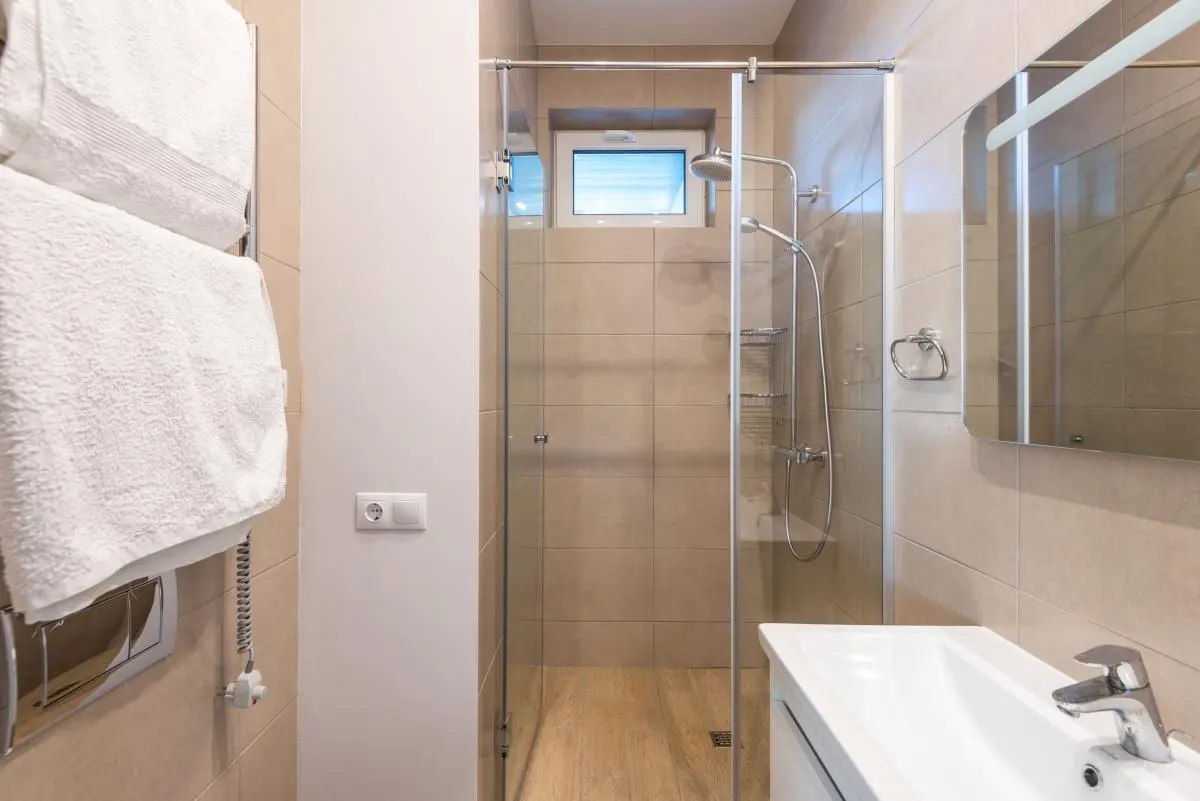
Completely transparent glass partitions are gradually losing their status as the only trendy option for showers. Designers are increasingly opting for frosted, tinted, or patterned glass, as well as half-walls and curtains that shield against prying eyes, according to CHIP.
That said, clear glass isn’t going away. It remains a practical choice for small and dark bathrooms because it lets light through and doesn’t create a visual barrier. However, the options are no longer limited to clear or frosted glass.
Spanish interior designer Carla Iglesias Vázquez attributes this trend to changes in the size and purpose of bathrooms.
“On the one hand, the space we allocate to bathrooms is getting larger and larger. Thanks to this, we can create separate zones—for example, a separate toilet area, a larger shower, or a sink area. Sometimes we can even integrate part of a walk-in closet and combine it with the bathroom,” she told the Spanish magazine Arquitectura y Diseño.
According to her, when the square footage allows, separate areas can be more clearly defined without making the room feel cramped.
Etched glass and patterns from the past
Among the alternatives, designers mention ribbed, smoked, etched, and colored glass; glass with prints or embedded fabric; as well as “cathedral” glass with an uneven surface. Many people remember the latter from interior doors in older apartments. It was long removed during renovations, but now it’s making a comeback in modern interiors—and no longer just as a retro element.
Iglesias Vázquez particularly appreciates ribbed and tinted glass, as well as options with fabric inserts. According to her, unique profiles or colored frames give the design a more distinctive look. Another solution is a low partition with glass on top. It provides privacy without blocking natural light, hides the faucets, and can serve as a shelf. Plus, the entire shower isn’t visible from the doorway.
A curtain instead of glass, but with a lining
Shower curtains are making a comeback. A British magazine surveyed designers, and the majority chose a curtain for a shower over a bathtub. This isn’t a standard model, but a custom-made fabric product, writes House & Garden.
Designer Lonika Chande, whose clients mostly prefer the softness of this solution, sees considerable decorative potential in it.
“It’s an opportunity to add fabric—and perhaps color—to what is usually a rather utilitarian space in the home. You can get quite creative with a curtain, using contrasting trims or lining fabrics,” says Chande.
To ensure the curtain lasts a long time, a water-repellent liner is hung inside the tub, while the decorative cotton curtain is hung on the outside. The liner is replaced as soon as it wears out or mold appears on it.
Timely replacement is important. American microbiologists studied vinyl shower curtains and discovered that the film, commonly thought to be soap scum, is actually a biofilm of microorganisms. These include members of the genera Sphingomonas and Methylobacterium, which contain opportunistic pathogens. Scientists recommend washing or discarding such curtains more often, especially in households where people with weakened immune systems live, according to a study on PubMed Central.