
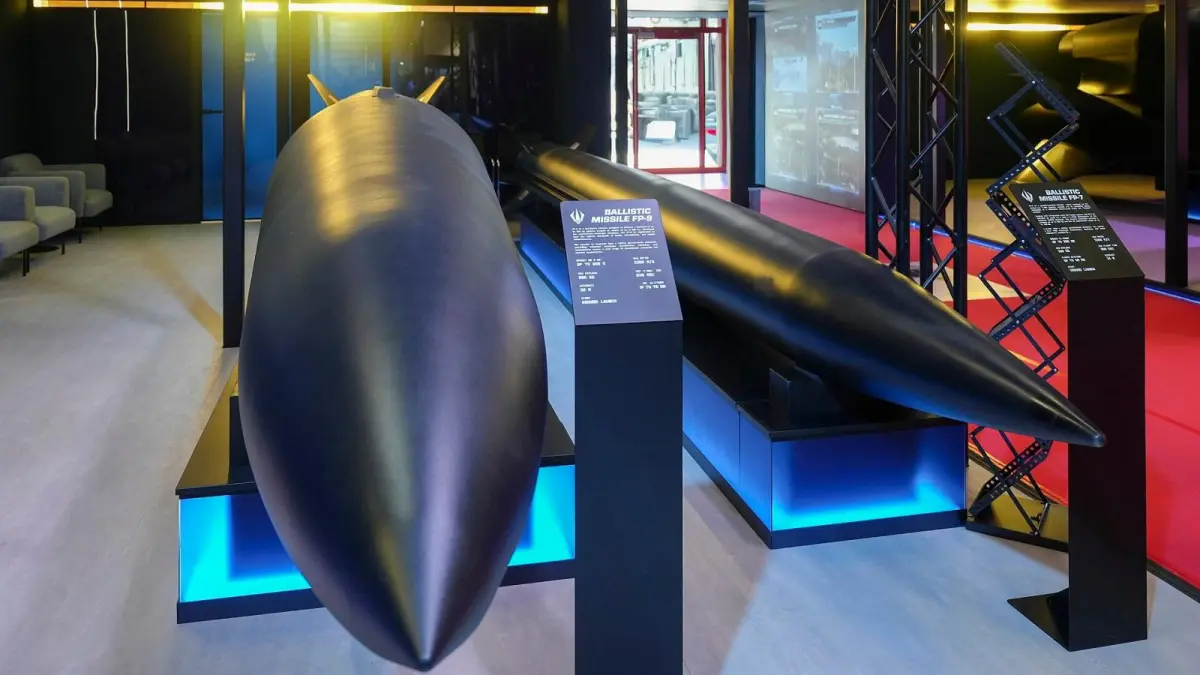
The Ukrainian company Fire Point has released range maps for two new ballistic missiles, the FP-7 and FP-9, and explained the difference between them. For the first time since the war began, Ukraine’s own ballistic capabilities allow it to independently strike targets deep inside Russian territory without Western permission to use supplied weapons, Interia reports.
The FP-7 is a tactical missile with a range of up to 250 kilometers and a warhead weighing up to 200 kilograms. Its purpose is to strike Russian bases and facilities immediately behind the front lines, from where the enemy supplies its troops with ammunition, equipment, and reinforcements.
This includes, in particular, Iskander launchers, Geran drone launch bases, and airfields used by Russian bomber and fighter aircraft. Bryansk, Voronezh, and Rostov-on-Don are within the FP-7’s range. Ukraine has already deployed this missile in combat and plans to use it on a much larger scale in the near future.
The FP-9 can reach beyond Moscow
A significantly more powerful weapon is the FP-9, designed for strategic-level missions. Its range reaches 850 kilometers, and its warhead weighs up to 800 kilograms. The missile is designed to strike military infrastructure hundreds of kilometers from the front lines, which provides logistical support for troops across multiple fronts.
According to Fire Point maps, Smolensk, Yaroslavl, Nizhny Novgorod, and the entire Krasnodar Krai fall within the FP-9’s range. Potential targets include defense industries, as well as ports on the Black and Azov Seas. The FP-9 has not yet seen combat, but according to the company, this is expected in the coming weeks as work on the system is nearing completion.
Until now, Ukraine has relied primarily on drones or Western missiles for strikes deep into Russia, the use of which has been limited by political constraints. Ukrainian experts are convinced that 2027 will see the most intense exchange of ballistic strikes since the start of the full-scale invasion.
Why Missiles Are More Complex Than Drones
As early as the beginning of 2025, Western analysts were skeptical of Ukraine’s missile ambitions. Unlike drones, which can be assembled in small workshops using commercial components, the engines, guidance systems, and fuel for conventional missiles require large-scale, stationary production facilities and high-precision engineering, as The Kyiv Independent notes.
Michael Duitsman, a rocket technology expert at the Middlebury Institute, considered the main obstacle to be not a lack of Ukrainian technological expertise, but Russian strikes on facilities well known to the enemy. “Once you’ve established the basic industrial infrastructure—which isn’t that difficult—it just becomes immeasurably harder when someone tries to bomb all your factories,” Duitsman emphasized.