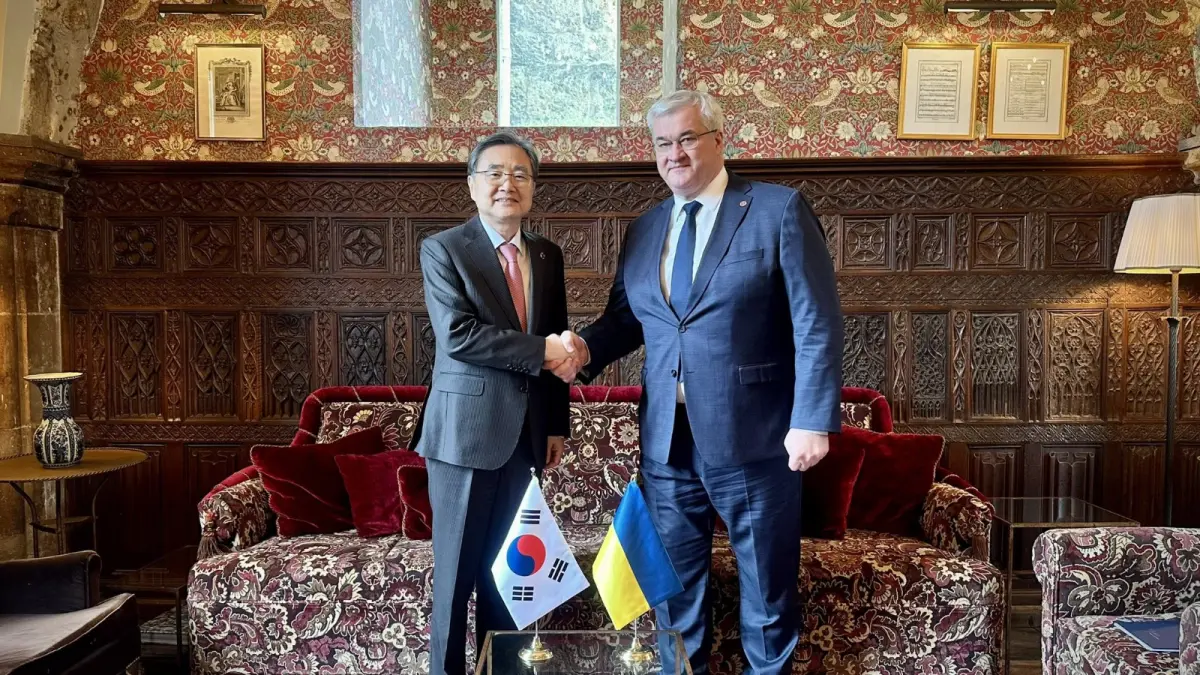
South Korea has recalled eight diplomatic staff members from Ukraine. The reason is a dispute over the disclosure of information regarding the transfer of two prisoners of war from North Korea to Seoul. South Korean Foreign Minister Cho Hyun explained this decision by stating that Kyiv had not taken appropriate measures to resolve the situation, as well as due to the constant threat of Russian airstrikes, according to “Slovo i Sprava.”
Seoul is demanding official explanations, an apology, and guarantees from Ukraine that such an incident will not happen again. Cho Hyun warned that further escalation could jeopardize diplomatic relations between the two countries.
Despite the tough demands, the South Korean side is not ruling out dialogue at the foreign ministry level. Seoul promises to continue providing humanitarian aid to Ukraine and participating in the country’s reconstruction.
“I have continued my communication with the Ukrainian foreign minister to resolve this issue as quickly as possible,” Cho Hyun said.
Earlier, South Korean President Lee Jae-myung criticized Ukrainian President Volodymyr Zelenskyy for his public statement regarding the transfer of prisoners of war. According to Lee, “it is wrong to criticize a decision to maintain confidentiality if it was reasonable and well-founded.” The Office of the President of Ukraine responded that Kyiv had not committed to remaining silent about this transfer. Following this, the South Korean Ministry of Foreign Affairs summoned the chargé d’affaires of Ukraine.
From the UN Podium to the Recall of the Ambassador
The recall of diplomatic staff was the latest in a series of reciprocal moves that have sharply deteriorated bilateral relations. The day before, on Saturday, South Korea’s ambassador to Ukraine returned to Seoul. The conflict began on September 23, when Zelenskyy told the UN General Assembly that Ukraine had handed over two captured North Korean soldiers to South Korea, according to DW.
Ukrainian forces had captured these soldiers in Russia’s Kursk region in January 2025, where they were fighting alongside Russian troops. Seoul insists that the parties had agreed to keep their handover—which took place in mid-September—confidential. Kyiv denied the existence of such an agreement. South Korea subsequently accused Ukraine of lying and demanded a public apology, but Kyiv limited itself to attempts to defuse the situation, calling it a “diplomatic misunderstanding.”
Last week, reports emerged that one of Zelenskyy’s close advisers had stated that more than 176,000 metric tons of diesel fuel and other energy resources had been shipped to Russia from South Korean ports in July and August. This would constitute a violation of international sanctions. Lee Jae-myung’s office rejected these allegations and, two days later, recalled its ambassador from Kyiv.
In his address to the UN, Zelenskyy mentioned the prisoners of war in the context of a broader issue—North Korea’s participation in the war on Russia’s side. He stated that Kim Jong-un uses his soldiers “as currency” and receives something in return, and that North Korea’s neighbors may have already noticed its advanced ballistic missiles and significantly expanded capabilities in the field of drones. The president specifically emphasized that one of the transferred prisoners had attempted to take his own life, according to the official website of the President of Ukraine.
“This is how people are raised in the North. Their freedom is taken away from them. Their right to choose is taken away from them. And they are drilled to believe that they must die at any cost. Do you really want to give such a force more time to learn how to fight?” Zelenskyy asked the participants of the General Assembly.
Why did Seoul insist on secrecy, and what was Kyiv hoping to achieve?
Erwin Tan, a professor of international politics at Hankuk University, cites several reasons why Seoul insisted on keeping the agreement confidential. One of them is related to domestic politics: for the left wing of the Korean political establishment, to which Lee Jae-myung belongs, rapprochement with North Korea has traditionally been a priority.
“The first reason was that revealing the fact that the prisoners had been repatriated to South Korea would have led to Pyongyang taking revenge on the families of these men for their surrender. Seoul also wanted to maintain a channel of communication with Pyongyang,” Tang said.
Kim Tae-joong, a board member of the Peace Foundation and former politician Kim Sang-woo, points out another aspect. In his view, Moscow and Pyongyang would have found out about the transfer sooner or later anyway. At the same time, President Lee himself is being criticized domestically for weakness, while Kim was surprised by how quickly the situation escalated.
“There is criticism that the Lee administration is effectively appeasing the North, that it has become too soft, and this is a very alarming situation. I think Lee was very angry that he was publicly accused of lying about the deal, and this quickly escalated into a very complicated standoff,” Kim notes.
Kim also suggests that Zelenskyy’s statement may have been a calculated move. Kyiv could have exchanged the North Koreans for its prisoners held in Russia, but instead complied with Seoul’s request, hoping for additional financial—and possibly military—support. However, according to the expert, this calculation backfired on Ukraine.
Victor Cha, president of the Geopolitics and Foreign Policy Department at the Center for Strategic and International Studies (CSIS), points out a curious detail: the expected reaction from Pyongyang never materialized. The DPRK has yet to comment on the issue of the prisoners. Cha does not rule out the possibility that the Lee administration warned the North in advance about the handover, hoping that Pyongyang’s silence would help resume inter-Korean dialogue. This, according to the expert, may explain the extent of Seoul’s outrage, writes CSIS.
Cha considers the simplest explanation—that Zelenskyy was unaware of an agreement reached at lower levels of government or the military—to be unlikely. He considers the theory of a psychological operation against North Korea to be more plausible. Its goal is to hint that Ukraine could hand over other North Koreans currently in its custody to Seoul. According to Cha, this is perhaps the only leverage available to reduce the flow of fighters to Russia.
“For Pyongyang, a dead North Korean soldier is better than one who has been taken prisoner,” Cha believes.
According to CSIS, since late 2024, North Korea has sent up to 25,000 troops to fight for Russia. Another 12,000 to 25,000 North Koreans are working in Russia, particularly in drone manufacturing plants. In exchange for supplying troops, ammunition, missiles, and labor, Pyongyang could have received up to $14 billion—more than half of the country’s annual GDP. Seoul’s position is further complicated by the war with Iran: due to risks to energy supplies through the Strait of Hormuz, South Korea may seek agreements with Russia.
Despite the intensity of the conflict, Erwin Tan does not consider a prolonged rift between the countries to be inevitable.
“Given the heated nature of the mutual accusations, both sides will likely continue to exchange recriminations in the near future, but I doubt this will escalate into a long-term feud. I expect that once the hype dies down and the press moves on to the next story, both sides will quietly resume contact based on mutual pragmatism,” Tan predicts.