
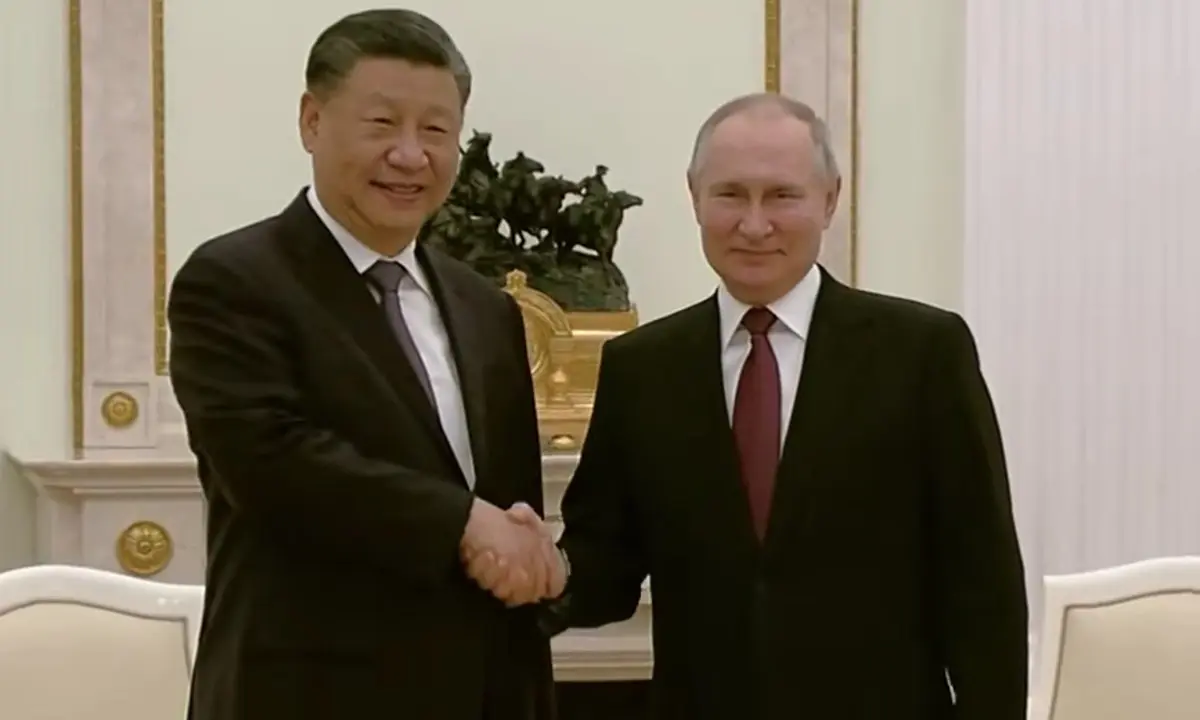
Chinese leader Xi Jinping did not go to Shenzhen Airport to meet Vladimir Putin, who had arrived for the APEC summit. The Russian president was received by Cai Qi, a member of the Politburo of the Communist Party of China and fifth in the PRC’s highest hierarchy. Meanwhile, Xi personally met Donald Trump at the aircraft steps, according to Onet.
The Asia-Pacific Economic Cooperation (APEC) summit began on November 18. A meeting between Putin, Trump, and Xi was scheduled for the second day. According to the publication’s source, it was Putin himself who proposed such a meeting. Pro-Russian media had previously dubbed it the “new Yalta,” comparing it to the 1945 talks between Stalin, Churchill, and Roosevelt.
The difference in protocol was also evident when the leaders entered the hall. As Trump entered, the orchestra played the U.S. national anthem. There was no anthem for Putin: instead, a passage from the ballet “The Nutcracker” was played.
In the group photo, Xi and Trump stood side by side, while Putin was positioned separately. The two leaders themselves indicated to the Russian president where he should stand.
At the gala banquet, Putin and Trump sat at different tables, so they were unable to speak with each other. Russian Presidential Aide Yuri Ushakov expressed regret over this and hoped they would be able to talk the following day. In the end, the leaders did meet on Thursday.
Symbols Instead of Agreements
Analysts doubt that the trilateral format will yield any real agreements. In their view, the significance of the meeting lies more in its symbolism than in concrete decisions, writes The Independent.
Kevork Oskanyan, a Russia expert at the University of Exeter, believes that agreements on substantive issues are unlikely because they require lengthy preparation. Most likely, the parties will limit themselves to vague, general statements of intent.
The expert also assessed the participants’ motives. Each of the three leaders, despite their own weaknesses, stands to gain something from this meeting.
“For Putin, this bolsters his claims to great-power status and diverts attention from the quagmire of his Ukrainian adventure. For President Xi, it creates the appearance that China is shaping the world order on an equal footing with the United States,” Oskanyan emphasizes.
For Trump, according to the analyst, the meeting provides a stage to play the role of “deal-maker” following the Republicans’ defeat in the midterm elections. Even before the talks began, Russian state media called the summit a “diplomatic victory.” At the same time, Moscow still refuses to agree to a complete ceasefire in Ukraine.
Oskanyan considers comparisons to Yalta to be overly alarmist. He points out that the participants are not allies with a common goal and do not control any “spoils” that they could divide.
“Russia has not conquered Ukraine—far from it; Trump is coming to this meeting with a hostile Congress that holds the purse strings; despite all the talk of a ‘renaissance,’ China faces ever-greater economic and demographic challenges. And a ‘new world order’ isn’t created in a day or two,” the expert asserts.