
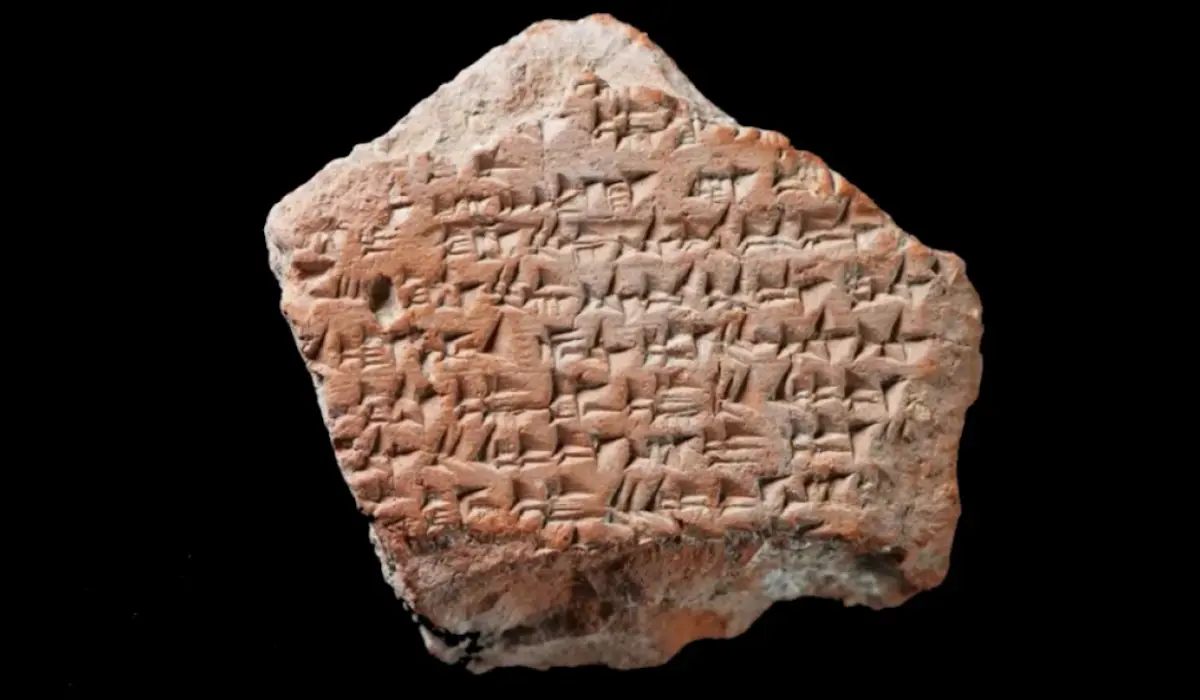
Turkish archaeologists have discovered in Hattusa, the ancient capital of the Hittites, a fragment of a copy of a peace treaty between Pharaoh Ramses II and the Hittite King Hattusili III. This treaty was signed approximately 3,300 years ago and is considered the oldest known peace agreement. The surviving lines describe how the rulers agreed to treat people fleeing from one kingdom to another, according to Antena 3 CNN.
The discovery was announced on September 21, 2026—International Peace Day—by Turkey’s Minister of Culture and Tourism, Mehmet Nuri Ersoy. The clay tablet inscribed with cuneiform was found in the province of Çorum, on a hill where the Hittite royal palace once stood. Experts studied it for about a year and determined that it is a copy of a treaty written in the Akkadian language.
The preserved lines correspond to Articles 12–20 of the treaty. The text has gaps, but the legible passages mention fugitives from both kingdoms and include a provision stating that their homes must not be destroyed.
According to the Turkish ministry, the fragment was discovered near Building “E” at the Büyükkale site. Ersoy called the find a “millennia-old trace of peace” on Anatolian soil and emphasized its relevance today.
“The words stating that people’s homes must not be destroyed carry a powerful message from the depths of millennia to the present day. This valuable discovery, which we shared with the public on September 21, World Peace Day, once again attests to Anatolia’s deep roots in the history of peace and diplomacy,” Ersoy stated, according to the Turkish Ministry of Culture and Tourism.
What the Pharaoh and the Hittite King Promised Each Other
From the complete translation of the treaty, it is known that fugitives were to be returned to the kingdom from which they had fled. It was forbidden to maim them, and their families and homes were to remain untouched. The same obligation to extradite fugitives was imposed on Benteshina, the ruler of the state of Amurru, which lay between the two great powers.
The agreement put an end to the long-standing conflict between the Egyptians and the Hittites. In 1274 B.C., Ramses II fought the Hittite King Muwatalli at Kadesh. Peace was subsequently concluded with Hattusili III around 1269 BCE. This date is used by the authorities in Çorum and the United Nations. In the treaty, both rulers referred to each other as “brothers.”
Some historians date the treaty to 1258 BCE, and the Battle of Kadesh is now considered a draw. The central provision of the treaty reads as follows: “Ramses, the great king, king of the land of Egypt, shall never attack the land of Hatti to seize a part (of that land). And Hattusili, the great king, king of the land of Hatti, will never attack the land of Egypt to take possession of a part (of that land),” as quoted by the World History Encyclopedia.
A Puzzle That Has Yet to Be Solved
Originally, the treaty was engraved on silver tablets, but they have never been found. Hieroglyphic copies on the walls of temples have survived in Egypt. The first Akkadian fragments from Hattusa were discovered during excavations in 1906–1912, and they are now housed in museums in Istanbul, Ankara, Berlin, and St. Petersburg. A copper replica of the tablet, which Turkey presented to the UN in 1970, is on display at the organization’s headquarters in New York, next to the Security Council chamber.
Excavations at Büyükkale are ongoing, and archaeologists hope to find other lost parts of the treaty. The ministry has not yet released a transcription or translation of the new fragment, so scholars outside the research team cannot compare it with known versions of the text.