
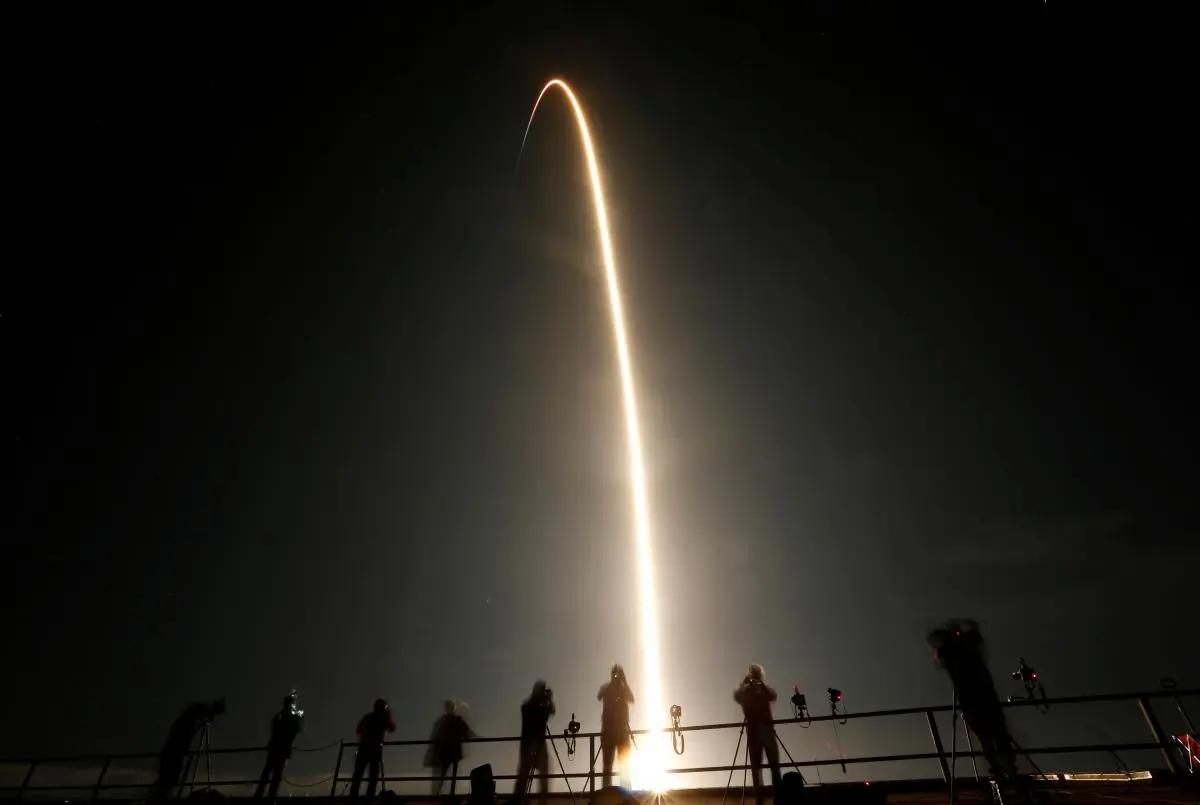
The launch of NASA's Artemis II lunar mission in April 2026 created a "hole" in Earth's ionosphere about 5,000 km long and caused GPS navigation errors of several meters. This is the conclusion reached by researchers from Taiwan, according to HVG.
Scientists from National Cheng Kung University analyzed data from more than 3,500 ground stations in the U.S. that receive signals from GPS, GLONASS, and Galileo satellites. The rocket launch triggered three so-called traveling ionospheric disturbances, which were powerful enough to cause navigation receivers to show deviations of several meters. The study’s results were published on the ESS Open Archive platform.
According to the researchers, these disturbances were the most extensive of any recorded following rocket launches. They were up to ten times more intense than those following SpaceX’s Starship test flights, even though the Starship has twice the launch thrust of the SLS rocket, according to Space.com.
Why a “hole in the sky” is dangerous on the roads
Navigation system satellites orbit at an altitude of about 20,200 km, so their signal passes through the ionosphere. When the concentration of free electrons in the ionosphere changes, the signal reaches Earth faster or slower, causing the receiver to miscalculate the coordinates. A rocket traveling at supersonic speeds creates a shock wave that literally punches a hole in the electrically charged layer of the atmosphere. Unlike solar storms, which disrupt GPS for days, this effect is short-lived.
Study co-author Charles Lin, a professor of Earth sciences, warns that the consequences of such disturbances could be significant for modern technologies that rely on precise coordinates.
“Positioning errors of a few meters are enough for a self-driving car to change lanes. This could have a major impact not only on self-driving cars but also on drone navigation,” Lin said.
The upper stage left the most noticeable mark
Researchers recorded two large “craters.” The first was left by the 65-meter-long central stage of the SLS, while the second was formed by two engine firings of the upper stage at an altitude of about 185 km. These maneuvers took place more than an hour after launch and sent the Orion capsule toward the Moon. Both trails stretched across the American continent from east to west for approximately 5,000 km. Despite the upper stage’s lower thrust, the disturbances caused by its operation directly in the ionosphere turned out to be significantly more noticeable.
Lin is convinced that as space programs continue to develop, this problem will become increasingly significant.
“Rocket launches from Earth into space create this effect, but we’ve never seen such an orbital maneuver during an interplanetary mission. In the future, when we see many more missions to the Moon and Mars, these space weather effects will become much more pronounced,” the scientist noted.
Linn’s team had already observed a similar phenomenon in 2017: at that time, a SpaceX Falcon 9 rocket left a 900-km-long “hole” in the ionosphere.