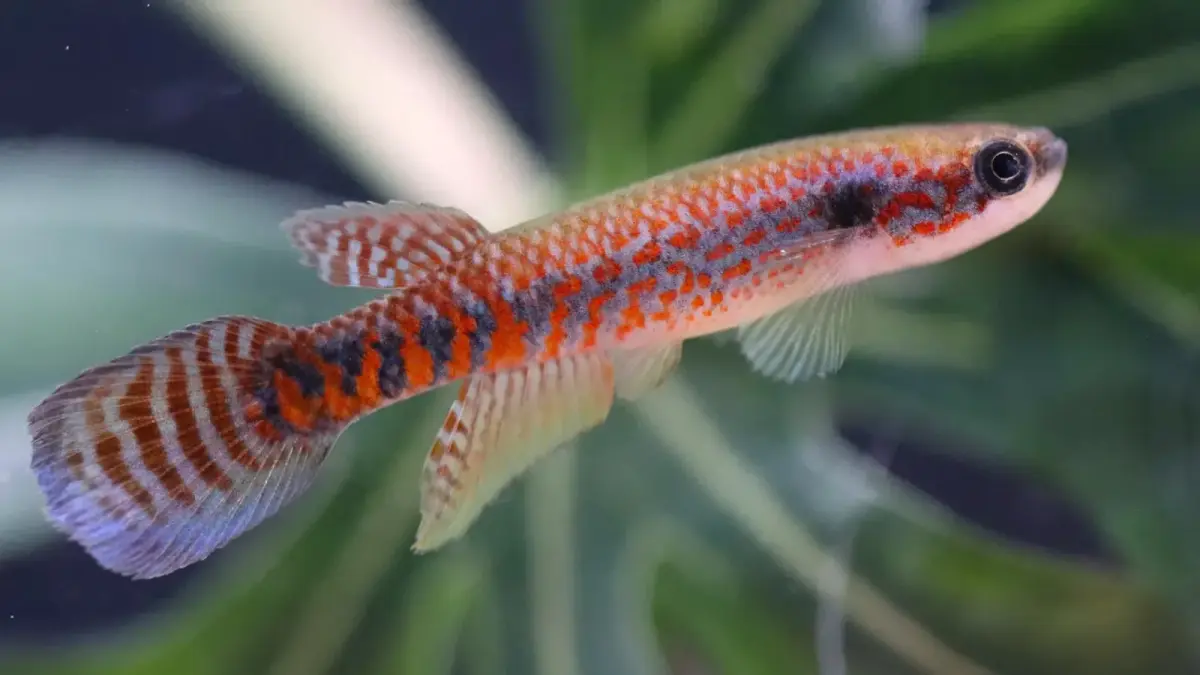
A new species of small fish with bright orange markings has been discovered in the Brazilian Amazon, but scientists warn that it may already be at risk of extinction. The fish has been found in only a few forest ponds, which are threatened by deforestation, mining, and urban development, according to ScienceDaily.
The species has been named Laimosemion laranja and belongs to the killifish, a group of small freshwater fish in the Rivulidae family. It measures no more than three centimeters in length. Males have rows of bright orange spots along the front half of their light gray bodies, which give way to orange chevron stripes toward the tail.
The discovery was made during field research in the Kazhari River basin in southern Amapá state. Scientists from three Brazilian institutions and the University of West Florida were studying how fish in this family adapt to different biomes when they came across these unusually colored specimens. To confirm the species’ novelty, the team compared the fish’s body proportions, number of scales, skeletal structure, and mitochondrial DNA with data from closely related species.
“It was an unexpected moment. At first, what caught our attention most was the striking coloration of the males and females, unlike anything we had previously encountered in the study area. This filled us with awe and great curiosity,” recalls lead author Yuri Abrantes of the Federal University of Rio Grande do Norte.
The Portuguese word “laranja” refers to both the color and the fruit, the orange. The name also honors the municipality of Laranjal do Jari, where the fish was discovered.
A total of 25 square kilometers
So far, the species has been found in only three small forested water bodies near Laranjal do Jari, and each shows signs of human interference. One is located near water that is murky from mining sediments, while another is within the city limits, where the environment is polluted by plastic.
The species’ entire known range is estimated at 25 km². According to the researchers, the fish meets the criteria for the “Endangered” category as defined by the International Union for Conservation of Nature. The team recommends expanding the boundaries of the neighboring Rio-Kajari Extractive Reserve to include its habitats.
The Key to the Mysteries of Aging
The discovery was part of a broader project for which Brazil’s National Council for Scientific and Technological Development allocated approximately $49,000. Scientists are investigating how killifish independently adapted to temporary water bodies. This adaptation is linked to the fish’s short lifespan and the rapid wear and tear on their bodies, according to UWF.
“This work is part of a larger project that may help answer broader questions about which molecular mechanisms lead to a short lifespan and accelerated aging. These questions are relevant to many fields, from the physiology of aging to human health and medicine,” emphasizes study co-author Valdir Miron Berbel-Filiu, an associate professor of biology at the University of West Florida.
The study’s findings were published in the journal *Zoosystematics and Evolution*.