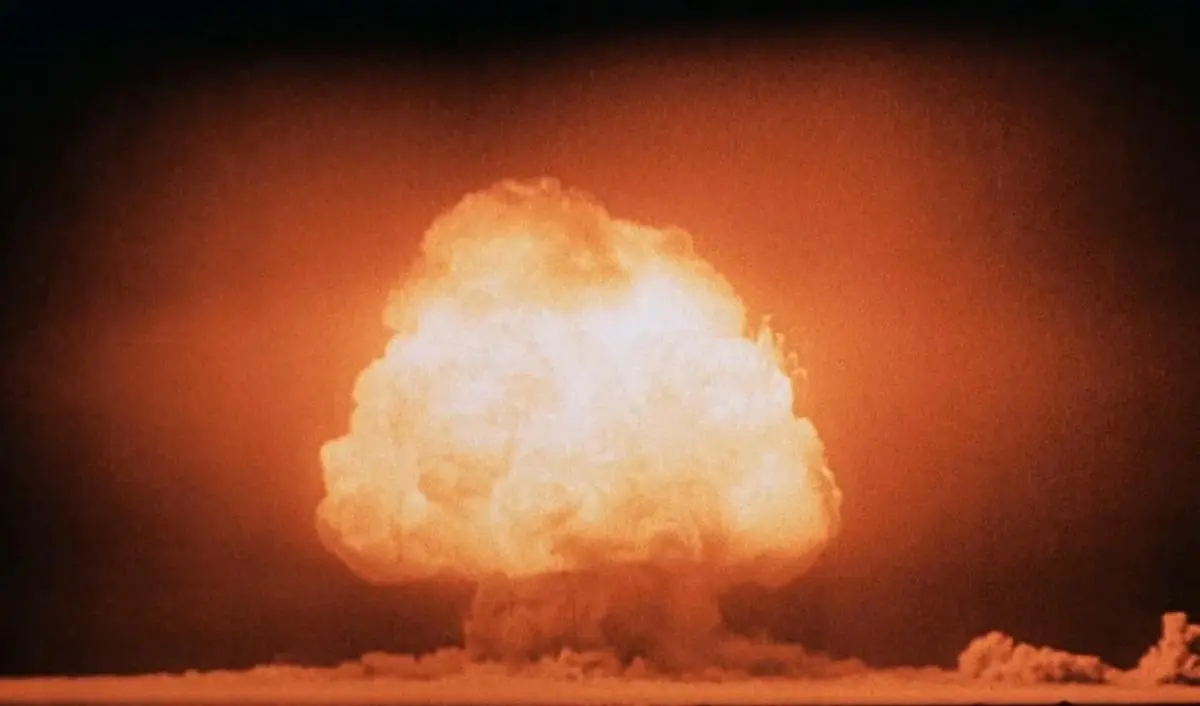
A nuclear explosion near a dangerous asteroid could deflect it away from Earth—or it could prove almost useless. The outcome depends on the shape of the celestial body and the area where the blast is directed. This is the conclusion reached by physicists who simulated the effects of X-ray radiation on real, irregularly shaped asteroids, according to RBC-Ukraine, citing a study in the scientific journal Icarus.
In previous models, asteroids were mostly depicted as perfect spheres to simplify calculations. The new algorithm made it possible to recreate in detail how radiation affects individual sections of bodies with complex topography. Among the simulated objects were the asteroids Bennu, Itokawa, and Golevka.
For one of the test asteroids, the rate of deviation from the trajectory was 3.9 mm/s when struck on one side and only 0.8 mm/s when targeted on the other side. For another object, the post-explosion rotation rate differed by a factor of seven. According to the researchers’ assessment, an incorrectly chosen target can significantly reduce the chances of saving the planet.
The model works with 3D images captured by spacecraft during flybys. It constructs thermal maps of surface vaporization and calculates the impulse, rotation speed, and probability of localized destruction. The goal of such an intervention is to gently nudge the object, not to shatter it into dangerous fragments. However, it is still difficult to precisely aim a charge at a fast-moving asteroid and study its entire surface in advance.
Why the Nuclear Option Hasn’t Been Ruled Out
According to an assessment by the U.S. National Research Council, nuclear charges are the only available technology capable of deflecting large asteroids with a diameter exceeding 500 meters. They can also mitigate collisions with smaller bodies if there is little time for warning. When there are decades left before impact, it is sufficient to alter the object’s velocity by a few millimeters or centimeters per second. The most difficult challenge is to deflect a small object without breaking it apart, according to researchers at Lawrence Livermore National Laboratory in an article published on ScienceDirect.
Nuclear devices release more energy per unit of mass than any other human-made technology, and this is critical for space launches. Previously, Lawrence Livermore National Laboratory physicist Mary Burkey and her colleagues had already developed a model that simulates the effects of X-ray radiation from an explosion on four different asteroid materials.
“We would detonate the device and either deflect the asteroid, keeping it intact, but providing a controlled push away from Earth, or we would shatter it into small, fast-moving fragments that would also fly past the planet,” Burkey noted while commenting on the study in *The Planetary Science Journal*, according to Space.com.
NASA’s Ram and Its Limitations
NASA first tested an alternative method—the kinetic impactor—in September 2022. The DART spacecraft struck the asteroid moon Dimorphos and reduced its orbital period around Didymos by 32 minutes. At the same time, the agency acknowledges that such an impact might be less effective against a denser body than the loose Dimorphos, so other deflection methods need to be tested, NASA emphasizes.