
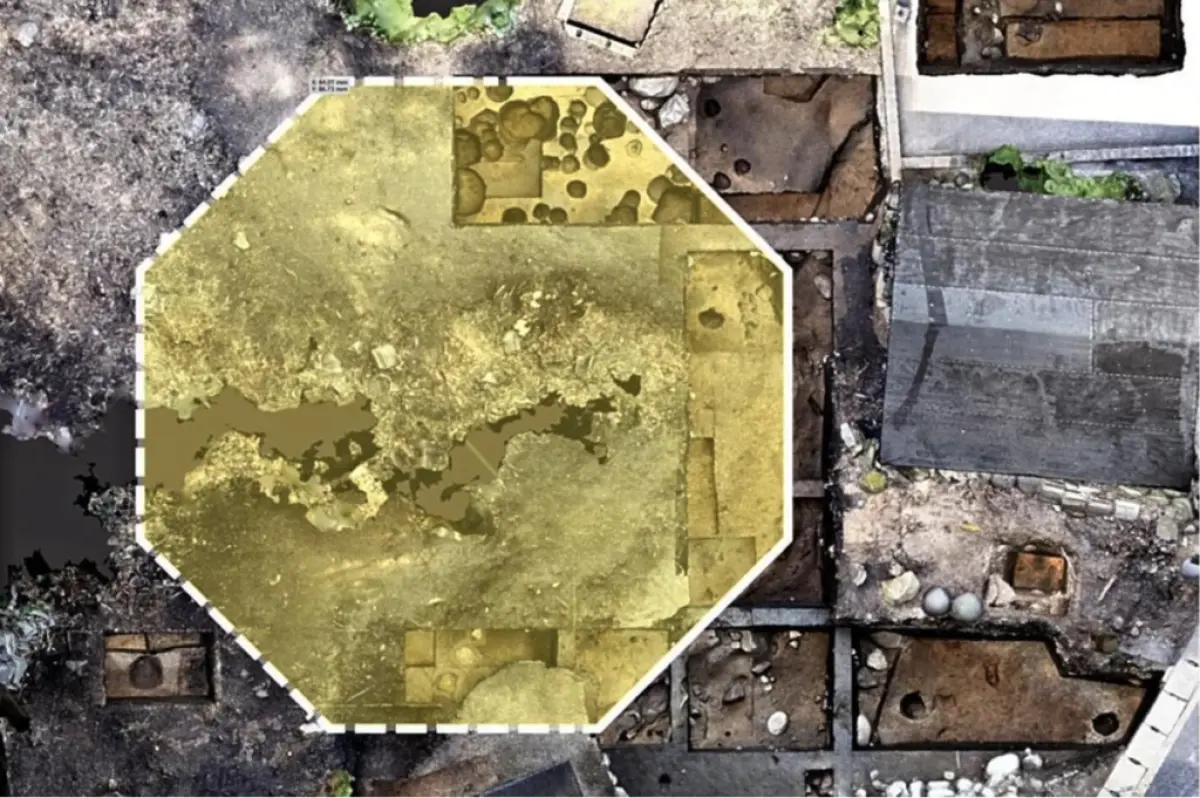
On the island of Kuroshima in southern Japan, archaeologists have discovered the foundation of an unusual octagonal structure, believed to have been built about 900 years ago. Researchers speculate that a Buddhist pagoda or other religious building stood here in the 12th century, according to Arkeonews.
The discovery was made by a team led by Professor Satoshi Nakazono of Kagoshima International University at the Osato archaeological site in the village of Mishima, Kagoshima Prefecture. The distance between opposite corners of the upper part of the foundation is about 8.9 meters; each side measures approximately 3.4 meters, and the wider lower part may have been 10–11 meters across. Rows of stones and traces of scorched earth were found around the foundation. The above-ground portion has not survived, so it is not yet possible to definitively determine the building’s appearance and purpose.
Several factors support the theory that it was a sacred structure. In Japan and China, an octagonal plan was used specifically for Buddhist pagodas and certain temple halls. Furthermore, the building is located in a religiously significant part of the settlement, and roof tiles characteristic of China’s Southern Song Dynasty were found nearby.
Roof tiles that traveled a thousand kilometers across the sea
Kuroshima is the southernmost point in Japan where Song Dynasty roof tiles have been found. Similar specimens are known from Hakata, the main hub of medieval maritime trade between China and Japan, and from Kyushu. In 2015, Nakazono’s team found roof tiles of the same shape in Ningbo, China, and chemical analysis confirmed their origin. The new foundation suggests that this material may have covered the temple’s roof, implying that architectural traditions may also have been adopted from China.
A Japanese television network dates the foundation to the Heian period. Nakazono hopes the discovery will help shed light on the nature of trade between the two countries, according to FNN.
“Thanks to this discovery, we will be able to gain a deeper insight into the nature of trade between Japan and the Song Dynasty. We will be able to investigate aspects that have remained overlooked until now,” Nakazono emphasizes.
An Island on a Maritime Route
Kuroshima lies along the maritime routes of southwestern Japan. The neighboring island of Iojima was famous in the Middle Ages for its sulfur deposits, which were exported to China. Researchers believe that Kuroshima may have played a role in maritime transport between Kyushu, Hakata, and more distant regions. It is not yet known whether Chinese ships ever called at the island.
In the 12th and 13th centuries, Ningbo was the most important port in Sino-Japanese relations and, at the same time, a popular pilgrimage site for Japanese Buddhists. Artisans also traveled from there to Japan: for example, in 1196, stonemasons from Ningbo worked on the reconstruction of the Tōdai-ji Temple in Nara, according to the *Journal of Chinese History*.