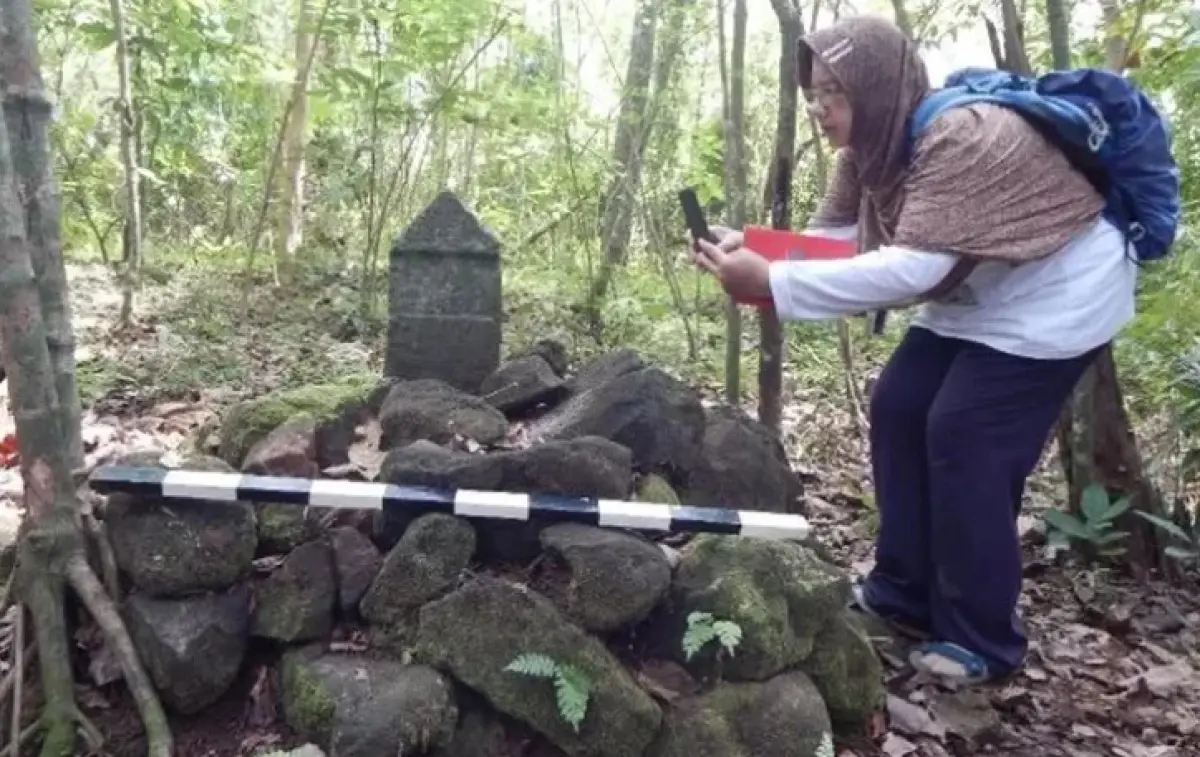
Archaeologists have discovered traces of a complex megalithic landscape on the forested slopes of Mount Tangkil in West Java: four hidden terraces, carved stones, and trade artifacts. The research began earlier this year when Zubair Masud found a fragment of an ancient sculpture in dense undergrowth, according to Inforoom, citing Arkeonews.
The dense vegetation concealed most of the objects, so the researchers used LiDAR technology. Laser scanning revealed landscape anomalies with patterns and stone complexes. According to the researchers, the arrangement of the stones indicates intentional construction.
The stone remains on the slopes of Mount Karan and the menhir in the Tugu settlement indicate that Tangkil was once part of a megalithic network that spanned the entire island of Java. Archaeologists also found fragments of pottery from the 10th to the 20th centuries that show a clear connection to goods from China. This indicates that busy trade routes passed through the region.
The researchers behind the discovery plan to petition the authorities to have the mountain recognized as a cultural heritage site. Tangkil could become Indonesia’s most significant megalithic site, as this landmark offers insights into ancient engineering, ritual landscapes, and regional trade.
A Neighbor with a Scandalous Reputation
The most famous megalithic site in West Java is Gunung Padang. In 2023, it made global headlines when a group of researchers claimed in the journal *Archaeological Prospection* that a pyramid up to 27,000 years old might be hidden beneath it. Many archaeologists were skeptical of this claim. Flint Dibble of Cardiff University acknowledged that the data in the article were legitimate, but he believed the conclusions regarding the site’s age and origin were unfounded. “I’m surprised that [the article] was published in this form,” Dibble said, according to Scientific American.
Subsequently, the journal’s editorial board retracted the article. An investigation revealed that the radiocarbon dates were obtained from samples of natural soil rather than from layers showing evidence of human activity. Archaeologist Lutfi Yondri, who has been excavating Gunung Padang for over thirty years, believes that the oldest structures were built about 2,000 years ago. Charcoal found beneath the retaining wall of the lower terrace is dated to approximately 117 B.C., according to Archaeology Magazine.
Similar stepped temples, known as pundan berundak, were built on Java throughout the 1st and early 2nd millennia CE. Many researchers link their emergence to the prosperity brought by trade along the Maritime Silk Road between India and China.
“Gunung Padang does not stand alone, but, together with other sites, provides insight into the development of the archipelago’s megalithic culture,” emphasizes archaeologist Harry Truman Simandjuntak of the Center for Prehistoric and Austronesian Studies.