
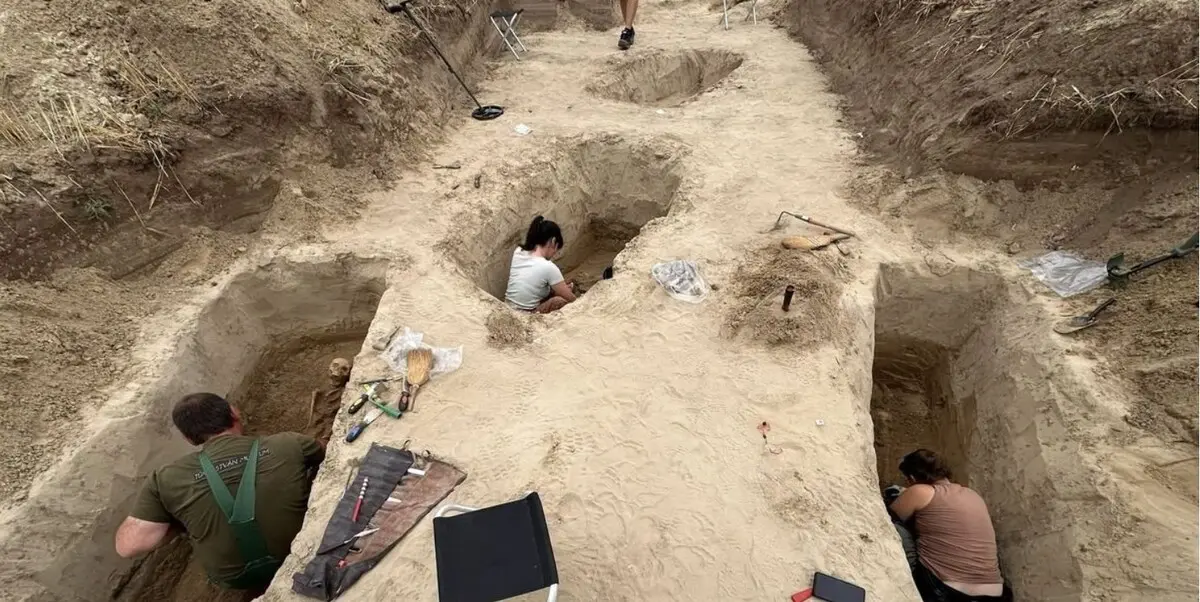
Archaeologists from the King Saint Stephen Museum have discovered an Avar burial ground near the Hungarian village of Szaroshd. Experts have identified more than 30 graves, in which, in addition to human remains, they found impressive burial goods, according to 24.hu.
Test excavations were conducted in the fall prior to the construction of a farm for raising young chickens. As far back as 1959, during the construction of stables for an agricultural cooperative, two Avar graves were discovered here, which were likely destroyed during construction. Even then, archaeologists suspected that the area concealed an Avar cemetery, and the current work has confirmed this.
According to museum archaeologist Veronika Berek, the most notable find is the grave of a nobleman buried during the Middle Avar period, approximately between 650 and 700. Next to his remains lay a gilded silver braid clip and stamped belt ornaments. These items indicate the deceased’s high status and made it possible to date the burial.
Such clips were a characteristic element of Avar attire: they were used to adorn long braids. They were made primarily of gold, silver, or bronze and decorated with various patterns. Other graves in Sharoshd are considerably more modest: simple iron knives and spindle whorls were found in them.
A people who survived until the arrival of the Hungarians
The Avars took control of the Carpathian Basin in 567–568 and were the first, before the Hungarians, to hold this territory for an extended period. Their khaganate lost its independence after the Frankish-Avar War of the 790s, and the successor state disappeared between the 820s and 840s. However, the population itself survived this period, as museum archaeologist Fridés Szucha points out in an interview with fmc.hu.
The researcher is convinced that the connection between the Avars and the later inhabitants of Hungary is deeper than is commonly believed.
“Moreover, an increasing number of archaeogenetic findings indicate that the Avar population constituted the majority of the Hungarian population during the early Árpád era. And in this sense, the Avars can be considered the ancestors of the Hungarian people!” emphasizes Szucha.
The burial of the nobleman from Sharosda dates to a period when Avar society was already changing its way of life. According to the archaeologist, after the failed siege of Constantinople in 626, the Avars lost the tribute they received from their neighbors and transitioned to a sedentary way of life. By the second third of the 7th century, most of society lived in rural-type settlements, which in the Transdanubian region were located a few kilometers apart.