
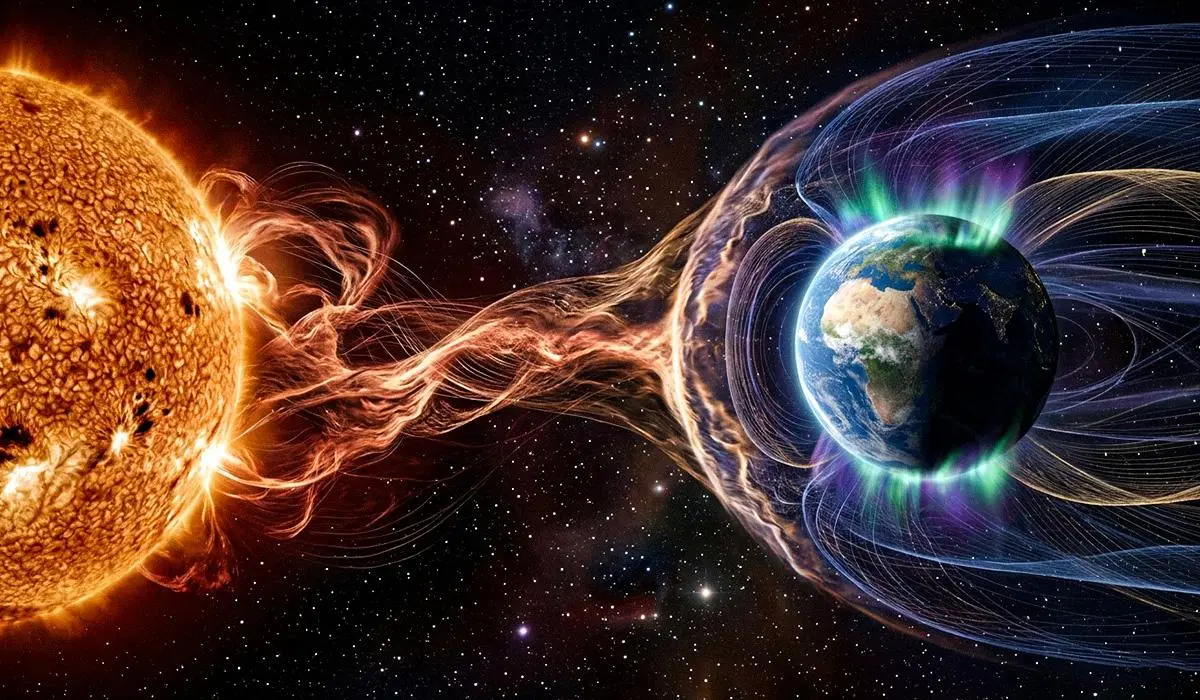
The inner boundary of the Van Allen radiation belts—which for more than a decade was believed to be impenetrable to so-called “killer electrons”—failed to hold during an extreme solar storm in May 2024. The Japanese satellite Arase recorded that electrons there accelerated to energies of several megaelectronvolts, even though scientists had considered this impossible, according to Digi24.
A team led by physicist Yoshizumi Mioshi of Nagoya University published the study in the journal Geophysical Research Letters.
“Here, we show that this barrier can be breached under extreme space weather conditions,” the authors write.
Particles accelerated to nearly the speed of light pose a serious threat in Earth’s orbits. They are capable of penetrating satellite shields, damaging sensitive electronics, shortening the service life of spacecraft, and increasing the radiation risk to astronauts.
A distinct boundary at a distance of about three Earth radii from the planet’s center was discovered in 2014 by NASA’s Van Allen Probes. The most energetic electrons almost never penetrated beyond it.
How the Storm Cleared a Path
The storm in May 2024 reached G5, the highest level on the geomagnetic storm scale. It sharply depleted the layer of cold plasma surrounding Earth, and so-called choric waves developed in the rarefied medium. Instead of scattering the electrons, these waves most likely accelerated them right inside the “protected” zone. At energies around 3 MeV, the electron flux increased more than 5,000-fold compared to pre-storm levels.
The increase occurred in stages. First, lower-energy electrons appeared; about half a day later, higher-energy ones joined them; and another day later, the number of particles above 3 MeV rose sharply. According to the researchers, this sequence indicates that the electrons gained energy specifically in this region, rather than arriving from outside.
This theory was further supported by a distinct peak in the electron distribution near the barrier boundary, which grew stronger over time. The rarefied conditions persisted for an unusually long time, which likely contributed to the further acceleration of the particles, according to Nagoya University.
“Typically, the plasmasphere recovers in about two days. However, during the superstorm of May 2024, it took approximately 4.3–4.7 days for the plasma density in the studied region to recover to more than half of its pre-storm level,” Mioshi emphasizes.
Risks to Space Technology
Electron levels continued to decline for months. Arase observed the decline until October 2024, when the next solar storm reached Earth.
“This discovery underscores the need to understand and predict how energetic electrons behave under extreme space weather conditions. Such knowledge is important for assessing radiation risks to spacecraft and improving future space weather forecasts,” Miossi believes.