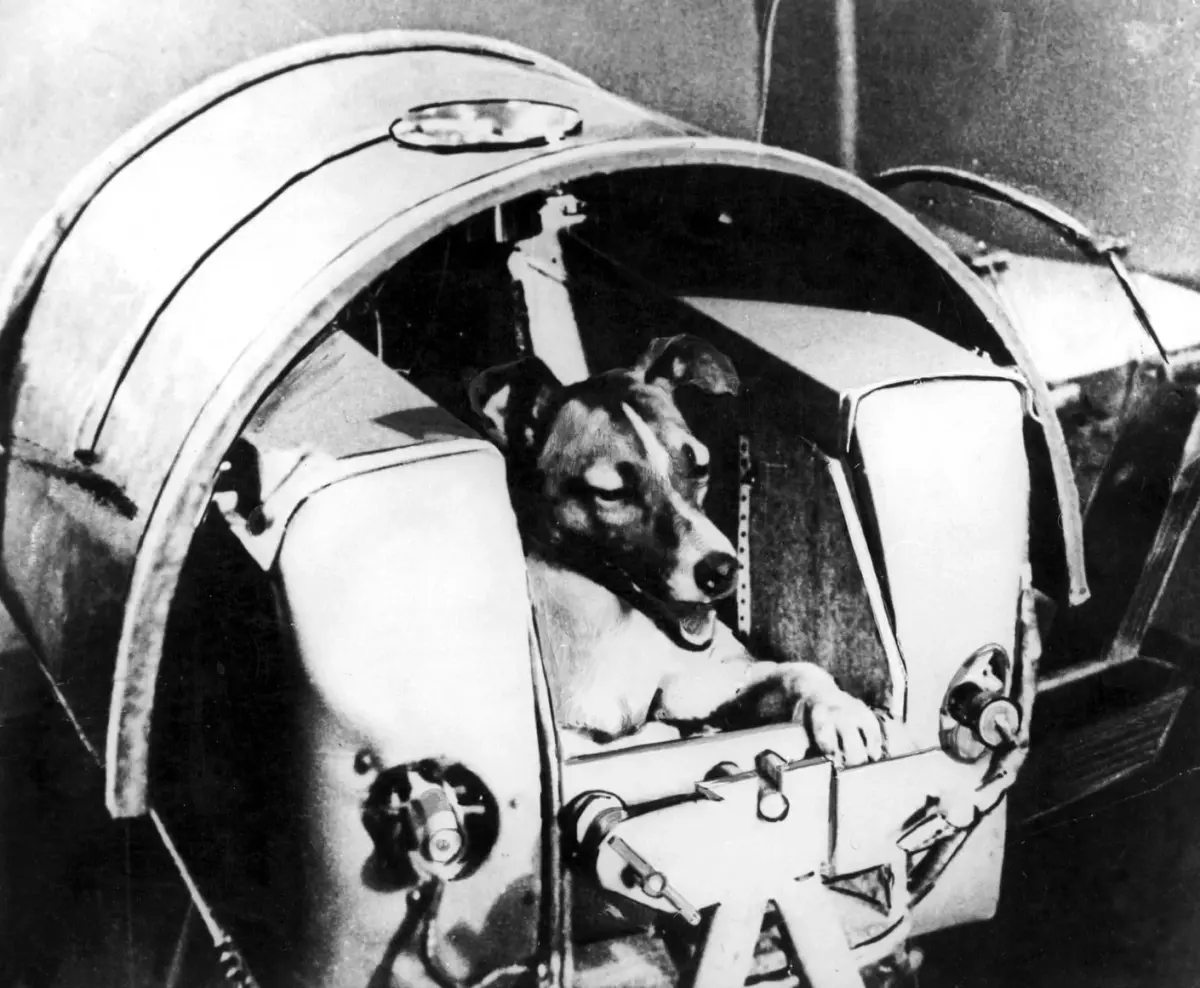
November 3 marked the 69th anniversary of the Soviet Union’s launch of the dog Laika into Earth’s orbit—the first living creature to orbit the planet. The flight aboard the “Sputnik-2” spacecraft was a step toward manned missions, but the animal died just a few hours after launch due to cabin overheating and stress, according to Blic.
Laika was a mixed-breed stray dog from the streets of Moscow. “Sputnik-2” had no safe-return system, so the passenger’s death was built into the mission from the very beginning. The spacecraft burned up in the atmosphere on April 14, 1958.
The Truth That Was Hidden for Decades
The official Soviet version claimed that Laika lived in orbit for up to a week. The true circumstances were revealed in 2002 by Dmitry Malashenkov of the Institute of Biomedical Problems in Moscow at the International Astronautical Congress in Houston, CNN reported.
“The story about overheating had been circulating for a long time. Even the Soviet media of the time hinted at it. But the fact that she died within five to seven hours came as a shock to me,” admitted Swedish space historian Sven Gran.
According to Kathleen Lewis, curator of the National Air and Space Museum at the Smithsonian Institution, due to the loss of the heat shield, the temperature inside the capsule exceeded 90 degrees Fahrenheit (over 32 °C) after the fourth orbit. She emphasizes that Soviet documents about the flight were falsified, and on the air they claimed that the dog was alive until November 12, according to Smithsonian Magazine.
“We Didn’t Learn Enough”
Preparations for the mission were rushed: Nikita Khrushchev demanded a launch by the 40th anniversary of the revolution on November 7, so Sergei Korolev’s team had only a few weeks. The son of the program’s chief medical officer, Viktor Yazdovsky, admitted that the capsule’s thermal insulation system was never fully functional, according to the BBC.
“Scientists at the time didn’t know how to bring living creatures back to Earth from orbit. Everyone was very concerned about Laika. They knew she wouldn’t return from her journey,” Yazdovsky said.
The decision to condemn the dog to death sparked international outrage: in Britain, animal rights activists picketed the Soviet embassy, and in New York, dog owners marched outside the UN building. Subsequent missions were equipped with return systems. In August 1960, Belka and Strelka completed 17 orbits around Earth and landed safely.
“Working with animals is a source of suffering for all of us… The more time passes, the more I regret it… We didn’t learn enough from this mission to justify the dog’s death,” said Oleg Gazenko, who selected and trained Laika, in 1998.