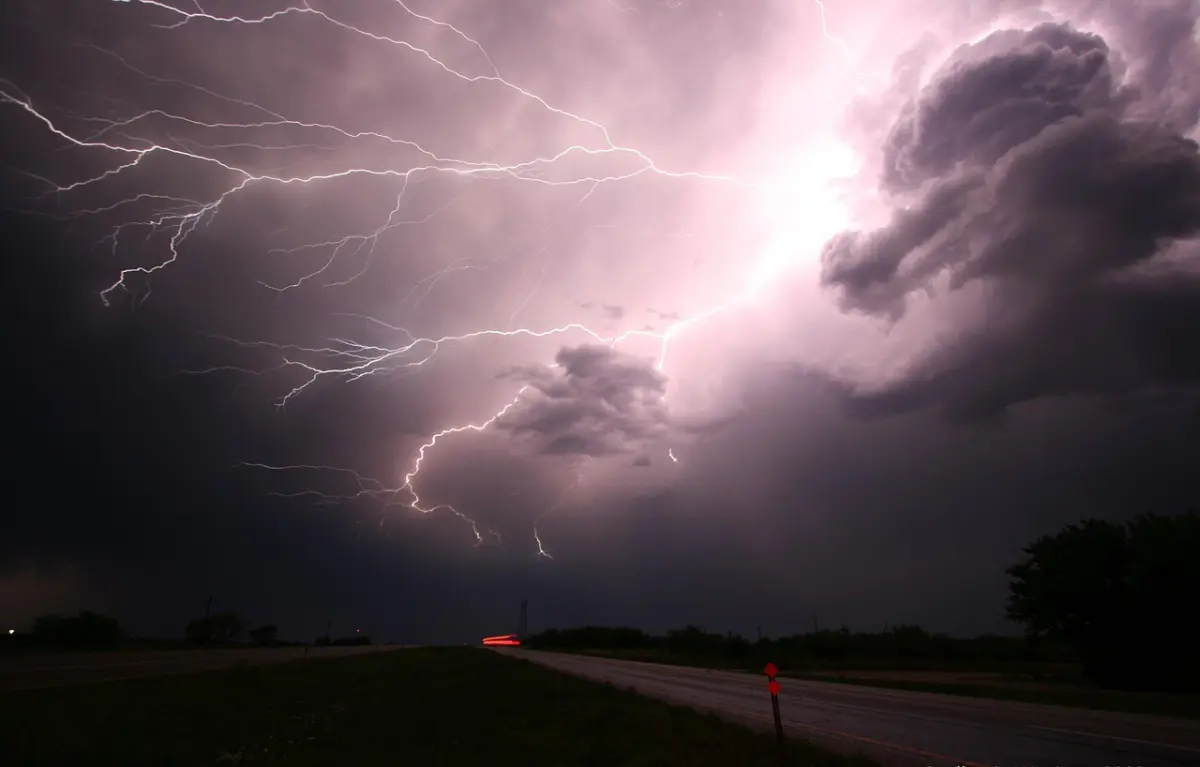
Lightning can strike the same spot multiple times: it strikes the Empire State Building an average of more than 100 times a year, and the Christ the Redeemer statue in Rio de Janeiro several times a year. At the same time, 90% of lightning strikes never reach the ground and occur between clouds. dobrapogoda24.pl reports on this and other facts about thunderstorms that debunk common myths.
During a discharge, the air around the lightning bolt heats up to 28,000 °C. Theoretically, the energy from a single discharge would be enough to power a 100-watt light bulb for over three months. At any given moment, there are about 2,000 thunderstorms raging across the planet, generating up to 100 discharges per second, most often over tropical forests.
You can estimate the distance to a thunderstorm by counting the seconds between the flash and the thunder: three seconds correspond to approximately one kilometer. Without the internet, a standard long-wave (LW or AM) radio can help detect an approaching thunderstorm: each lightning strike can be heard as a distinctive crackle at a distance of up to 50–100 km. This method shows whether a thunderstorm is approaching or moving away, but it does not indicate the direction.
Roy Sullivan, an American park ranger from Virginia, is considered the record holder among those struck by lightning: between 1942 and 1977, he was struck by lightning seven times and survived every time.
You Can’t Hide Under a Tree
Dale Zhang, a meteorologist and fulminologist at the University of Maryland who studies thunderstorms, explains why one of New York’s skyscrapers has become a favorite subject of scientific research, according to the University of Maryland.
“People often say that lightning never strikes the same place twice—unfortunately, they are very wrong. Objects that rise above the ground, such as trees or buildings, are actually more likely to be struck by lightning repeatedly. A prime example of this is the Empire State Building,” Zhang noted.
During a thunderstorm, the scientist advises seeking shelter in a building equipped with lightning rods. Rubber soles or tires, she says, offer almost no protection: a person in a car is saved by the metal body, which diverts the charge into the ground.
“There is no safe place outdoors. It’s dangerous under a tree or in a tent. In fact, 10% of all lightning-related deaths and injuries worldwide are associated with trees—lightning can ‘jump’ from a tree trunk to a person, and it doesn’t necessarily have to strike you directly to cause harm,” Zhang warns.
Scientists are refining the details
Not all data matches across sources. According to NASA estimates, a lightning strike heats the atmosphere to approximately 20,000 °C, which is three times the surface temperature of the Sun, notes NASA Earthdata.
Benjamin Franklin is considered the inventor of the lightning rod, but historians still debate whether he actually flew a kite during the thunderstorm of 1752. It is known that in the same year, French researchers were the first to conduct the experiment he proposed using a tall metal rod, according to Smithsonian Magazine.