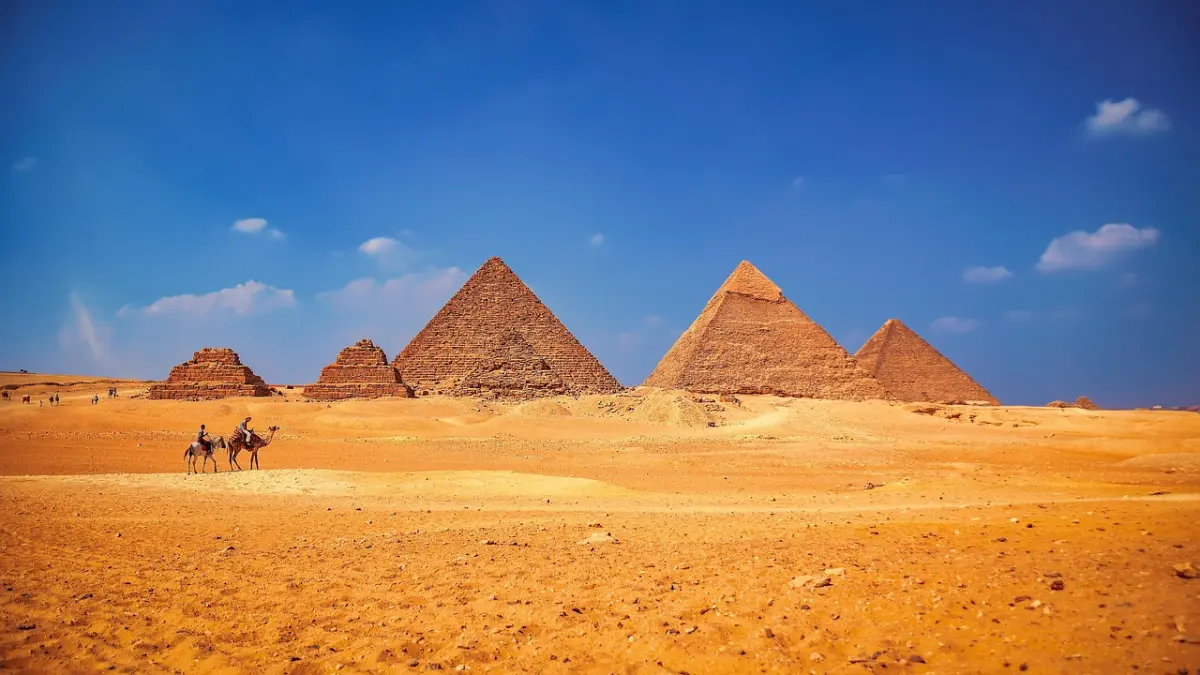
The Pyramid of Cheops in Giza, one of the world’s most famous landmarks, originally looked quite different from how it does today. When construction was completed around 2560 B.C., its four sides were covered with polished slabs of white limestone that reflected sunlight. Today, however, tourists see only the stone core of the tomb, according to ChilliZET.
The facing stone was likely quarried in the quarries of Tura, not far from modern-day Cairo. Before being laid, the slabs were carefully polished, so the surface was smooth, and the structure itself appeared to shine in the sun. Over the centuries, the outer layer gradually eroded. Today, the pyramid’s surface is uneven and stepped, ranging in color from sandy beige to light brown in places, as it consists of massive limestone blocks of varying shades.
The tomb of Pharaoh Khufu was built over 4,500 years ago and covers about 5.3 hectares, which is roughly equivalent to seven soccer fields. It has the shape of a regular quadrangular pyramid with a square base and nearly perfect proportions. The apex may have been crowned with a special stone capstone, known as a pyramidion, made of granite or limestone, possibly adorned with gold or silver, hieroglyphs, and symbols. It was meant to associate the image of the pharaoh with the sun, which was worshipped at the time. However, archaeologists note that this is only a hypothesis.
There are no lavish halls inside the pyramid: the interior consists mainly of narrow, dark corridors. The main burial chamber, known as the King’s Chamber, is located high within the structure; its walls are lined with red granite. The sarcophagus still stands there, though the pharaoh’s mummy has never been found.
What the surviving facing block reveals
One of the fragments of the original white casing is preserved at the National Museum of Scotland. This limestone block was once part of the outer face of the Great Pyramid. It was brought to Edinburgh in 1872 for astronomer Charles Piazzi Smith, who was studying the structure’s dimensions and proportions. In April 2013, David Lightbody reexamined the stone. According to his findings, the block allows for the determination of its original location on the pyramid and also reveals a great deal about ancient Egyptian measurement systems and construction techniques, reports the *Journal of Ancient Egyptian Architecture*.
Merer’s Journal: How Limestone from Tura Was Transported to Giza
We know exactly how the facing stones made their way to the construction site thanks to the oldest papyri ever found. In 2013, French archaeologist Pierre Tallet discovered them in boat storage caves at Wadi el-Jarf on the Red Sea coast. Among the scrolls was the diary of a previously unknown official named Merer, who led a crew of about 200 people. Merer describes how he loaded a boat with stones in Turi and transported it down the Nile to Giza, reporting to the “noble Ankhaf,” Khufu’s half-brother. The records cover the last known year of the pharaoh’s reign and effectively document the final stages of work on the pyramid, according to Smithsonian Magazine.
The port at Wadi el-Jarf was in operation for only a short time, primarily during the reign of Khufu, yet it played a key role in the construction. The Egyptians needed a vast amount of copper—the hardest metal at the time—to work the stone, and the main mines were located in the Sinai, directly across from the harbor. Archaeologists discovered an L-shaped stone breakwater there, over 180 meters long, along with about 130 anchors and 30 boat moorings.
Experts have enthusiastically welcomed this discovery. Mark Lerner, who has been studying the pyramids and the Sphinx for 40 years, compared it to a journey back in time to the era of the builders. Egypt’s former Minister of Antiquities offered an even more resounding assessment.
“The greatest discovery in Egypt in the 21st century,” declared Zahi Hawass.
The head of the excavation team himself is cautious about such high praise. After more than 20 years of work in the regions surrounding the ancient Egyptian state—from the Libyan Desert to the Sinai—the press has only now turned its attention to him, and he attributes this to the topic of the scrolls.
“The century is just beginning. We must not overstate the significance of this kind of discovery,” Talle emphasizes.
The papyri survived precisely because of the remoteness of this location, whereas in Memphis and Giza, the fragile documents from the early dynasties have almost entirely been lost due to centuries of use and looting. According to the archaeologist, the ancient Egyptians “threw all the papyri inside—some of them were still tied with rope”—presumably when they sealed the site.