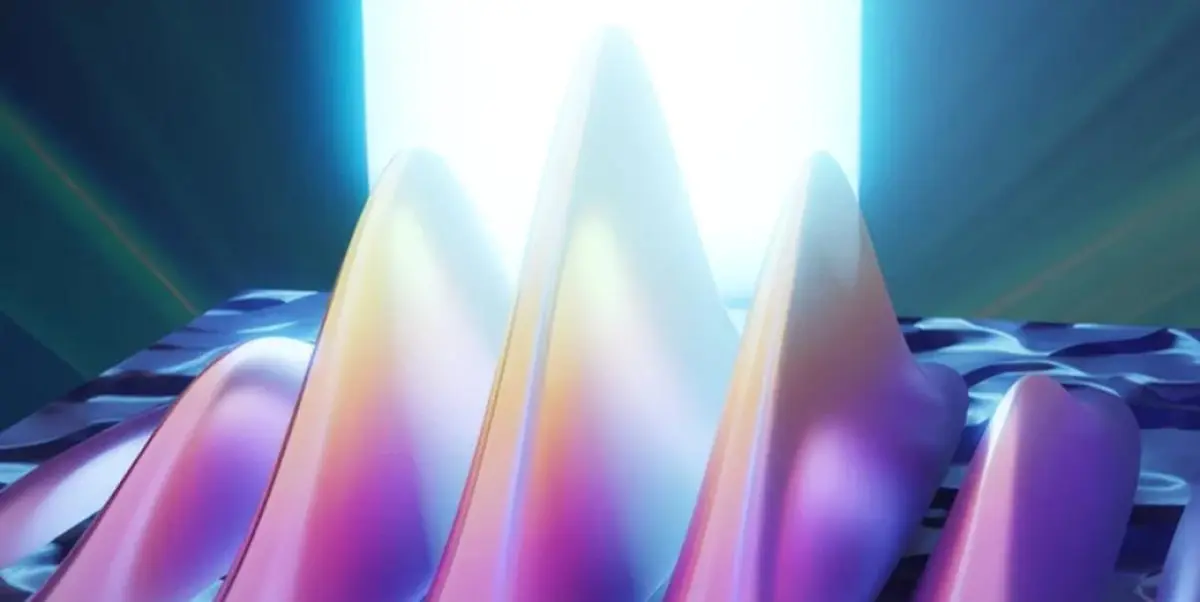
An international group of physicists has created a super-solid—an exotic quantum state of matter that combines the properties of a liquid and a solid without requiring ultra-low temperatures. The setup operates at room temperature and even at temperatures close to 60 °C, according to NV Techno.
This refers to the super-solid phase in an exciton-polariton Bose–Einstein condensate. In this state, the particles behave as a single quantum system: the matter flows without resistance while maintaining an ordered crystalline structure. This was achieved using a microcavity—a tiny structure that traps light.
For the experiment, the researchers combined a liquid crystal—whose properties can be controlled by voltage—with an organic semiconductor that interacts strongly with light. Laser pulses provided the energy needed to create the quantum state.
The study was published in the journal *Science Advances* on October 16, 2026. As stated in the article’s abstract, the microcavity was filled with a nematic liquid crystal and two layers of the organic polymer MeLPPP. Superhardness in such condensates arises due to spin-orbit interaction, which in this case is generated by the liquid crystal. During the experiments, quantum vortices—a characteristic feature of superfluids—also appeared spontaneously, as noted on the publication’s page on the IBM Research portal.
Bands that appear in a different place each time
Each laser pulse regenerated the condensate, but the characteristic bands of its crystalline structure appeared in new locations each time. This confirms that the ordering arises spontaneously and does not depend on the shape of the microcavity. Physicists refer to this phenomenon as a spontaneous symmetry breaking.
The quantum state lasted only a fraction of a second, but that was enough to make observations. The results were confirmed on several samples and matched computer simulations.
Simplicity Instead of Cryogenics
The main advantage of this development lies in its relative simplicity: it does not require a cryogenic cooler, and the system can be controlled using an electrical voltage. At the same time, the materials gradually degraded due to the interaction between the semiconductor and the liquid crystal, so new samples had to be prepared for repeated measurements.
Going forward, the researchers plan to extend the system’s lifespan and study the quantum vortices in its structure in greater detail. This development could simplify experiments with quantum fluids and superhard materials, as well as open up new possibilities for information processing technologies and the creation of sensitive sensors.