
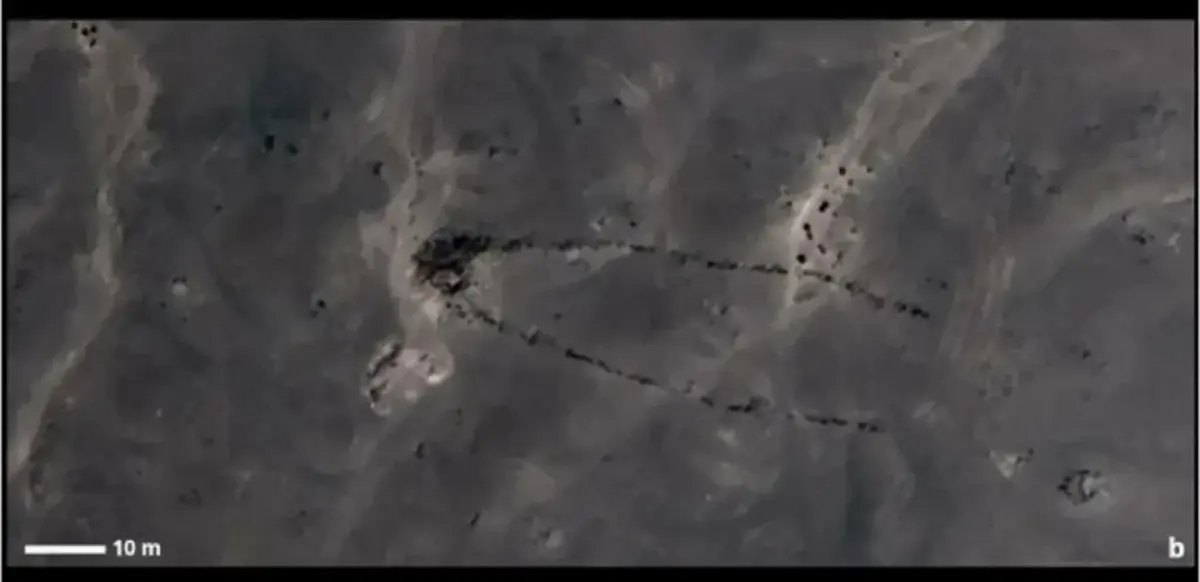
A stone structure stretching across the desert lands of Western Sahara could not escape the attention of researchers. Although its purpose and chronology remained poorly understood for many years. And only now have scientists established that the person buried inside it lived about 4,400 years ago. This is the first absolute dating of an object of this type, Focus.pl reports.
As scientists explain, the tomb under study is located near the bed of the seasonal river Wadi Lawash el Telli. It sits on the edge of the archaeological site of Sluguilla Lawash, which is known for its numerous rock carvings. This monument belongs to the group that archaeologists call “antennae tumuli” — that is, mounds with antennae. Their characteristic feature is a stone mound from which two long linear structures extend. In the case under study, the entire structure is 54.5 meters long. The main part of the tomb measures about 12.5 by 10 meters. And its height does not exceed three meters.
The builders used local limestone. They laid the stones without mortar. Most of these stones are less than one meter long. Although the structure is impressive in size, its construction may not have required a large group of people or any advanced tools. Archaeologists also drew attention to the orientation of the stone “arms”. They are directed at an angle of about 102 degrees relative to north. A similar arrangement has already been observed in other similar monuments. However, it remains unclear whether it had symbolic or ritual significance. Or whether it stemmed from some other considerations.
The excavations that played a special role in this case took place in April 2018. At that time, under a layer of loosely laid stones, researchers discovered larger limestone slabs. These slabs covered the remains of a person. The skeleton probably belonged to a person aged between 25 and 35 years. Due to the poor condition of the bones, the person’s sex could not be determined. The deceased lay on his back. His head was pointed south, and his legs were bent to the west. Scientists found no clear traces of a burial pit. Nor was any evidence found that the burial had later been disturbed.
Near the remains there were only four ring-shaped beads. They were made from ostrich eggshell. Similar objects are found in various parts of this region. Therefore, they do not allow for an unambiguous determination of the cultural affiliation of the deceased. And on one of the finger bones, a growth was visible. It may be a consequence of repeated loads on the hand.
Determining the age of this tomb was not easy. The first attempts in 2018 yielded no results. The thing is, there was not enough collagen in the bones — and it is needed for the applied dating methods. Only last year did researchers use the mineral part of the remains. And they obtained two matching results. The analyses showed — this burial was made about 4,417-4,100 years ago. The most likely time range is approximately 4,407 to 4,230 years ago. This means that the monument was created at the end of the Neolithic. That is, in the period when mounds resembling the shape of a crescent also appeared in this region.
This discovery is important in the context of research into the prehistoric societies of the Sahara. Until now, there was a lack of reliable dates for mounds with characteristic stone “arms”. Although similar structures are found over vast areas of the region. Previous studies of one such tomb — located in the Tasua Valley — did not lead to the discovery of remains or objects that could explain its function. The new findings, however, confirm that at least some of these structures served specifically as burial sites. However, they do not provide answers to all questions. It is still unclear why their creators chose such an unusual shape. Or what exactly the direction of the stone “arms” meant. As well as what beliefs accompanied these burial rites.