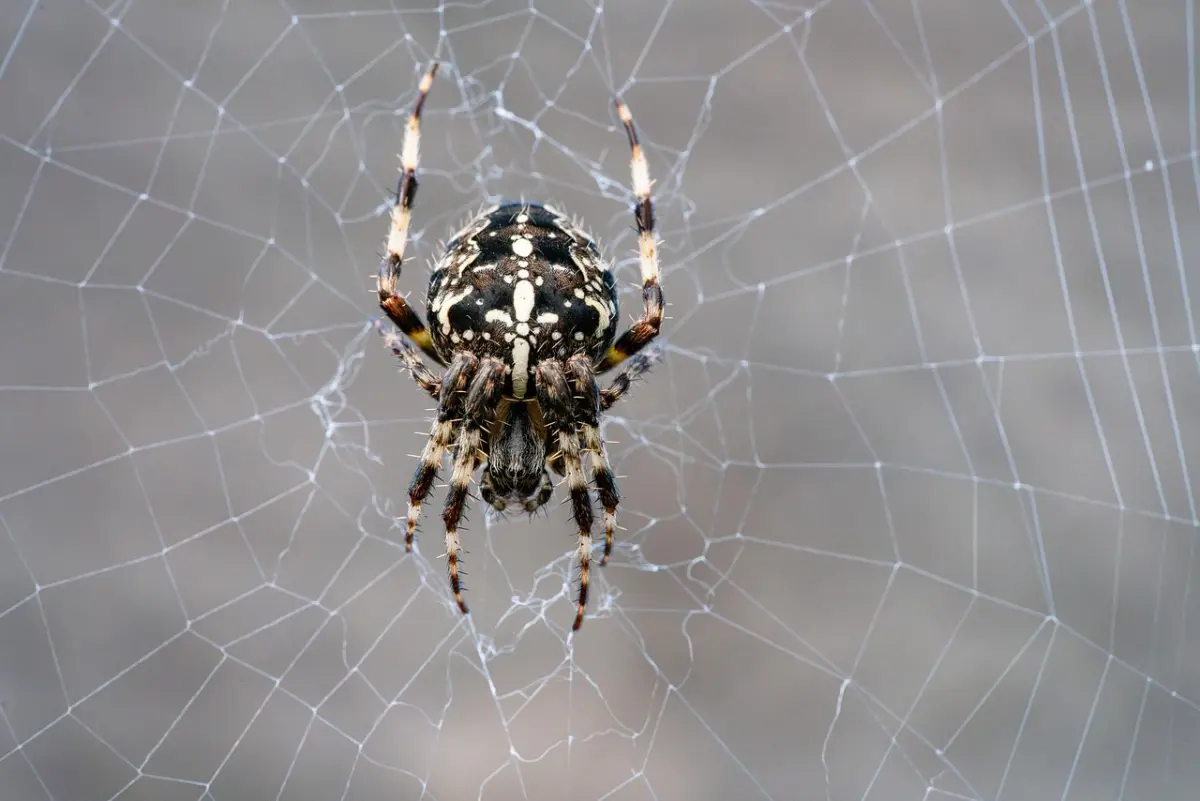
Spiders exhibit true regulated sleep with two distinct phases, one of which resembles human rapid eye movement (REM) sleep. During this phase, the animals move their eyes and twitch their muscles. This is the first comprehensive experimental confirmation that spiders sleep rather than simply becoming motionless, reports ScienceDaily, citing researchers from the Institute of Organism Biology at the University of Bonn.
The study focused on the Australian jumping spider Portia fimbriata. An adult spider is about the size of a one-euro coin, yet it hunts other spiders. To do this, Portia mimics the vibrations of an insect caught in a web, thereby luring the web’s owner. Because of this complex behavior, biologists consider this species a useful model for studying the connection between sleep, the nervous system, and cognitive abilities.
The spiders were placed individually in plastic cups 12 cm in diameter and observed for several days under various lighting conditions. At night, the animals were filmed with infrared cameras. To distinguish sleep from ordinary immobility, the scientists measured how quickly the spiders responded to auditory stimuli. They also tested for “restorative sleep”: whether the animals made up for interrupted rest with longer periods of sleep later on.
The main limitation of the study was that the researchers were unable to measure the spiders’ brain activity. The conclusions are based solely on behavior recorded in a large dataset of high-resolution video footage. The authors specifically emphasize that eye movements alone do not prove that spiders dream.
The Debate Over Dreaming
The Bonn study builds on a 2022 study published in the journal PNAS. At that time, a team of former Harvard researchers analyzed infrared recordings of 34 young jumping spiders. Through the young spiders’ translucent exoskeletons, retinal movement was visible, accompanied by twitching and curling of the legs. This was likely the first time that behavior resembling rapid eye movement (REM) sleep had been observed in a terrestrial invertebrate, according to the Harvard Gazette.
Co-author Daniela Rösler is convinced that, for science, the distinction between intuition and proof is fundamental in this context.
“Personally, I think they dream—just as anyone who watches a sleeping dog or cat twitching its paw would think they’re dreaming. But proving it scientifically is a whole different story. I don’t think we can claim that they dream, and I’m not even sure we ever will be able to, but the very fact that we’re thinking about it is quite amazing,” Rösler noted.
She considers muscle atony to be a key indicator of this state. In spiders, the legs extend hydraulically: muscles in the head pump fluid into the limbs. When these muscles relax, the pressure drops, and the legs fold up, just like in a dead spider.
“For us, this muscular atony proves that they are not in a state of alertness and indicates that the body is trying to suppress movement,” the researcher emphasized.
Mark Blumberg, a sleep researcher at the University of Iowa who was not involved in the study, called the spiders’ behavior “simply marvelous.” At the same time, he remains cautious about interpreting these observations, according to NPR.
“When people look at rapid eye movements, they see activation of the visual system. They see these eye movements and immediately conclude that the spider is dreaming, but I think that’s a step too far at this stage of the research,” Blumberg cautioned.
Rössler agrees that even if spiders do dream, those dreams are unlikely to resemble human ones. Some species have poor vision but are highly sensitive to vibrations, so, as she suggests, they may “dream” of vibrations.
An Evolutionary Mystery and New Experiments
Almost all our knowledge of sleep comes from studies of vertebrates, primarily mammals and birds. Similar sleep phases in animals with radically different nervous systems could shed light on when and why different types of sleep evolved. The Bonn team calls for studying species with unusual adaptations or simpler nervous systems to determine whether sleep mechanisms are widespread throughout the animal kingdom or whether they arose independently in different evolutionary lineages.
Paul Shamble, a co-author of the 2022 study, believes this discovery challenges our conventional understanding of rapid eye movement (REM) sleep.
“Since these animals’ brains are so different from ours, and their evolutionary history is so different from ours, you start to wonder if this kind of visual dreaming isn’t just what visual brains do. And that would be a completely different way of thinking about REM than how we usually think about it now,” Shamble noted.
Next, researchers in Bonn plan to compare REM-like sleep across different spider species, as well as the animals’ behavior in the wild and in the lab. Another goal is to determine whether specific sleep phases affect learning. The scientists will also investigate how climate change and artificial nighttime lighting disrupt the sleep of spiders and other arthropods.