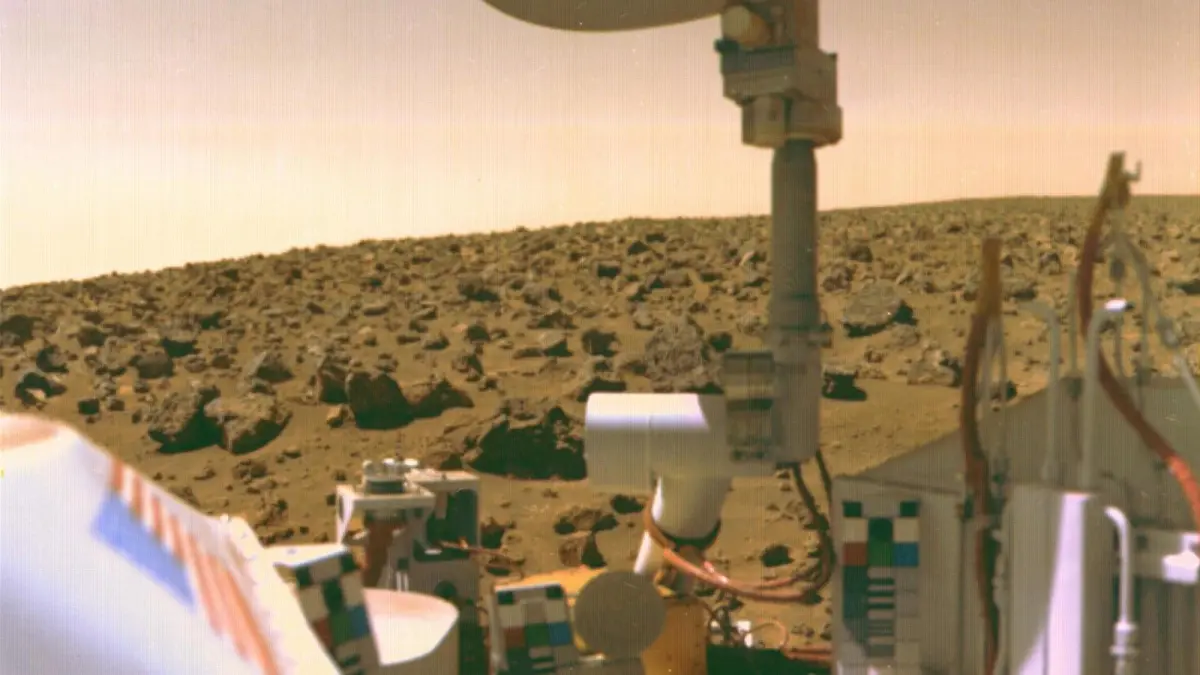
The first-ever Martian earthquake was recorded 50 years ago during the Viking 2 mission, as confirmed by a reanalysis of archival data, according to Blik.ua.
A Look Back at the Legacy of “Viking 2”
In 1975, the U.S. National Aeronautics and Space Administration (NASA) sent two landers equipped with seismometers to the Red Planet to study geological activity. However, due to technical limitations, the instrument on “Viking 2” was mounted directly on the spacecraft’s hull rather than on the ground, making it extremely vulnerable to noise from the Martian wind. For a long time, scientists were unable to distinguish mechanical vibrations from actual seismic events, according to IFLScience.
The situation changed thanks to data from the InSight lander, which recorded more than 1,300 seismic events between 2018 and 2022, enabling the creation of accurate digital models of Martian earthquakes. By comparing these recent recordings with archival data from 1976, researchers identified two anomalous signals recorded on the mission’s 53rd and 80th sols, which exhibit characteristics of tectonic activity.
“The Viking 2 seismometer recorded two anomalous signals on sols 53 and 80, which were initially cataloged as potential Martian earthquakes. These two events exhibit wave characteristics that are strikingly similar to earthquakes recorded in California and Marsquakes detected by the InSight mission, but differ significantly from the wind noise recorded by “Viking 2,” the research team noted in a publication for AGU Advances.
Context of the Historic Mission
The Viking program marked a significant milestone in the exploration of Mars by combining the work of orbiters and landers. In addition to seismic studies, the spacecraft mapped the surface and searched for signs of life, ultimately yielding thousands of images and new data on the composition of the atmosphere, according to NASA Science.
Currently, scientists are inclined to believe that the event on Sol 80 was a genuine Martian earthquake, as it occurred in the morning under conditions of low wind speed and had a significantly higher amplitude than typical background noise. Nevertheless, researchers have not ruled out alternative explanations for the signal’s origin, such as a meteorite impact or a distant tectonic shift.
“The event at Sol 80 of Viking 2 imposes new constraints on the seismic history of Mars. Its independently determined location spans a large northern plain associated with the seasonal Martian earthquakes detected by InSight, indicating a possible extensive active zone beyond Cerberus Fossa,” the study authors concluded.