
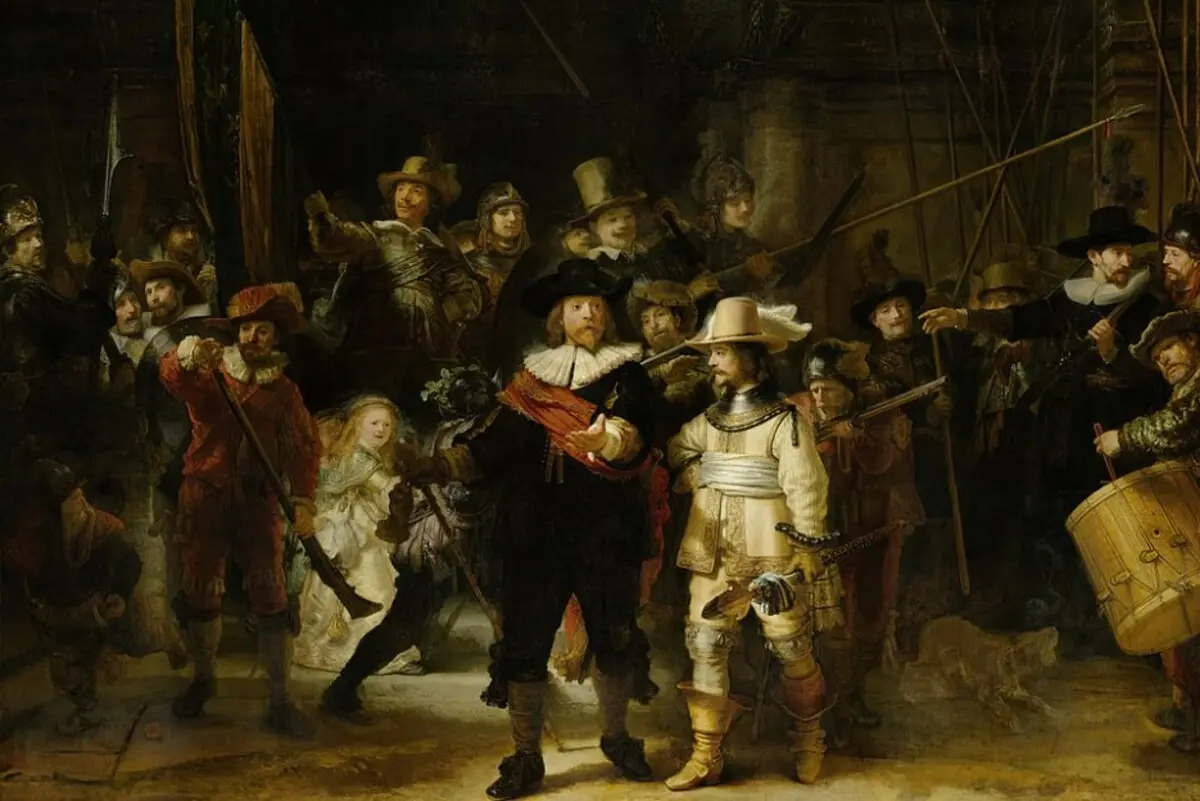
In Rembrandt’s painting “The Night Watch,” scientists have discovered microorganisms they did not expect to find. Among them is a bacterium first described in Japan from a sample taken at a sugar refinery, according to TVP Info.
The research is being conducted by the Rijksmuseum in Amsterdam and the Artis-Micropia Museum of Microorganisms. In total, they plan to take 60 samples from ten areas of the canvas. To do this, sterile cellulose discs are gently pressed against the surface of the painting, and the collected microbes are then cultured in Petri dishes.
Most of the findings were as expected: bacteria typical of human skin, soil, and plants. Among them were Staphylococcus epidermidis, Micrococcus luteus, and the soil bacterium Lysinibacillus sphaericus, which is capable of surviving even in environments with high levels of heavy metals.
The biggest surprise was Microbacterium saccharophilum. This species was described in 2013 based on samples from the Ensuiko Sugar Refining plant in Yokohama, Japan.
“We did not expect to find Microbacterium saccharophilum, and we don’t know how to explain it,” admitted Artis-Micropia microbiologist Elin van Bloois.
Four Hundred Years or One Day
The Japanese bacterium was found on a section where the varnish had already been removed. According to van Bloois, the microbes found do not harm the painting itself, and it is impossible to determine whether any of them date back to Rembrandt’s time, AFP reports.
“It would be really cool, wouldn’t it? If we could link them to Rembrandt. But, unfortunately, you can’t tell from a single microbe whether it’s been there for 400 years or just one day,” the researcher emphasized.
“This is something that will keep me up at night for years. That’s the beauty of science: you ask one question, and you get a hundred answers,” van Bloois added.
What the findings will offer restorers
The microbiological analysis is part of the Operation Night Watch project, which the Rijksmuseum has been carrying out since 2019. It is the largest study and restoration of the painting in its entire history. As part of the project, researchers have already discovered a hidden sketch, a lead layer to protect against moisture, and pigments containing arsenic.
The study of microorganisms will continue for about another half a year. Samples will be taken from both varnished areas and those without varnish. The results will be shared with the conservators, who, starting in 2024, will be removing the varnish applied in the 1970s behind a glass partition in full view of visitors.
Scientists speculate that the artist’s technique for priming the canvas may also have influenced microbial growth. Rembrandt used a glue layer made from a mixture of oil and lead to protect the painting from mold in Amsterdam’s humid climate.
The results of the study are on display at an exhibition at Artis-Micropia. On display there are a life-size reproduction of *The Night Watch* and a graphic depicting the composition of the microorganisms found on the canvas. The exhibition will run through May 2027.