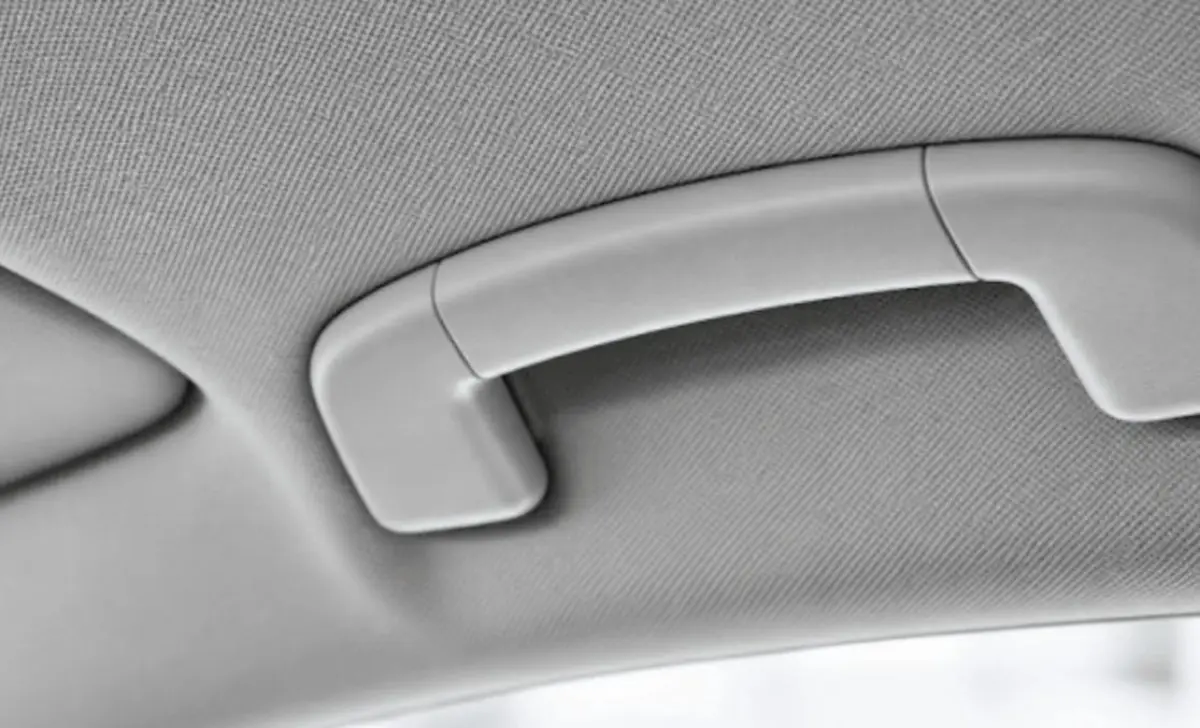
You shouldn't hold onto the overhead handle in a car unnecessarily, and you certainly shouldn't use it as a hanger: the area along the edge of the roof is where the curtain airbag deploys. Heavy or sharp objects secured nearby could get in the way of the airbag or fly into the passenger compartment during a crash, according to Channel 24.
The side curtain airbag deploys in a fraction of a second along the windows and pillars, protecting the passenger’s head. Just how powerful its deployment is was demonstrated by an incident involving a Mazda CX-60, in which the curtain airbags unexpectedly activated while the car was traveling on the highway. However, you should not remove the handle itself: in some models, its mounting is part of the structure connected to the curtain.
It’s even more dangerous to hang a bag or package on the handle. During sudden braking, a heavy bag, bottle, or other solid object becomes unsecured cargo.
What the Manuals Say
Automakers explicitly describe the risks in their owner’s manuals. According to Mazda and Toyota, the handles are designed to support a person who is already seated and are not intended to bear the full weight of the body. Both companies advise against grabbing them when getting in or out of the car, and Mazda warns that under significant strain, a handle could break and injure a person, according to Family Handyman.
“Hanging heavy or sharp objects, such as a clothes hanger, on the handles or coat hooks is dangerous, because if the airbag deploys, they could fly off and strike a passenger, potentially causing serious injury or death,” the Mazda manual states.
The airbag operates only as part of the system
The handle’s intended purpose is to help a passenger maintain balance on a rough road or during a sharp turn. Airbags are designed for the correct seating position of the occupant and to work in conjunction with seat belts; therefore, you should not hang onto the handle constantly, attach accessories to it, or place items near the curtain airbags. If the airbags have already deployed following a collision, they must be fully repaired rather than simply covering up damage to the interior.
Volvo also emphasizes the importance of comprehensive protection; the company was the first to introduce an inflatable side curtain airbag in the 1998 S80 model, according to the Volvo Cars press office.
“A greater number of airbags does not necessarily increase the overall level of safety. It is important to view the airbag as part of a systematic approach in which the vehicle’s design, seat belts, and airbags work together to ensure optimal absorption of collision forces during an accident,” said Lennart Johansson, head of interior design at Volvo Cars.