
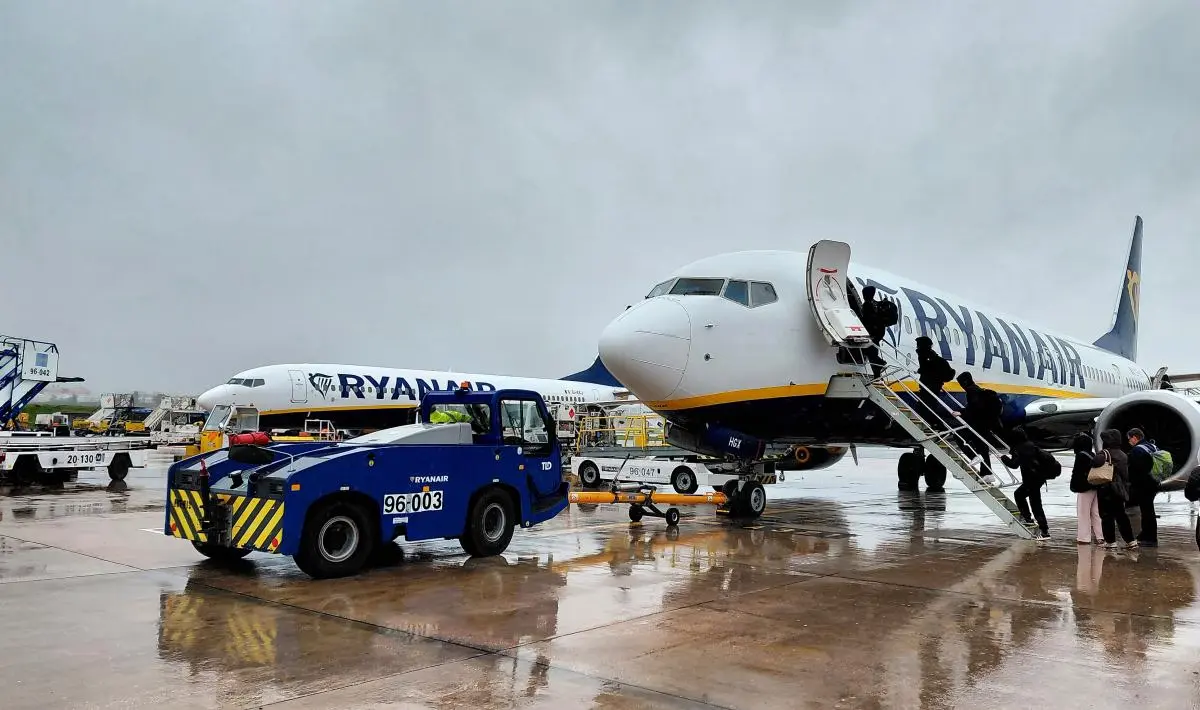
Starting November 10, baggage check-in counters at all Ryanair airports will close 60 minutes before the scheduled departure time, rather than 40 minutes as is currently the case. The low-cost carrier reminded passengers of this on October 27, although it had already announced the change back in April, according to Ryanair.
The new rule applies only to those checking a suitcase into the baggage compartment. The remaining 80% of customers who check in online and travel with carry-on luggage will, as before, proceed directly to the boarding gate. The airline also expects to reduce the number of passengers who miss their flights due to delays in the terminal.
The company explains how travelers with checked luggage will benefit from the extended deadline as follows:
“This small change will give 20% of Ryanair passengers who check baggage more time to get through security and passport control lines and reach the boarding gate before boarding begins, especially during peak travel periods when lines at airports can be longer,” emphasized Ryanair Marketing Director Dara Brady.
He advises anyone using the baggage check-in counters to arrive at the airport early and make sure to check in and drop off their luggage before check-in closes one hour before departure.
How much time should you allow for the airport?
The change at Ryanair coincided with the popularity of the “airport theory” trend on TikTok: users try to complete check-in, baggage drop-off, and security screening with only 15 minutes to spare before boarding. Official recommendations are much more conservative: London’s Gatwick Airport advises arriving at least two hours early, Heathrow recommends three hours for international flights and two hours for domestic and European flights, while Ryanair itself asks passengers to be at the check-in or baggage drop-off counter at least two hours before departure, according to The Independent.
The publication’s journalists, who fly frequently, had differing opinions: ranging from a three-hour buffer “by the book” to arriving almost at the last minute. The riskiest strategy is advocated by columnist Simon Calder, who usually arrives 10–15 minutes before check-in closes.
“Unless you occasionally miss a flight, you’re spending too much time at airports. Of course, missing a flight is both frustrating and expensive,” Calder notes.
To cut down on time at the airport, he advises taking the train there, checking in online, and generally avoiding checked baggage. This eliminates unpredictable waits at the check-in counter and the risk that your suitcase might “go off on its own little vacation.”
Baggage as a Business Model
This isn’t the first time Ryanair has changed its baggage rules. After introducing a policy of two free carry-on bags in 2013, flight load factors rose from 82% to 97% in August 2017, and there wasn’t enough room in the cabin. At that time, the company made guaranteed cabin baggage space a paid service, charging a £5 fee for priority boarding, while simultaneously increasing the checked baggage allowance from 15 to 20 kg and lowering the fee from £35 to £25, according to Wired.
Additional services, particularly baggage, accounted for 27% of the carrier’s total revenue in 2017. Keith Mason, a professor at the Center for Air Transport Management at Cranfield University, doubted that the discount would convince a significant portion of passengers to check their bags and predicted that the free options would not last long.
“History shows that new services introduced for free, if they are popular, usually become paid services—first at a low ‘cost-based’ price, and then they get more expensive,” Mason warns.
Tim Coombs, managing director of Aviation Economics, links the fight against delays to the company’s business interests. Ryanair services an aircraft between flights in about 25 minutes and uses this speed as a bargaining chip in negotiations with airports to lower fees. He identifies passenger boarding as the biggest bottleneck.
“Ultimately, Ryanair is obviously interested in generating additional revenue in all forms; it’s an important part of their business model. They’ll be flexible about revising fares in the future,” Combs believes.